
Showing posts with label Wheatear. Show all posts
Showing posts with label Wheatear. Show all posts
Wednesday, 26 November 2025

Monday, 29 September 2025

Tuesday, 12 August 2025
April Adventures 2025

Sunday, 10 December 2023

Wednesday, 11 October 2023
Flashback #6; First Half of September 2022
Welcome to another attempt to catch up on last years birding highlights in a (probably futile) attempt at logging a whole years birding.
Saturday, 5 August 2023
WhoDunnet? Monday 12th June 2023

Whenever we're in Scotland we like to visit a seabird colony. Up until a few years ago we preferred to go to Handa Island for a day out but became tired of that trip for a number of reasons. So in recent years we changed our destination to Dunnet Head on the north coast. Dunnet Head is the most northerly point on the British mainland and the towering cliffs there hold impressive numbers of many types of seabird. The viewing isn't as good as it is on Handa, and I do miss the boat trip, but it's a lot easier to reach Dunnet Head and you're not bound to staying there for the duration while you wait for a boat to come and rescue you and take you back to the mainland. You also don't have to be lectured at length about what you can and can't do before being allowed out near the cliff edge.
Dunnet Head lies around 150 miles from where we were staying near Boat of Garten. The drive takes a little over three hours, primarily along the A9. We left early hoping to reach the cliffs by ten o'clock. The going was good, and we only stopped to scrutinise a low flying raptor which turned out to be a Red Kite and not the Hen Harrier that we'd hoped for. We pulled into Dunnet Bay just before ten and took the road through Brough towards the cliffs. We reached the turn to the Head and noticed a Road Closed sign. My usual practice is to ignore such signs and carry on until I either find the road actually open or if it really is closed then it's easy enough to turn around and find another route.
The road was blocked completely by a council highways van parked across it. I pulled up alongside the van and wound my window down. I asked the chap sat in the van, how would I get to Dunnet Head. The answer was a curt, 'You can't'. I was temporarily gobsmacked and asked the chap what he meant. He said that the road was closed because of roadworks. Trying to remain calm, and partially failing, I told him that I'd just driven for three hours to visit the Head and now he was telling me that I couldn't go there. His reply had annoyed me ever so slightly. I asked about an alternative route, 'There isn't one' was the reply. I couldn't believe it and not trusting myself, turned my car around and sped off back the way I'd come. I pulled up in a siding and calmed myself, all the time cursing our luck, that we should choose a day when the road was closed. I checked Traffic Scotland's website and couldn't find any mention of the Dunnet Head Road being scheduled to close. So, against Mrs Caley's wishes, who wisely said that it was just bad luck and we'd just have to accept it, I drove back to ask the man in the van a few questions. The road was shut apparently because three days before a driver of a camper van had managed to drive over the foot of one of the men working on the narrow road. The man required hospital treatment and would be off work for sometime. The police were called and the outcome of their investigation was that the road should be closed whenever work was taking place upon it. So, between eight in the morning and five to five-thirty in the evening, there would be no access to the Head. The seabirds were off limits. I pointed out the fact that the road closure wasn't posted anywhere and was told that the road is actually owned by the MOD and they could do whatever they liked whenever they liked. The road was shut to traffic and that was it. We were welcome to walk the three and half miles each way if we really wanted to go. At that point I had to laugh. I'd have cried otherwise.
Luckily there are other options in the area when it comes to seeing seabirds. Much of the Northern coast of Scotland is blessed with high cliffs although most are remote and accessible only by walking many miles. For the less willing to yomp over miles of moorland, there is Duncansby Head near John o' Groats which lies around ten miles from Dunnet Head so we made our way there. Unfortunately many other folk had obviously had the same idea and the road up to the lighthouse was akin to an Oxfordshire highway, loaded as it was with other road users. The parking area was just a couple of camper vans short of chaotic gridlock, vehicles were strewn everywhere. Duncansby Head, on the face of it, looks very similar to Dunnet Head but it doesn't feel quite the same. I guess the road closure at Dunnet had deflated my balloon somewhat and I struggled to raise the enthusiasm as we walked along the clifftops. I tried to make the best of it however, and if you love Fulmars, as I do, then Duncansby Head isn't so bad because there are Fulmars everywhere. I'd never seen so many in one place before.

 |
| Fulmar (Fulmarus glacialis) |
The cliffs house the usual species but they are more difficult to see owing to the viewpoints being less handy. We did find our first Razorbills of the year, along with Guillemots and Puffins. I resisted the urge to take loads more photos.
 |
| Puffin (Fratercula arctica) |
Rock Doves were on the cliffs in good numbers. The consensus nowadays though is that in the UK pure Rock Doves are only found on Skye and on the Outer Hebrides but I was happy to add them to the year list. We had a day out scheduled to Skye later in the week so would hopefully see some "real" ones there anyway.

 |
| Rock Dove (Columba livia) |

A Rock Pipit had a nest secreted right next to one of the busy footpaths. This could either be regarded as a wise decision because the presence of people would keep potential predators at bay, or an unwise one since the young in the nest wouldn't get fed so regularly. After watching the Pipit stood on a fence post noisily scolding everything and everyone that passed close by, I surmised that its mate must have been sat on eggs because the sentry wasn't interested in delivering any food yet.

 |
| Rock Pipit (Anthus petrosus) |
Hooded Crows are handsome and intelligent birds. They are also, like the rest of their family, cunning and capable of much wrong-doing. The ones here appeared satisfied picking through the sheep pastures for insects and the like. When they have their own chicks then they will become more interested in other food sources. I added a few flight shots to my holiday portfolio although the heat shimmer of what had turned into a warm and sunny day on the cliffs didn't help at all.
 |
| Hooded Crow (Corvus cornix) |

It was getting too busy for our liking and the carpark was in danger of disappearing under the sheer weight of cars, vans and motorcycles, so we chose to leave, we had to for our sanity. Crucially we hadn't had any sign of any Skuas, the birds we had most wanted to see on this trip so we headed back to Dunnet Bay and to the pier at Dwarwick feeling a little bit deflated. There we unpacked our picnic lunch and I erected the scope so that I could scan the bay. Instantly I noticed a Diver, a long way out, but clearly a large Diver species. It looked like a Great Northern Diver in non-breeding plumage except something didn't quite fit. Now, I admit that I'm not the best at identifying Divers in plumages other than full adult but I've seen quite a few juvenile Great Northern Divers and this bird lacked the obvious white notch that I always look for and that Great Northern's generally have. I checked my Collins App on my phone and realised that I was probably looking at a White-billed Diver. I looked back through the scope but couldn't relocate the bird. Knowing that it had probably just dived under the water, I waited for it to resurface, except it didn't. Somehow the Diver had managed to disappear. So, and because I was far from confident of the identification, I filed it as "one that got away".
Black Guillemots swimming in fairly close to the small pier were easy to see and identify. I like birds that are named as "it says on the tin" and Black Guillemots are just that, they are black and white and they are Guillemots. Mind you, what's a Guillemot supposed to do or look like?. And come to think of it why aren't they called Black and White Guillemots? Anyway they're smart birds and on good views they also have fabulous bright red feet and an equally bright red gape to the bill. There were as many as seven of the birds in the bay.


 |
| Black Guillemot (Cepphus grylle) |
There were also (Common) Guillemots in the bay and I spotted one with a fish, striking much the same pose as one I saw from the Puffin Cruises boat on our trip to Coquet Island a few days before (see here).
 |
| Guillemot (Uria aalge) |
We continued with our lunch, soaking up the beautiful surroundings as well as the fine weather. We had sat at this same spot in the winter once, when the conditions had been far less amiable, and had seen a Little Auk swimming fairly close in shore. This time I spotted a larger bird, it was another Diver, not the big hulking bird that I'd noticed way out in the bay earlier, but a much more slender Red-throated Diver which, judging by the fact it did a wing flap, had just flown in to the bay. I secured a quick record shot.
 |
| Red-throated Diver (Gavia stellata) |
Another Red-throated Diver was slowly swimming into towards the pier. As it approached I could see that it hadn't quite developed into its breeding plumage, so it lacked the deep red throat, leaving it draped in a pattern of light greys. I walked back to the pier and made my way to the end where I would have the best view of the incoming Diver.

There was a train of buoys held together by ropes about thirty metres off the pier and the Red-throated Diver was quickly closing in on them. I've had a few close views of Red-throated Divers before but always in less optimal conditions so I was willing this bird to keep swimming towards me as I knelt on the pier half-concealed behind a concrete bulkhead. I attempted some restraint in firing off photos but it was difficult to resist.


Before it reached the buoys the bird dived and I waited for it to resurface. I fully expected it to reappear further out so when it popped up just ten metres out from the pier I was surprised to say the least. I beckoned Mrs Caley over so that she could enjoy the bird at close quarters as well. Now I set the camera into action. It's moments like this that make birding so exciting. A beautiful bird so unconcerned (or disinterested) by our presence that it goes about its own business so naturally. It's also why I love Scotland so much, the opportunities for encounters like this come along with much more regularity than at home in hectic Oxfordshire.


Red-throated Divers are one of those birds that I actually find tricky to capture on an image. The soft grey tones of the bird defeat the camera and resulting photos always seem to be a bit soft. There are other birds that give similar problems when photographing, Waxwings for example. At such close range though, I'm not complaining, the images will always serve as a memory of a wonderful fifteen minutes when just Mrs Caley and myself enjoyed watching a superb bird in a wonderful setting. Life feels good at times like that.


The Red-throated Diver drifted out into the bay again and was joined by a full breeding plumaged adult, presumably the same bird we saw earlier. The more striking bird refused to follow the others lead though and stayed frustratingly just out of reach for decent photos.

Incredibly the younger and less timid Red-throat swam directly in again. It was like it wanted close views of us as much as we did of it. I went and sat on the slipway next to the pier to get some more level views. However, that ploy was soon dashed by a couple walking down towards the water along with two boisterous dogs that plunged straight into the bay. The bird dived and the show was over. But what a show it had been!


We reclaimed our picnic table, not that there was anyone else around to challenge us for it. A pair of Wheatears had nested in a void created by rocks used for the construction of the jetty and we watched the protective parents taking food into the nest. By keeping a distance I could make out two quite well grown chicks waiting patiently for their next meal.


 |
| Northern Wheatear (Oenanthe oenanthe) |
Being unable to visit Dunnet Head we decided to keep to the second part of our plan and drive back south through the Flow Country to look for other rare birds. Firstly though we stopped off at Melvich for a much needed coffee and the ideal accompaniment, an ice-cream. It was a warm day. and astonishingly the temperature was in the mid-twenties celsius by the mid-afternoon, which is very unusual for the top of Scotland. It was while sitting in the sun that I decided that because I'd come to the north coast specifically to see Skuas that we may as well wait for the road to reopen at five-thirty and go to Dunnet Head and grab our Bonxie year tick. There was still a couple of hours to wait though so we headed back to the pier at Dwarwick again and see if the Red-throated Divers were still in the bay. Little did we know that the very next morning a rare bird would be found just half a mile from where we sat (and we'd return to see it three days later).
The carpark at the pier back at Dunnet Bay was deserted now so we reclaimed our previous pitch. There was no immediate sign of the Divers but a few of the Black Guillemots remained although further out than before. A long way out in the bay, while scanning the hillsides opposite on the off-chance that an Eagle might be thermaling, I noticed two large Divers. By zooming right up to the maximum on my scope I then had a decent view of the two non-breeding plumaged birds. The first bird I scrutinised was clearly a Great Northern Diver. I had learnt a few good identification pointers by studying wintering birds at Farmoor over the last few years. There was a sharp notch cut into an otherwise dark half-collar around the neck and the bird held its head and large bill level to the water. Great Northern Divers look "tough", menacing almost, and this bird certainly looked impressive. I moved onto the other bird. Although superficially similar, there were differences. The bill and head were pointing slightly skywards in Red-throated fashion. But the bird was at least as big as the Great Northern Diver just a few metres away from it so it couldn't be the smaller species, and besides the plumage didn't fit. Crucially the neck lacked the triangular indent to the neck which was generally paler than the other bird. I knew that I had re-found the possible White-billed Diver, that I'd seen earlier. This time I was sure that I had the rarer bird.
It was only then that I remembered that a White-billed Diver had been reported in Dunnet Bay a few days before. I had obviously found the same bird independently. I checked BirdGuides and saw that there had actually been three previous reports of the bird. Somehow I hadn't collected and retained that information before travelling to Dunnet. If I had then I'd have made a beeline to the bay to look for it! Still, now I was sure that I had a White-billed Diver. My first ever and the 410th bird to make it onto my UK life list.
Seeing a new bird obviously lends the observer a moment of elation. Finding your own rare bird is probably one the best birding experiences that there is, even if it's only a re-finding. However, when the bird is very distant and photography is futile, there is also a feeling of anticlimax. We all want the best views of birds, lip smacking ones, but of course that's not always possible. Two years ago I was shown a Sooty Shearwater at great distance while aboard the Ullapool to Stornaway ferry which felt a very underwhelming tick at the time. Luckily I went on to get great close-up views of another while on a pelagic trip in Falmouth Bay. Hopefully I'll go on to get a similar close view of another White-billed Diver one day. But for now, I'll happily take what I have!
At a little before five-thirty we left the distant Divers and proceeded to the road up to Dunnet Head. I was dismayed to find the road still blocked by the road workers van. I parked up behind a couple of other vehicles (camper-vans) waiting to go up and got out of the car. I was wary of engaging the worker again after the mornings shenanigans so I walked cautiously up the road and noticed a small white car, half on the road and half off it. The driver had clearly tried to drive around the van but hadn't been able to do so and had seemingly half run off the road. At that point I could hear raised voices and although intrigued, I thought that I'd stay well out of it. A chap walked towards us so I asked him if he knew what was going on. Apparently a couple, the occupants of the stricken car, had taken exception to being prevented from continuing up the road. They had taken their frustration out on the road worker and had actually smashed a side window and dented a door on his van. Then they'd gotten their own vehicle stuck while trying to drive round the van. The police had been called and nobody was moving until they arrived. So once again we were unable to drive up to the head. We decided to wait and see what happened though. The police did arrive and thankfully they quickly organised getting the car out of the way. When I saw the couple who had lost their heads, I was astounded. They weren't a day under eighty years old! And I thought I could be tempestuous. Despite their advancing years the pair had managed to cause considerable damage to the workers van. They must have been seriously annoyed to go to such extreme lengths.
It took another twenty minutes before the works van finally moved out of the way. Then the "work force" of just two had trundled down from their site in a small digger to get their lift home. Finally the road was clear. We passed the veteran vandals who were still be quizzed by the police and made our way towards the head. When we drove slowly along the narrow road we saw that the road had been shut so that a trench could be dug, apparently for new optical cables to the houses at the head. The trench wasn't even in the road but a few metres away from it. I wondered why they couldn't just operate a stop/go system and allow traffic to pass. At least that way there wouldn't be a smashed van window to repair.
Anyway we reached the carpark at Dunnet Head some nine hours after intending to. As if by magic the nice sunny warm day had morphed into a rainy cold one but I still leapt out of the car and raced to the viewpoint to finally add both Great and Arctic Skuas to they year list. Except that the cliffs and the skies above them were empty. Totally devoid of any flying seabirds apart from a few Fulmars. Not a Skua in sight. All that waiting had been in vain, there weren't any Skuas there at all. I couldn't believe my rotten luck!
On a serious note, the lack of Skuas was indicative of the massive problems that seabirds are facing in light of the outbreak of bird flu. So many birds have already been lost and it seems as if the Skua population is facing one of the biggest losses, presumably because of their predatory nature and they propensity to catch and eat stricken individuals of other species. One early report has suggested that up to ninety percent of Great Skuas have died in the North of Scotland. Hence there are very few left around.
We drove home far later than we imagined we would. I felt happy that I'd found the White-billed Diver, and that we'd had outstanding views of the Red-throated Diver and other birds, but that joy was still a little soured by the lack of any Skuas and by the kerfuffle of a day that we'd had. If we visit Scotland again next year then I think we'll be putting Handa back into our itinerary again since the seabird populations there have been less affected by the bird flu virus. Fingers crossed it stays that way.
Year List additions;
246) Razorbill, 247) Hooded Crow, 248) Rock Dove, 249) White-billed Diver

Tuesday, 3 May 2022
North Wales Part 2, 22-23 March

Tuesday 22nd March; Anglesey, Again.
It was going to be hard to beat the fantastic birding of the previous day but we'd be attempting to at least match it with a planned journey to Anglesey. The island at the top of Wales has long been a favoured spot of ours to visit since it offers up some really good birds that are seldom found elsewhere in the UK and certainly not in Oxfordshire. Our last visit in June last year didn't disappoint, neither did our dash across from a twitch to see the Albatross at Bempton in order to catch up with an Elegant Tern.
It was Mrs Caley's birthday and we had no need to rush after the very early start of the day before so we made a leisurely departure from the cottage and arrived at Holyhead Harbour at half past eight. The extremely non-salubrious surroundings of the busy port where ferries steam in and out, to and from Ireland, and a variety of other craft come and go, was a necessary stop made in order to year tick Black Guillemots, even though we would probably see them in Scotland in June, but they're here and so were we so it would be daft not to. We found six of the smart seabirds, all decked in their summer breeding dress of black and white supported by bright red legs and, if the bill was opened, an equally bright red gape. They were all distant, way across the harbour, but we didn't care in the bright and warm sunshine since we've witnessed them at very close quarters on countless occasions before. Record shots secured we headed up to the RSPB's reserve at South Stack where we knew we could add more good birds to our year list.
 |
| Black Guillemots |
Arriving at the carpark perched on top of the cliffs, early in the morning sunshine is always a joy and not only because of the outstanding views. At nine o'clock the carpark is likely to be empty, as it was today, and for an hour or so at least we'd have the run of the place. We walked down the steps to Ellin's Tower and looked across to the lighthouse across the bay. Most of the seabirds that make the cliffs their summer homes had already returned and we quickly added Guillemot and Razorbill to our year list. It was still early for Puffin but a few had been reported the day before so I was hopeful that we'd find at least one somewhere around the cliffs. I scanned the cliffs and the tops carefully and found one of the birds that we really wanted to see, a Chough was soaring high above the highest point. We waited for it to fly past us but instead it flew the other way and disappeared around the cliffs to the North. Still a year tick though, and as with the Black Guillemots, we've had many fine views of Choughs before. There are better places to view seabirds, like Bempton Cliffs where the birds are much closer, but for peace and solitude South Stack takes some beating.
 |
| Guillemots & Razorbills (top left & right) |
 |
| The Lighthouse |
 |
| Chough |
I scanned the cliffs and the sea below us, searching through the rafts of Auks looking for the smaller Puffin. After five minutes of only finding Guillemot after Razorbill after Guillemot after Razorbill, I noticed three birds detached from the main rafts immediately below us. We had our Puffins and even though they were hundreds of feet below they looked absolutely fabulous!
 |
| Puffins |
We took our favoured path southwards from the Tower. We'd only visited South Stack this early in the year once before when we'd seen freshly arrived Wheatears so we were hopeful of seeing some again on this walk. We saw some of the ubiquitous Linnets first, lots of the delightful finches breed on the gorse covered clifftops here. A small pale coloured bird suddenly darted away from us as we rounded a bend, a Wheatear for sure, but I couldn't relocate it and I was reluctant to add it to the year list until I had. Besides for a bird to be included on the Old Caley's year list, Mrs Caley has to see it as well.
 |
| Linnet |
We rested for a while on the lovely little bench that overlooks the Irish Sea, it's a beautiful spot in which to relax and forget all the stresses of life. I envy people who live in these places and can enjoy these views everyday. We walked on heading out to the southernmost point of the reserve, the furthest point that can be walked to because the cliff path has eroded away and the path has been lost to the sea. As we reached the point I suddenly noticed a Peregrine perched on a rock ahead. I backed up and ushered Mrs Caley forwards to see the bird, taking photos over her shoulder. The Peregrine had seen us as well of course, and was instantly unnerved and took to flight so our views were brief as it sailed out of view below the cliffs. Those few seconds though will be remembered forever. Witnessing the impressive falcon at such close range was a rare treat indeed.


 |
| Peregrine Falcon |
We were treated to a flypast of a different type when two RAF trainer jets (thank you Graham for the info) passed overhead while we took another sojourn on the bench again. As we sat there in the warm sunshine, I noticed a quick movement to my right and stood facing us was a Wheatear, this time easy to see by both of us. Our year total moved up another notch.

 |
| Wheatear |
The Wheatear hopped along the cliff edge, stopping frequently as they do, before darting off to snare another fly for breakfast. We were afforded terrific views of the newly arrived migrant which at times was just a few metres away. South Stack had fulfilled its promise again.


The Wheatear flew off northwards but was replaced by one of our most underrated but still lovely birds, a Rock Pipit, a resident of these cliffs all year round. We'd seen our first Rock Pipit of the year the day before at Little Orme but that one had been elusive so to see one now so close up was a bonus. The Rock Pipit shared the cliffs with a few Meadow Pipits which allowed for a rapid comparison between the two similar species.

 |
| Rock Pipit |

 |
| Meadow Pipit |
We followed the Wheatear's route back to the carpark and found another two of them, including a male. However, now that they formed a small close-knit group, they all became more furtive and it was impossible to keep up with them so getting views and photos became much more difficult. The male was always away before I could aim the camera so the only extra photos that I took were of, presumably, the original female bird that showed so well earlier.

There were other places on Anglesey that we wanted to visit so we elected not to walk up the road to where we'd seen the Chough flying earlier. Later we learned that a couple of Black Redstarts had been found at the northern cliffs which would have been nice to see but we have already seen a cracking male this year so we weren't too disheartened. I took another last look at the lighthouse and the Tower and saw another couple of Chough fly past the exact spot that we'd just sat at and watched the Wheatear from. A fairly typical occurrence in birding is that. We returned to Holyhead and after much searching found a cafe that served us breakfast, nothing like the gut-buster we'd eaten on the previous morning but it sufficed.
Year List additions;
161) Black Guillemot, 162) Chough, 163) Puffin, 164) Guillemot, 165) Razorbill, 166) Wheatear
Our next stop was at Cemlyn Lagoon, a place we'd visited twice last year. Our first visit in June was our first visit ever to Cemlyn and we enjoyed the terrific Tern spectacle on offer, the islands of the lagoon offer good breeding grounds for many Terns including Sandwich, Common and Arctic. On that first visit we were also lucky to see a Roseate Tern that had paired up with a Common Tern. We returned again in July to twitch a lifer, an Elegant Tern, that had appeared at the colony, and incidentally on the same weekend that we'd finally caught up with the famous Black-browed Albatross at Bempton Cliffs . On this trip it was still too early in the year to see any Terns but there would still be other birds to find and hopefully we'd add a couple more to our year list.
It was nearing high tide and I was slightly surprised to see the water lapping right to the brink of the carpark leaving only a narrow path to use to get to the shingle and pebble beach that separates the lagoon from the sea. I didn't imagine that the sea would come in any further so felt safe in navigating to the beach. That confidence would be challenged just an hour later!
The beach had been narrowed by the incoming sea leaving only a few metres along which to walk. There was plenty to interest us as we walked, plenty of raucous Black-headed Gulls swirled around and Oystercatchers called noisily as they moved from one spot to another. I stopped to admire a lone Redshank that stood at the edge of the pebbles.
 |
| Redshank |
Before we'd even arrived at the first island I had spotted a new bird for the year. A very smart Mediterranean Gull was stood on the island and wasn't a species I'd expected to see so I was very happy to have found it. We hadn't seen any Med Gulls on either of our previous visits to Cemlyn, but maybe we'd just overlooked them in the mass of Terns and other Gulls that are present in summer. I then found another Mediterranean Gull which was still sporting a few black feathers in the wings denoting it as a second winter bird but one which would soon be moulting into full adult plumage like its presumed mate.


 |
| Mediterranean Gulls |
When the Med Gulls were disturbed by an overflying Herring Gull, I scanned the water of the lagoon and found our first Red-breasted Merganser of the year. It was a female, a hundred metres out from the shore and viewing was against the sun but they all count regardless.
 |
| Red-breasted Merganser |
The island itself was also hosting a small troop of Golden Plovers, a few of which were already moulting into their summer breeding finery. Soon they would be on their way further north to their upland breeding quarters. We see lots of Goldies in the winter locally on Otmoor when they form large flocks and brighten up dull days when they glitter against the leaden skies.

 |
| Golden Plovers |
The two Med Gulls were on their way back to the island and gave a us a nice flypast and me an opportunity to take some flight shots although yet again the conditions weren't my best friend. Med Gulls, in full breeding condition, have to be one of our most striking Gull species. They are noisy too and sound a bit like a wild Tom Cat!


We had a problem. When we arrived back at the path which normally crosses the small carpark pool, it had completely disappeared under water. So we had to make a choice, we could either wait on the beach for the tide to go out, which could be still be hours or we'd have to do a fair bit of rock climbing around the derelict beach house to escape. What would be an easy jaunt across slippery rocks for some would actually prove quite difficult for us and more than a bit troubling in a couple of places. We had to undertake the scramble though because we still had other plans for the day!
It took us a while but we emerged back on terra firma unscathed, albeit with wet boots though. We looked for a couple of Snow Buntings that had been seen the day before but there was no sign. We stopped to admire a Little Egret despatching a small fish, at least something was enjoying the flooded carpark pool.


Year List additions;
167) Mediterranean Gull, 168) Red-breasted Merganser
In the previous two days since we'd left home to come on this trip, much of the bird news reports concerned a major influx of Garganey arrivals including several in Oxfordshire. As with all newly arriving birds, I always have a moment of panic in working out when I'd be able to see them and to add them to my own year list. Garganey are our only summer migrant duck species and once settled into their breeding areas can be difficult to find so I was eager to see one soon. Luckily a male, a fine looking duck if ever there was one, had been seen at Cors Ddyga RSPB reserve in the middle of Anglesey and conveniently next to the main A5 and A55 roads that would take us back to Denbighshire afterwards. So an hour later, after a brief stop to look for a Slavonian Grebe that we couldn't find, we parked up on the old railway track that has been converted into a cycle and walking path and which leads across the marshes of the reserve. The track leads through a recently constructed marshland environment which looked akin to a miniature Otmoor. Ditches and scrapes bordered by hedgerows and mature trees have attracted large number of waterbirds as well as other species, and the reserve has been firmly ensconced on the Anglesey birding map.
The Garganey had been reported from the scrapes to the east of the main path. We stopped at a convenient place from where we could see over the main concentration of birds and almost immediately spotted our target bird. It couldn't have been easier. The Garganey was distant, most of the birds were, but through the scope looked as splendid as any, even in the absence of any photographic justice. Other birds of interest were Pintail, half a dozen Black-tailed Godwits and a Ruff.
 |
| Garganey (& Black-tailed Godwits) |
 |
| Ruff |
We sat for a while on a bench next to a bridge over a narrow river enjoying the sunshine. I noticed a large bird flying towards us and readied myself with the camera. To my good fortune the Raven that was headed our way continued almost straight on its course and flew very close past as I rattled off some shots. To have a magnificent creature such as the Raven offer up such good views and come so close was a rare treat. Just a shame that black birds in glaring sunshine make for difficult photographic subjects so once again I failed to do the bird full justice in my captures.

 |
| Raven |
With time pressing, importantly we still had to find time for Mrs Caley's birthday meal, we backtracked towards the car. A Grey Heron had flown into the scrape and was busy fishing but there was no sign now of the Garganey. A Great Egret, quite rare still in this part of the country, flew overhead and a Marsh Harrier quartered the most distant reeds. Cors Ddyga had provided us with a handsome couple of hours of relaxed birding and, with the Garganey, another year tick.
 |
| Grey Heron |
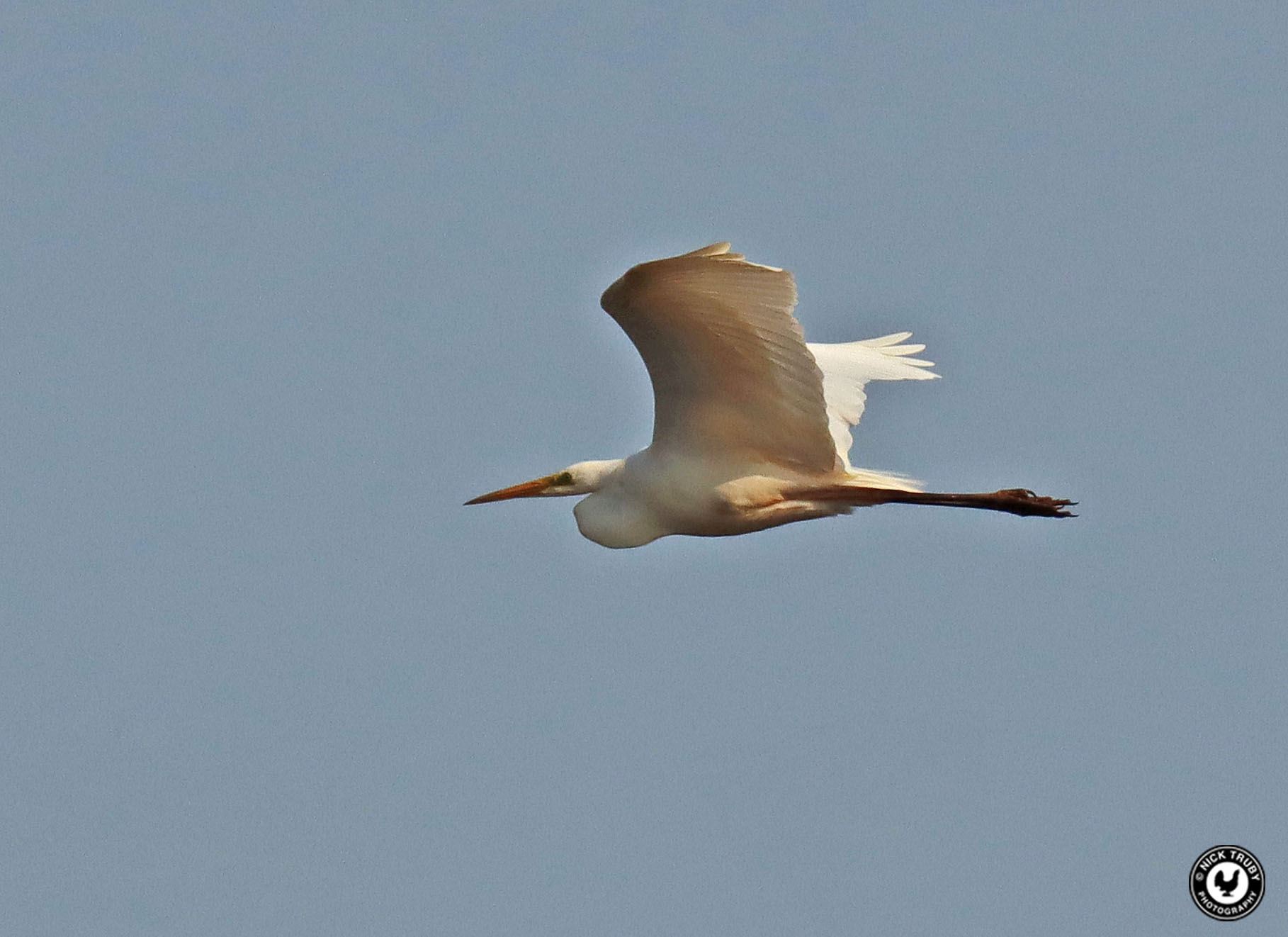 |
| Great Egret |
We chose to eat again at The Brookhouse Mill but managed to arrive before it was open. So we spent a few minutes looking for the Dipper that we'd found on the Sunday from the bridge but there was no sign of it this time. My attention was caught though by the sound of a Goldcrest in a large conifer next to the stream. As I watched I could see a male of our smallest bird species displaying to another, presumably female, and singing almost constantly in its attempt to woo it. I grabbed the camera from the car and spent the ten minutes or so while we waited for the pub to open trying to capture the energetic little sprites as they chased around the tree. Darkness was falling and I had a dinner date but some birds are hard to resist.

 |
| Goldcrest |
The meal was excellent.
Year List additions;
169) Garganey
Wednesday 23rd March; Homeward Meandering
As I always do, I would stretch the short holiday out for as long as possible and drive to another couple of places where I knew there would be other interesting birds to find. The Crossbill invasion of last year hadn't been repeated in 2022 and although I'd seen a couple this year, flying overhead at our local go to spot for displaying raptors, I was keen to get a better view of some. I remembered that on our previous visit to these parts a few years ago, there was a picnic spot in the Cloconoeg Forest where Crossbills were almost guaranteed. Our holiday cottage was just a few miles away from the forest so after leaving our excellent accommodation behind we were parked up nice and early and in an empty carpark once again. There is a lot to like about North Wales.
As soon as we were out of the car, we could hear Crossbills chipping away. The trees are tall in this forest and we had to crane our necks to find them but soon we were enjoying pretty good views of probably more than twenty of the fir tree specialists feeding in the upper branches. As is usual when it comes to my photography, the beautiful salmon pink males evaded capture so I was left with just the greenish females with which to embellish this blog.


 |
| Common Crossbill |
The Crossbills were frequently visiting the margins of the lake opposite the carpark. They were dropping into thickly branched trees that sat around a stream so we concentrated our efforts there. Problems were that the trees, even in the absence of leaves were incredibly difficult to see into, it was very dingy beneath them, and the sun was shining directly at us. All in all, while we were enjoying excellent views of the birds, it was nigh on impossible to photograph them successfully. The best I could do was to hope that a Crossbill would choose to drink and bathe in one of the slivers of sunlight that found its way through the trees and into the stream.
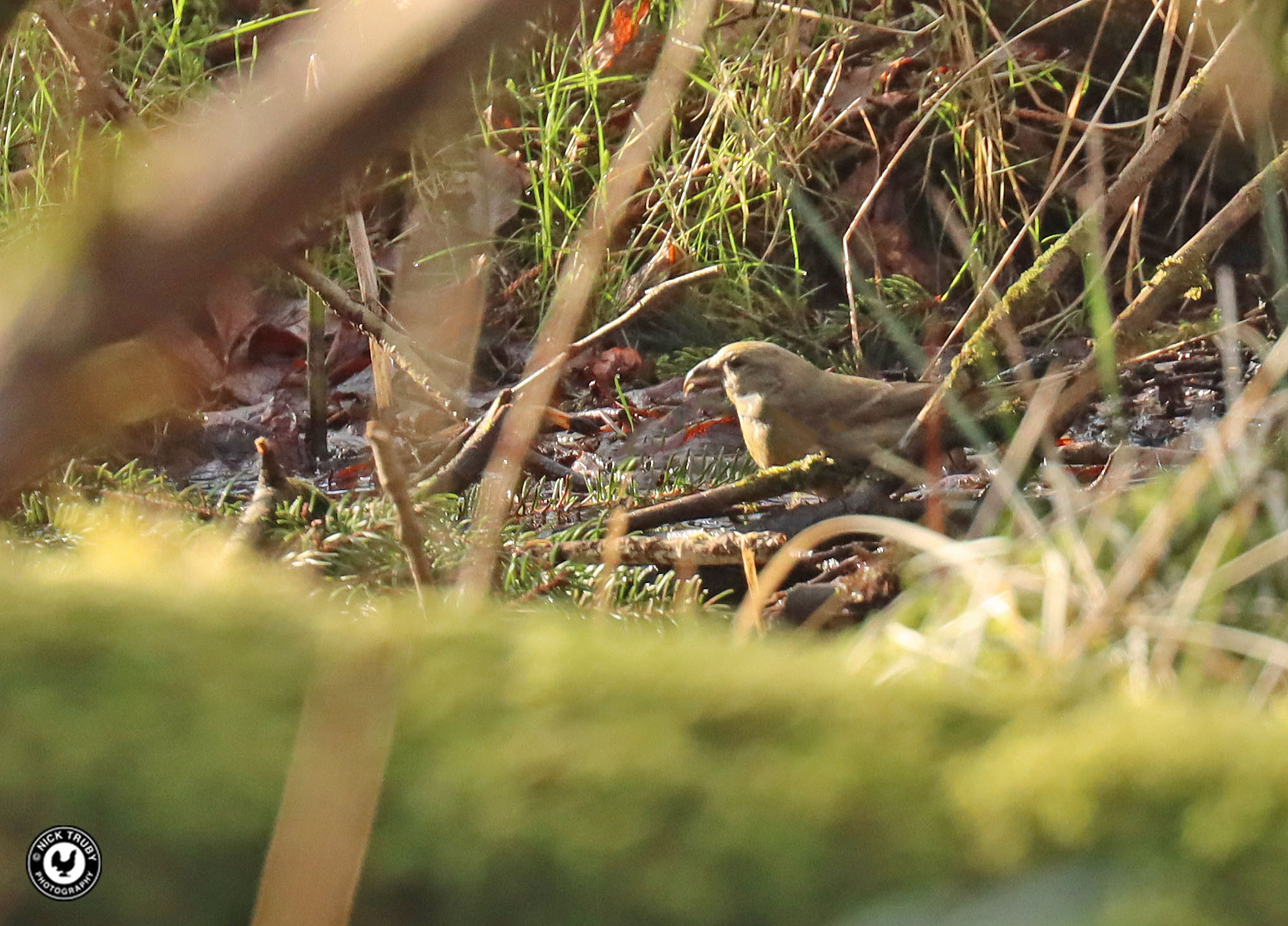
There were streaked juvenile birds amongst the flock and one of them perched just metres away from us, although it chose a spot which was tricky for us to see it. Crossbills are very early breeders, presumably so that the young can be fed on the seeds of the cone crop of the conifers which open early in the year. The juvenile birds already appeared pretty much independent of their parents.


A female type bird flew in and perched in the tree above our heads but again proved really difficult to photograph. We soon realised that this tree was being used as a staging post for the Crossbills on their way to and from the water. They would watch from the tree until they were sure the coast was clear before going to drink.

We found a male, not a bright reddish bird but more of a subdued orange-pink colour so probably a first year bird and for a moment it perched in full view, although not long enough for me since I was a bit slow of the mark with the camera as I had been all morning. I did manage to find the bird again when it perched in the tangle of twigs above the stream but all of those interfering factors mentioned previously put paid to me getting any decent images. But, hey, it's not every day that we get to see Crossbills.


Lake Vrynwy is a normal stopover for us on the way out of Wales, even though it hardly on a direct route home. We've never seen much of note there either other than enjoying fine views of Brambling once and finding a Dipper at the base of the dam. The drive from the Cloconoeg Forest takes you over desolate and remote moorland and it was while driving at the highest point this point that we probably had the most thrilling moment of the trip (if it can get any better than seeing Black Grouse at a lek). Shortly after cresting a hill, Mrs Caley noticed a bird of prey sailing along the ridge to our left and asked, "What's that?". It's awkward viewing for me out of the nearside windscreen whilst driving but I could see enough to know that we weren't following a Buzzard or a Red Kite, both birds that we're very familiar with. I sped past the bird and found the first available spot to park the car off of the road, jumped out of the car and looked back along the ridge, urging Mrs Caley to so the same. Initially there was no sign of the bird but then, as I had suspected, a ringtail Hen Harrier emerged from behind a patch of bracken on the crest of the hill and was amazingly followed by a male! We both watched the birds approach for a few seconds and then I went for the camera. Which, stupidly was stored in the boot of the car, and by the time I'd retrieved it and armed it, the pair of Hen Harriers had sailed over the ridge and were lost to view. We waited for ten minutes hoping for a return of the birds but our chance had gone.

 |
| Hen Harriers (female above & male below) taken in the Outer Hebrides |
When we arrived at Lake Vrynwy we were greeted by a massive building project with roadworks, and huge lorries and tractors everywhere. There was so much pressure on the parking situation caused by the temporary loss of places that we couldn't find anywhere to park ourselves, the cafe and its own parking area that we'd been hoping to visit was rammed so we had no option but to turn around and beat a retreat. Folk were parking on the other side of the dam and then walking back across it to access the village but considering the fact that Lake Vrynwy is huge and the dam is best part of a half mile wide we decided that we'd have to visit another day. It had been a full on three and a half days during which we'd seen lots of birds including twenty-four year ticks. As we drove away we wondered how long it would be until we visited North Wales again.
Year List addition;
170) Hen Harrier
Subscribe to:
Comments (Atom)