
Showing posts with label Shrike. Show all posts
Showing posts with label Shrike. Show all posts
Monday, 29 September 2025

Tuesday, 12 August 2025
April Adventures 2025

Tuesday, 19 November 2024

Monday, 30 September 2024

Saturday, 6 July 2024

Thursday, 25 April 2024

Tuesday, 10 October 2023
Migrant Happy! September 2-3 2023

Autumn is the time of plenty. Lots of birds, adults that have finished breeding and the juveniles that they've produced, head south to spend the winter in warmer climes where food will still available. Many of those northern breeding birds pass through Britain and in times of easterly airflows numbers of them can be high. Some of those passage migrants are expected every year and for the year lister must be seen to bolster the total. A few of the birds heading south may stopover in inland counties and some of those may be found in Oxfordshire. But to really increase the chances of seeing them, a trip to the east coast, or to a lesser extent the south, is in order. It's ironic that the two main subjects of this blog are birds that I've seen plenty of, but have yet to see either in my home county!
Monday, 31 July 2023
Flashback #3; 9-10 July 2022

Saturday 9 July; Finally!
The bird that I'd been alluding to in my previous flashback blogs, finally came home to roost when we travelled up to Bempton Cliffs to see the very rare Red-tailed Shrike that had already spent a few weeks on and close to the RSPB reserve. The Turkestan Shrike, as it also sometimes called, forms one half of a species pair with the Isabelline Shrike but has slight differences in appearance, voice and range. Both birds hail from Central Asia and both are very rare migrants to the UK. We'd seen two Isabelline Shrikes before, remarkably both were within just two miles of each other in an area of the South Devon coast but a year apart. The Red-tailed Shrike would be a lifer, my 396th species seen in Britain.
By the time we made the trip, the Shrike had moved to the overgrown part of a farmyard about a mile walk from the parking area at the RSPB visitor centre. The walk was along the cliffs which would be the usual focus of attention when visiting Bempton. It was difficult to ignore the thousands of seabirds that filled the air as we walked but we'd come for the rare Shrike so just about managed it. We'd spend some time with Puffins and the like later. The only bird that I stopped to admire on the way was a fine Corn Bunting that rattled its car keys as it perched on an ear of wheat.
 |
| Corn Bunting (Emberiza calandra) |
We joined around twenty others at the farmyard, paid our "fee" to the farmer who had graciously allowed us all onto his land and studied the scrubby area at the back of a lawned area. Apparently this was the garden to the farm house but was typically adorned with broken down tractors and machinery and I'm sure that if you looked hard enough then you'd find a bottomless hole full of goodies such as dead cows and kitchen sinks (Handsome Family reference right there). We got our first view of the Red-tailed Shrike only five minutes after arriving when it suddenly appeared in the hawthorn hedge.


 |
| Red-tailed Shrike (Lanius phoenicuroides) |
Shrikes of all persuasions can be active birds and very mobile when hunting but can also sit tight for ages within hedges. This bird was of the less active variety which meant that for the next hour and half I'd take hundreds of very similar photos. I managed to get most of the angles and poses covered and it felt as if this bird knew it was a superstar because it posed like a catwalk model. Not that anyone was complaining about that.


The Red-tailed Shrike was most active on the odd occasion it decided that it needed a snack. We saw it chase and catch bees, a butterfly and a huge green caterpillar (for this Shrike's size) which the bird took several minutes to despatch.


A colony of Tree Sparrows were also residing in the garden and while wary of their temporary neighbour, didn't appear too bothered of it. If it was a Great Grey Shrike then that would be an entirely different matter but Red-tailed Shrikes are not much larger than a Sparrow. With a full memory card we decided that the cliffs demanded a bit of our time. We had seen the fantastic Black-browed Albatross back at the end of May and it had been reported as being in residence again. Nobody could ever get enough of that spectacular creature (read about it here)!
 |
| Tree Sparrow (Passer montanus) |
Opposite the gateway that led to the farm was an indent in the high cliffs. We sat by the edge and while enjoying our lunch had superb views of Puffins both stood on the cliffs and flying in and out from them. The Puffins used the updrafts to help with the old air brakes but many looked to be just enjoying the fact that could pull some shapes and stunts.


 |
| Puffin (Fratercula arctica) |
Other birds were also enjoying the clifftop breezes but generally I just watched the birds having taken many photos here before. I still took a few photos of course of Razorbills and Guillemots that shared the cliffs with the Puffins. It was fun watching the Gannets as we walked back to the car as well. Sadly we couldn't find the Albatross and it wasn't seen flying around at all that afternoon.

 |
| Razorbill (Alca torda) |

 |
| Guillemot (Uria aalge) |
 |
| Gannet (Morus bassanus) |
Year List addition;
249) Red-tailed Shrike
Tuesday, 15 February 2022
End of January 2022; Hawfinches, a Grey Dip, Beans and a Queen!

Friday28th January; Chocolate Box Birding!
Just before Christmas a small flock of Hawfinches had been discovered and reported via the Bird News Services in North Oxfordshire frequenting trees in a couple of neighbouring villages close to Banbury. The birds proved to be very elusive and despite being searched for on subsequent days by several local birders, including ourselves, nobody was able to pin them down. Fast forward to the end of January when intrepid local birder, Mike Pollard, found presumably the same flock feeding in Yew trees in Great Tew, around five miles away from the original sightings. Great Tew is a quintessentially English village with charming cottages, a huge Manor House with vast gardens and country estate and locally famous (and very expensive) pub and cafe. It is usually a very popular place for American tourists to visit and the village can become very busy, particularly in the summer, but tourism is very muted owing to the pandemic so for the time being the village is reasonably quiet and undisturbed.
Our quest to see the Hawfinches began on Friday morning. We knew where Mike had seen the birds although he had said that they were very mobile and I know Great Tew quite well having worked there a few times over the years. Our home is only fourteen miles away, about twenty-five minutes by road. We planned on stopping at a pub in another village on the way that from experience produces excellent breakfasts but incredibly as we walked into the pub at 09:15 we were told that they were full! So with no other viable local options available, we thought we'd try the Great Tew village cafe. As with many "posh" cafes these days, the Quince & Clover offered what I think of as "weird" food for breakfast and wasn't really to my taste, I'm far from posh and don't see the problem with a "proper" breakfast and to my mind, Avocado and Broccoli shouldn't be on any breakfast plate but maybe that's the dinosaur in me. The coffee was excellent but maybe something stronger should be offered to relieve the shock at the size of the bill which was as heavy as the ones possessed by the Hawfinches!
A couple of other birders were also on site and we said a few hello's as we wandered around the village. Every tree was scrutinised for any bird that looked like a Hawfinch but the only ones that we saw were flyover birds, first two then a single and finally three birds. None of them settled although I did see the lone bird fly up from a tree as soon as I spotted it.

Later in the afternoon we made a quick visit to our local wetlands reserve and managed to conjure up our first Green Sandpiper of the year.
Year List additions;
122) Greenfinch, 123) Hawfinch, 124) Green Sandpiper
Saturday29th January; Another Dippy Dippy Shrike!
We had spent Saturday dipping a Great Grey Shrike close to Cambridge but went on to "save the day" by getting some fine views of a small group of nine Tundra Bean Geese at Welney WWT in the afternoon, all in some very blustery weather. A fine Merlin also helped to ease the disappointment at missing out on yet another Great Grey Shrike which must be the species that we dip the most and far more often than we don't. They are difficult birds to pin down. The Shrike had been present since November and had shown virtually every day until Saturday when it was nowhere to be seen and of course it turned up again in the same place the next day. That is so typical!
Welney doesn't quite have the allure of Slimbridge, it lacks the variety of habitat and consequently the spread of birds that the flagship reserve has, but is still a great place to visit. We've seen a singing Bluethroat and a Pallid Harrier at Welney in the past so it holds many good birding memories. The nine Tundra Bean Geese were resting sleepily on the main island when we arrived in very windy weather mid-afternoon. Fortunately a couple of them awoke and went for a quick paddle and drink allowing some good reference points to be taken.
 |
| sleepy Tundra Bean Geese |


To rouse the rest of the flock though needed a close flyby by a Marsh Harrier although the Geese were big enough to stand (or sit) their ground. It took a helicopter flying over to get the Geese to leave their slumber and fly off.


Welney is of course a hugely vital staging post for thousands of waterbirds and we enjoyed good views of them all, not as close as you can at Slimbridge perhaps but nice all the same. The only slight disappointment was missing out on a Barn Owl, too windy maybe for them to fly early, but that's par for the course for us recently, after seeing all of our resident Owl species in the first fortnight last year, this time around we are struggling. We did see a Short-eared Owl but that was hunting very distantly on the far side of the floods.


By contrast our friends Kyle and Kev had spent some time chasing the Hawfinches on Saturday and despite having the same trouble in pinning them down as we had the day before, they had at least had the good fortune to see one feeding in a Yew tree that enabled Kyle to get some really nice photos (see them at Birdwatch Britannia). My pique was reignited for the next day!
Year List additions;
126) Grey Partridge, 127) Tundra Bean Goose, 128) Merlin
Sunday30th January; More Finches!
So, fired up by their success, Mrs Caley and I returned to Great Tew early on Sunday morning. We parked up in the same place, this time the road was devoid of cars and we had the run of the place to ourselves. We had left the car for less than a minute and walked less than ten metres from it when a Hawfinch flew out from the hedge on our left and alighted in a Bramble on the other side of the road. It then briefly flew into a tree above the Yews by the car. Although it was still very gloomy, it was only just eight o'clock, I managed to grab a couple of half-decent record shots.


The Hawfinch departed but other birds were around to keep us occupied, especially a Goldcrest that was working its way through a beech hedge by the path. The tiny little sprite was animated too and was regularly "flaring" its orange-red crest feathers, which briefly had me thinking that I'd found a Firecrest. It was a Goldcrest however, and we followed it as it fervently hunted its microscopic insect breakfast.


I thought I saw a Hawfinch fly into one of the Yews so we decided to return to the car and watch from within it. A vehicle acts as a good hide especially if birds are as close to a road such as these promised to be. We were helped by the sun bursting forth from behind the up to now heavy clouds and even if the Yews remained in shade the grassy bank on which they stood were suddenly illuminated. There was no obvious sign of any Hawfinches but other birds were on hand to entertain. The two smallest Yews were being guarded by a pair of Mistle Thrushes although they were as furtive as the Hawfinches. Woe betide any other Thrush species that ventured into those trees. Redwings were particularly dealt with aggressively by the Mistle Thrushes but that animosity was also extended towards Blackbirds and Song Thrushes, and to a lesser extent to Greenfinches too. Song Thrushes knew their place, and that was on the ground beneath the trees.

A female Bullfinch appeared on a small Bramble bush behind the trees and commenced nibbling away at shrivelled up Blackberries to extract the seeds. Bullfinches are messy eaters but that bill wasn't developed for decoration but for dealing with hard seeds and stones and the fleshy pulp of the berries isn't the part that the bird wants. Hawfinches, that have even bigger and more powerful bills than Bullfinches, are similarly untidy diners.


The female Bullfinch was joined at the banquet by the more brightly male although he seemed to be less interested in eating. Bullfinches are many peoples favourite birds, they bring a taste of the exotic into many gardens and when lit up by the low winter sun they look stunning!


Mrs Caley noticed some movement in the darkest part of the shadiest Yew tree. The bird responsible for the movement took some finding but there secreted within the tree and very difficult to see behind the fronds was a male Hawfinch. Taking a photo of the bird was even more tricky, not only because it was so dark in the confines of the tree but locating the bird in the viewfinder was almost a task too far. When I did eventually get on it I thought that I was just seeing its face between the needles and yet the edited image shows almost the whole bird proving just how well the bird blends into its habitat. Hawfinches are much easier to observe when they perch high up in the surrounding trees.

Fifteen minutes later I noticed some more movement on a branch that extended out towards the lighter side of the Yew but it was still shaded by overhanging and taller trees behind. It was another Hawfinch, this time a slightly more muted plumaged female, that was moving very gingerly through the branches. It settled almost in full view giving me a good chance at a few better shots. Unfortunately I had the same problems as before with locating the bird through the viewfinder and then actually focussing on it (which I failed to do). How I wished that I'd get a similar opportunity with a bird in full sunshine and not hidden away in the shade.


Monday31st January; Just Can't Get Enough & A King (Queen)
I had yet another day off so we headed back to Great Tew once more to have another go at claiming a good view of one or more of the Hawfinches. We resolutely stayed in the car this time, partly because of the blustery wind and associated rainy squalls but also to maximise our chances of seeing without disturbing any Hawfinches. That weather put paid to any chance of getting those decent views although I did find a Hawfinch feeding very quietly tucked away within the often violently shaking branches of one of the Yews.
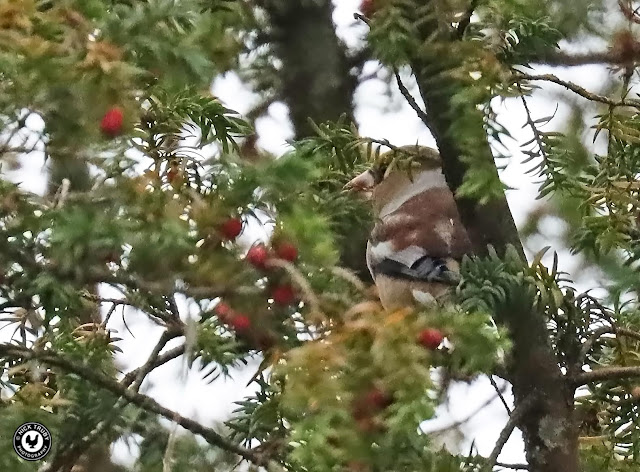
More violence was exhibited by the resident Mistle Thrushes which were even more protective than before and just about every other bird than the Hawfinch were ousted in some style by them. Being larger the Mistle Thrushes were able to cling on to the outer branches more easily and posed more readily for photos. But what I really wanted was for a Hawfinch to pose that openly and I guess that Hawfinches just don't do that, certainly not for me anyway.


There was no further sign of the Hawfinches although a few Greenfinches and other smaller birds ran the gauntlet of the Mistle Thrushes. The greenfinches were quite difficult to pick out amongst the similarly coloured Yew leaves.


We stopped for a coffee at Yarnton on our way through to Oxford where I wanted to have another go at photographing the Kingfisher there. The week before I'd not been able to see the female Kingfisher, distinguished by having a red lower mandible to the bill as opposed to the all black bill of the male, at all since she had flown off before I knew what was happening. This time, given the opportunity I would exercise a bit more fieldcraft and hopefully do better. On arriving at the carpark, I instantly spied the female Kingfisher perched in a similar place as before. This time though I was keen not to frighten her off so exited the car carefully. Unfortunately she wasn't perched in a very accessible spot and the shots were obscured by many small branches. Then to compound the problem a large dog went bounding straight down the bank and into the water right next to the favoured, now vacated branch since the Kingfisher had unsurprisingly fled downstream. Birding in urban environments has many interruptions, not least having to answer the inevitable question of, "What are you looking at?". "Nothing as it happens, thanks to your dog!"

I sat in the car with Mrs Caley enjoying the warm rays of sunshine that had replaced the earlier inclement weather and wondered whether it would be worth returning to Great Tew again but I felt that it was probably only a temporary lull in a cycle of more rain to come. I also felt sure that the Queen-fisher would come back to her favourite fishing spot as soon as she felt the coast was clear and it was safe again. A few minutes later I looked back towards the river and noticed that she was indeed perched there again. Kingfishers usually fly close to the water surface so it had managed to steal back in without me noticing. It had also obligingly chosen a less cluttered branch. I had also had the foresight to keep the camera on my person so didn't have to leave the car to photograph the bird which was only fifteen feet away.
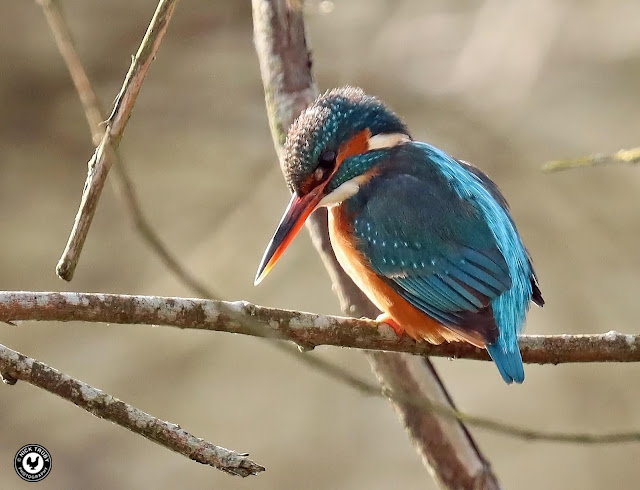
The female Kingfisher then obliged me even more by diving in after a fish. I didn't see the actual entry into the water because I was constrained by the car and my view was restricted but she did pop onto a partly submerged log in which to devour her catch. Images were difficult to get owing to me having to lean partly out of the car window to take the shots and hence they weren't my best.

When the (Queen) Kingfisher flew up to a higher branch to scour for its next fish it was obscured by more branches again. I didn't want to disturb it so moved the car away before getting out and finding myself a better angle for a few more photos. My fun didn't last too long though when the bird was once again put to flight, this time by an over enthusiastic couple who wanted some smoochy selfies next to the river. Like I said, there are many disruptions when urban birding.


Thursday3rd February; Score Finches!
I have been working just a few miles from the Hawfinches and had popped in a few times on my way to and from the site. I don't take my birding kit to work however, the temptations to skive off would be far too great, so had to make do with my old (and first) pair of Kowa binoculars which were never that good and certainly no comparison to the expensive ones that I use these days. I met a few of my birding friends there through the week and all had enjoyed some views of the Hawfinches. On Thursday Mike, the original finder of the birds had reported more than twenty of the birds centred in and around the church area, a spot that I had neglected to look at myself so far. I finished work at lunchtime and walked through the churchyard scanning the skies, the tall trees and the many Yews that grew there. A flock of around fifteen Hawfinches flew over my head and alighted in one of the tall trees. I had cracking views though they were poor through the rudimentary "work" bins. I should really invest in a better pair to keep in the van. And of course I had no camera. Thankfully there would be time for me to return home and collect my gear and Mrs Caley and return by three o'clock.
Mrs Caley thought better of it so it was just me. I was alone at the church too because the other birders that had been present earlier had left. Unfortunately there was no sign of any Hawfinches either, in the hour or so I'd been gone the birds had seemingly shipped out as well. I wandered around for a while and then remembered that Mike had said that he'd had really good views of several Hawfinches in a pair of Yews within the estate grounds but which could only be seen from the Ledwell Road. I walked around to the spot and peered over the six-foot high wall that protects the garden from oiks like me. The two trees, set amongst many other ornamental trees, were around fifty-feet from the road. Luckily there is a strip of grassy verge on which to stand otherwise I'd have been taking a huge risk with the traffic trundling in and out of the very upmarket Soho Farmhouse country club just a few hundred yards away. The Yews were illuminated by the late afternoon sun but appeared empty of birds. I watched a Nuthatch peck away at a dead tree next to the Yews and then, after ten minutes or so, noticed a very pale coloured bird fluttering along the right hand Yew. It was a Hawfinch!

A few seconds later I noticed another Hawfinch. With the sunlight making the birds appear so bright there was no problem in getting some nice images this time despite the increased viewing distance. The two birds were behaving quite strangely. Instead of sitting in the Yews patiently selecting berries or seeds to eat they both energetically flew up, down and around the outer branches, only settling temporarily, as if they were flycatching, which I'm pretty sure they wouldn't have been because they are hardly built for that type of feeding.


My best guess is that the Hawfinches must have been striving to get to the ends of the wispiest branches which were then unable to sustain their weight so it was a case of snatch and grab. The birds were on view sporadically, sometimes they'd disappear into the unseen parts of the trees but over fifteen-minutes I had some nice moments to watch them and take photos. It must have been some sight to see the whole flock feeding in those Yews as Mike had done earlier that day. Then the Hawfinches flew up to the top of one of the Yews and departed back towards the church. I was happy and thrilled that I'd finally been able to get some clear views of them.


Thank you for reading the blog!
Subscribe to:
Comments (Atom)