Welcome to another attempt to catch up on last years birding highlights in a (probably futile) attempt at logging a whole years birding.
Welcome to another attempt to catch up on last years birding highlights in a (probably futile) attempt at logging a whole years birding.

Back at the start of April this year a Forster's Tern had been found by a dedicated patch watcher at a small reservoir in Somerset. The bird only stayed for a few hours before disappearing. Just over two weeks later presumably the same bird appeared again, this time at Poole Harbour in Dorset. The Tern remained in the area for a month but was difficult to see and sightings were very sporadic. For some reason we never made the trip, probably because there was always something else that seemed easier to twitch at the time but also because the bird had chosen to roost at Brownsea Island which involves a boat ride to reach and expensive landing fees imposed by the National Trust to visit. On the 15th July the first-summer bird was found again at Lychett Fields on the outskirts of Poole but for the following week was as elusive as it had ever been. Then, thankfully, the Forster's Tern settled into an established pattern whereby it would visit a roosting spot at Shipstal Point, part of the RSPB's reserve at Arne. Now birders were able to connect with the Tern much more readily. So on Saturday the 29th we finally travelled down the dreaded A34 & M3 to take our chance of adding what would be a lifer to our list.
The Forster's Tern had already been reported as being present when we left home just after seven o'clock that morning. The drive would take around two and a quarter hours and I thought it would be pretty easy going on quiet roads. And it was, all plain sailing, until we neared Bournemouth and the traffic suddenly became very congested and we slowed to a crawl. I know that we are all constantly complaining about traffic but I'm intelligent to know that I'm part of that problem so shouldn't really be moaning about it but I do wonder where everybody else is going and why do they have to be on the road in front of me. I also know that they're unlikely to be travelling to the place where I'm going to. Anyway it took us almost an hour and a half to travel the last fifteen miles or so, and by the time we reached Arne it was already half past ten!
Luckily the Tern was still being reported so we'd hopefully connect with it without any trouble. The walk to Shipstal Point takes around twenty minutes and we were making good progress until I glanced behind me to see how Mrs Caley was doing, just in time to see her head butt the floor! She had stumbled over one of the many tree roots that lay across the path and had lost balance and hit the deck. Unfortunately her nose took the brunt of the floor and the bridge of it was now bleeding from where it had grazed the rough track. Obviously this stopped us in our tracks and I felt bad for maybe walking too briskly for her to keep up. It's far too easy to get over excited when pursuing a life tick. Fortunately a kind gent was following us and he luckily had a first-aid kit in his rucksack. Some antiseptic cream and a couple of plasters sorted Mrs Caley's nose out but she'd be bruised and in pain for a while. Steadfastly she decided to carry on rather than go for a sit down and a drink in the cafe. My wife is a good soldier.
Just after Mrs Caley had taken her fall, we met a couple of friends of ours who were returning from seeing the bird. They told us it had left the roost but was fishing in the channel and was giving great views, almost flying over their heads at times. We reached the beach ten minutes later and there was no sign of the Tern. Curse our luck!
We'd been told that the Forster's Tern had consistently flown up and down the channel so was "sure" to be back. I looked at my phone and saw that the time was eleven-twenty, the bird had last been reported almost an hour before but Steph and Rob had told us that it had still been present just twenty-minutes ago. We sat on one of the conveniently placed benches that overlooked the channel. I was concerned for my wife who had developed a headache but she said that she felt ok otherwise. It was a warm day too and we were sat in quite a sun trap with no shade. Luckily we had some painkillers in the bag. An hour passed with no sign of the target bird.
I must have scanned the roosting Terns and Gulls a hundred times and every passing bird was scrutinised as well. Other birders were present of course but all those that had seen the Forster's Tern earlier understandably drifted away. A chap joined us and we chatted about past twitches, especially those that ended in dips since this one wasn't going to plan, and year listing amongst other things. Another hour passed with little happening apart from the identity of a few juvenile Common Terns being questioned. We saw three Whimbrel fly in and rest for a while and then leave noisily. I found a couple of smart Bar-tailed Godwits in amongst the more numerous Black-tailed variety but because of the heat shimmer didn't bother trying to gain even record shots. At half-past two we began to question our own sanity in even bothering to twitch birds.
Rob and his son Thomas, who we've met many times over the past few years arrived. Rob told us that it was their fifth attempt to see the Forster's Tern, all of their four previous tries ending in failure. And I thought I was unlucky! At least we could recount a few successful twitches that we'd met each other at.
Another hour passed and the Clash song, "Should we stay or should we go now" was buzzing around my head. I checked and rechecked previous timings of sightings of the Tern and tide times to see if there was a pattern. There wasn't. The tides are so minimal within the harbour that birds wouldn't be affected by them unless feeding outside on the coast. The Forster's Tern could be seen at just about any time of day. Every time a birder left through boredom, our own expectation levels rose a little because of the "five minute rule", that period when a bird is sure to turn up after someone leaves. It's a myth obviously, but it must have worked at least once for it to have become "a thing" that is always mentioned at twitches. I'm not sure that rule would ever apply to us though, since it never seems to work in our favour. However, I'm superstitious enough to not voluntarily leave a stakeout for a bird unless I really have to. That "you should have waited another five minutes" rule would definitely apply to us!
Around four o'clock a few new birders arrived, presumably because they'd had better things to do all day. Some birders exhibit outrageous good luck and I was hoping that at least one of the newcomers who were now excitedly going through the same Terns that I'd scrutinised a hundred times already, were blessed with the Midas touch. As I was dwelling on that thought, it happened! A young chap shouted, 'What's this flying in from the left?' I was onto the bird in a shot and couldn't quite believe it. It was the Forster's Tern! After almost five hours of patient, and sometimes very impatient, waiting we had our bird. The Tern flew low over the water and made a beeline straight towards the other roosting birds. I held the camera up and semi-focused on the bird just as it stalled and rose above the water, presumably looking for a spot in which to land. It banked back around and then settled in amongst the other birds. My shots weren't great but I'd gotten my record.

 |
| Forster's Tern (Sterna forsteri) |
Everybody present was now greatly excited, our varying waits were over and we all got as close as we could to the waters edge to try for better views and photos. I collected Mrs Caley and the scope and focused that on the Tern so that she could get better views for herself. The bird was very distinctive with a black patch around each eye in an otherwise all white plumage apart from a black wedge at the end of each wing.
The Forster's Tern had landed about fifty metres away which is right on the limit of my lens. The Tern spent a few minutes preening, brushing up after a long day fishing somewhere around the harbour. The two black patches over the eyes lent it from the front on, a look of a very wide parting, reminiscent of Max Wall or indeed, Old Caley!

Initially I had trouble capturing the bird in profile but after a few minutes the Tern settled down. There was good, direct comparison with fellow resting Sandwich and Common Terns, and Black-headed Gulls. After all the careful scrutiny of every Common Tern, especially the juveniles, and trying to turn one into the Forster's Tern, now that the real article was stood on the spit there was no doubt at all as to its identity and I wondered why folk got so excited when seeing birds that were clearly not it. I guess we all have to gain the views, to gain the experience, in order to identify birds correctly. Practise in the field is far better than leafing through guidebooks.


The Forster's Tern then rewarded our lengthy wait for it to appear by tucking its head into its nape and going to sleep. There didn't seem to be much point in hanging around any longer, we'd gotten our bird even if I didn't get the photos that others had managed earlier. It was our second twitch in just over a week for a true mega bird that hadn't quite gone to plan but the outcome was that we had added both target birds to our life lists so, after allowing the dust to settle, there are definitely no complaints from me. The Old Caley life list nudged up to 412.
Year List addition;
272) Forster's Tern

Originally this posting was going to be combined with Part 1, but it would have been too lengthy so I spit it into two parts. The two parts combined together give meaning to the title since each part is based around a particular species of Tern.
We had stayed at the Purdy Lodge next to the A1 at Belford and had enjoyed a relaxed evening after our long drive and boat trips of the previous day. The only disappointment was that we didn't hear any Quail singing in the large wheat field that lay outside our room window. Not that we expected to of course but it would have been nice. As it happened, our wishful thinking would actually come to fruition later in the day, so stay tuned. I had chosen to stay near Belford because from there it is only a fifteen minute drive to High Newton-by-the-Sea where you can park to visit the Long Nanny Tern colony. We had already been to the area this year, to twitch the first ever Grey-headed Lapwing found in the UK. You can read about that weekend during which we also drove to Fife to add another two birds to our life lists here.
So after an early and very fine breakfast, we parked up at Newton Steads carpark before eight o'clock. We did the same excursion last year to see the American Black Tern that had taken up summer residence within the primarily Arctic Tern colony, and you can view the account of that visit here. The Tern had returned again this summer and although a little less reliable since being rediscovered, it had been seen regularly over the preceding week so we were confident that we'd bag it for our year list once again.
Last year we had visited on a warm afternoon, hadn't known the way and had walked much further than we needed to. This time we would be sure to beat just about everyone else to the tiny viewpoint and would go directly to it, thus saving energy for the drive up to Speyside later in the day. The walk through the dunes takes you through prime grassland which is packed with Meadow Pipits and Skylarks. The Northumberland coast still has lots of common birds and reminds me of a time when there were lots in Oxfordshire too. That memory is becoming rather distant now though. I stopped a few times to photograph some Skylarks which proved that they don't just deliver their delightful songs when in flight, and quite happy to serenade from a bush or the ground.

 |
| Skylark (Alauda arvensis) |
We were at the Warden's Hut overlooking the Tern colony by twenty past eight. Arctic Terns were everywhere although I felt that numbers seemed to be down on last year. An assistant warden told us later however, that numbers of nests were actually up on the previous year. Goes to show that appearances can be deceiving sometimes. Ten minutes of scanning the colony and the air and sea didn't reveal the American Black Tern however. I did find a few Little Terns, new for the year, sat resting on the sands of the Long Nanny burn mouth. Last year a couple of Little Terns graced us with a flypast, there wouldn't be a recurrence this year though. I resisted the temptation to take long distance and useless shots of the birds resting on the beach.
I remained confident that the American Black Tern would indulge us, and it was only ten minutes later when I spotted it flying in from the South. It flew right past the viewpoint before I had time to prime the camera correctly, returned going back the other way and dived into the marram right in front of us but landed out of view. I managed to grab a couple of images as it flew back. I count the bird on my year list although I realise that it's the North American counterpart and a subspecies of (European) Black Tern. It's my list.
 |
| American Black Tern (Chlidonias niger surinamensis) |
While we couldn't see the Black Tern, I watched the antics of the Arctic Terns that nest right next to the hut. I spent more time watching than photographing because I'd been here before and didn't need many more photos of the Arctic Terns. I did try to photograph one of the chicks though but that was tricky because of the grass stems and because the adults kept their offspring hidden for most of the time.


 |
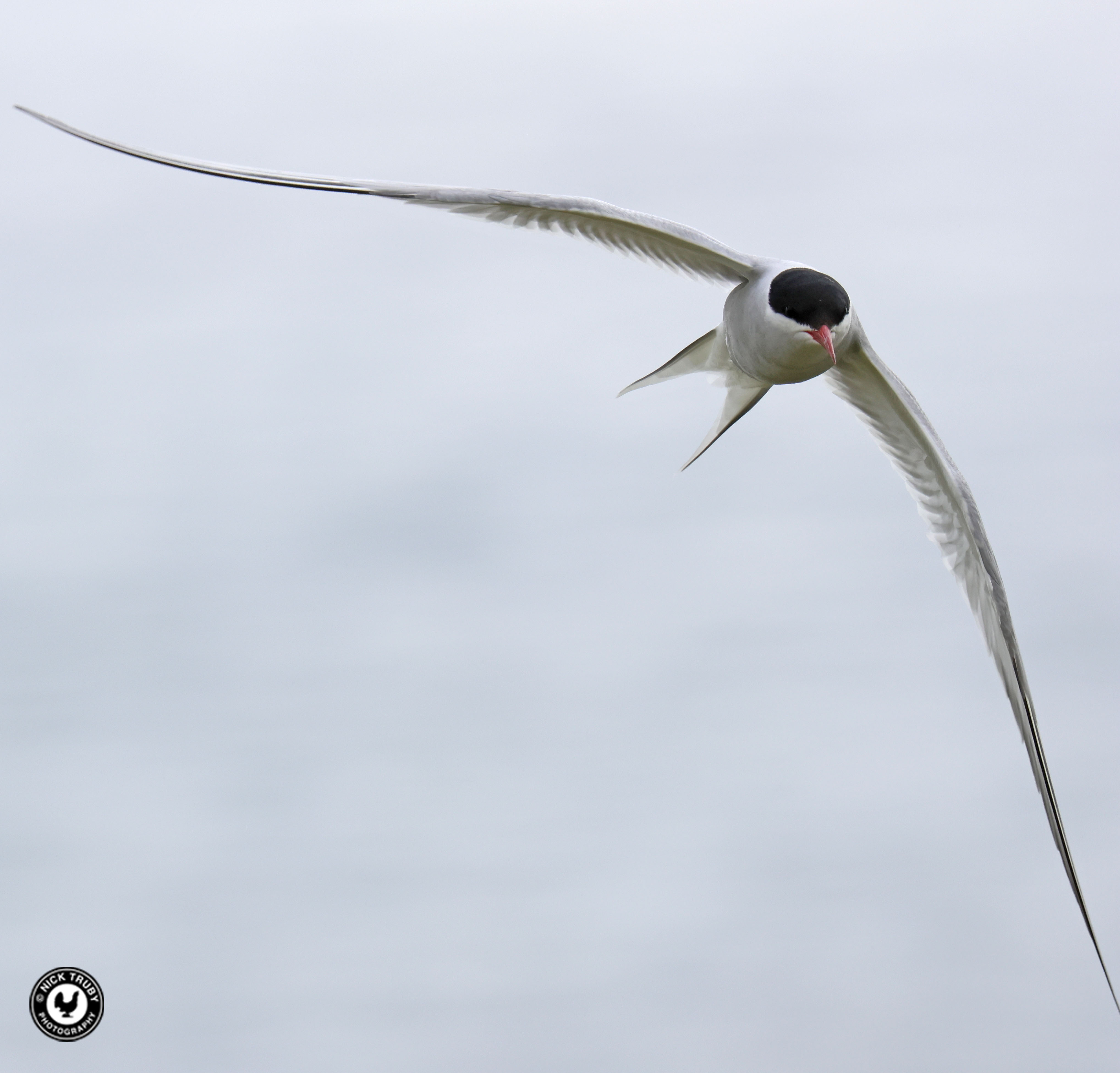
| Arctic Tern (Sterna paradisaea) |
Only ten minutes passed before the American Black Tern (ABT) flew into view again. Once more from our right as we looked eastwards towards the sea. This time the Tern put on a display for a good few minutes, flying up and down over the colony and affording extremely good views. It took me a while but eventually I began to tune in with the camera and gain some better photos, although still not as good as they should have been. We were generally viewing the bird against the light. The Tern rewarded my efforts by flying straight out to sea!


We were joined at the viewpoint by one of the volunteers who do a sterling job in looking after the colony. When we here last year we witnessed at first hand the efforts they put in to protecting the nesting Terns when two volunteers had to drive off an unwanted incursion onto the estuary by four people and two dogs. There is plenty of signage on both sides of the Long Nanny burn to indicate to folk that they should stay out of the area and yet some still choose to ignore the warnings. Maybe they couldn't read. I gladly added a few quid to the donation box.
It had been twenty minutes since the ABT had flown out to sea. We heard it before we saw it flying in from the south, the direction it always appears from. It announced its return by uttering its toy-trumpet bi-syllabic call. I thought it translated a bit like, 'I'm here, I'm here!' When the bird flew past we could see that it was carrying a fish, it continued, 'Got fish, got fish!'


The Tern continued to fly back and forth above the dunes and frequently flew right past the wardens hut and sometimes right over it. It continued to call so even if it couldn't be seen we knew where it was and if it was coming towards us. The subtle differences of the plumage between the American and European Black Terns is discussed and summarised brilliantly in a BirdGuides article here but essentially the ABT is "blacker" throughout its body and that contrasts more with the paler wings, particularly the underwing. The ABT also has a white leading edge to the wings which is very noticeable.


Apparently this is the fourth summer that the ABT has spent in the Long Nanny Tern colony, for the first two years it had been reported as a European Black Tern, which would be a rare enough occurrence in itself. Plenty of Black Terns are seen in the UK every spring but one staying in a potential breeding area is extremely rare and a returning bird even more so. The local birders that questioned the birds origins were right on their game!

I had fantastic views and photographic opportunities last year, this year was just as good. My only grumble was that my arm started to ache from holding the camera aloft so much! The usual exposure problems had to be overcome, and my skills aren't the best, with the jet black bird against the lighter background of the sea and sky. The best photos of birds show the eye and highlights or reflection on it but it isn't always easy to see a black eye in a black head.


My best shots were achieved when the ABT flew lower and in front of the grass which gave a darker background, allowing for more contrast. Because the bird was always flying so close to us, the background always blurred right out so the sea and sky resulted in the same grey wash.


At times the ABT passed so closely past us that my camera grabs couldn't even catch the whole bird. I guess I should have zoomed out but of course you don't get time to think about stuff like that when photographing fast moving birds.


The ABT had flown around continually for fifteen minutes, and for all of that time it had carried its fish presumably in a vain attempt to attract one of the Arctic Terns attention. At times it almost felt as if it was offering the fish to us. The call, "Got fish, got fish" continued. As the Tern approached and flew directly towards us, I took one last volley of it in head-on profile. Those shots probably just about surpassed last years efforts that can be seen here.


The American Black Tern had obviously had enough of charging around and landed in an unseen spot on the beach. I took a few more photos of Arctic Terns and headed off. We'd been on site for just about an hour. As we left other folk began to arrive so from our point of view, having the Tern to ourselves had been a big bonus. There isn't too much room at the viewpoint.


A Linnet sang heartily from one of the ropes that separate the off limits sections from the path. It's not often that I get such a close view of one of our more common and familiar birds. A little further along the sandy walkway, a Meadow Pipit also adorned the rope. Both species are present in good numbers in the dunes and coastal belt of Northumberland.

 |
| Linnet (Linaria cannabina) |
 |
| Meadow Pipit (Anthus pratensis) |
I paused on the way back to the car to photograph the field that the Grey-headed Lapwing graced five weeks before. Not sure why I did it but I guess it was for nostalgia. The bird was in the field beyond the cattle and we viewed from the trees on the left.

There was still time to aim the camera at some more Skylarks. It's hard to resist Skylarks when they're performing their song from on high. I've learned though that shooting them when they're high up is a waste of time. I now wait until they descend towards the ground or when they've just taken off and are in level flight.


Year List addition;
242) Little Tern, 243) American Black Tern


