Near the end of 2022 we saw a beautiful and extremely confiding juvenile Sabine's Gull in Kent. We had only had a couple of previous sightings of Sabine's Gull before and that was our first juvenile. You can read about, and see photos of that bird here (scroll down past the Pied Wheatear to reach the Sabine's). It had also been over twenty years since we had a really good view of an adult Sabine's Gull, at Farmoor in August 2001, and I now longed for another. The opportunity to see another adult Sabine's Gull finally presented itself when one was found in Langstone Harbour near Portsmouth in early January. Amazingly it was in full breeding plumage too, birds in that state are only usually observed high in the Arctic regions of Northern Siberia and North America. What a bird in that condition was doing on the South coast of England during our winter was a mystery and frankly mind boggling!
It just had to be seen though, so at the earliest chance that I had, on Friday the 13th, we travelled down to Havant and parked next to The Solent to join a dozen or so other eager twitchers to observe the Sabine's. The Gull had taken to feeding and resting on a small brackish lagoon that had been created by a breach in the sea wall about 400 metres east of the carpark. It was a sunny but also very windy morning with small waves breaking right up to the sea wall. I spotted a small bird clinging onto the top of a fencepost facing headlong into the stiff breeze. My initial thought was a Wheatear so I rattled off a couple of shots with my now two week old camera. While I was firing away the thought entered my head that Wheatears shouldn't really be in the country in January and if it was a Wheatear then it could well be rare. My excited review of the images showed that I had mistakenly jumped to a wrong conclusion and the bird was actually a Stonechat! I blame the wind and Friday the 13th gremlins, both of which were making viewing anything through binoculars or camera very difficult. We did get a year tick a few moments later with two Rock Pipits that fed along the strand line. To photograph those would have entailed pointing the camera directly into the strong side-wind and would have been totally futile. I'd wait until better views later in the year.
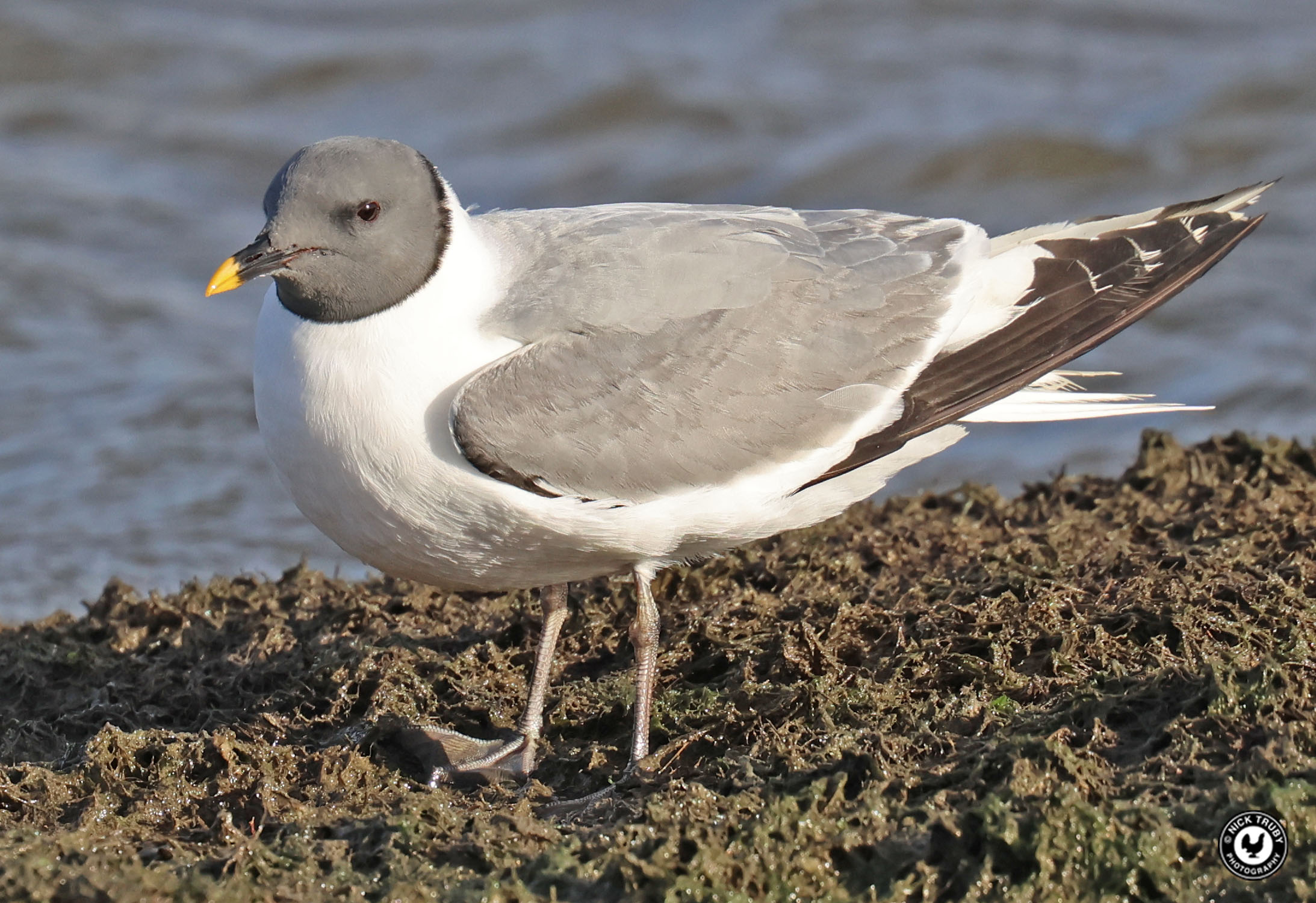
The whereabouts of the Sabine's Gull was obvious even from two hundred metres away because we could see the attendant birders. The bird itself was obvious too, lit up by the low sun and shining as brightly as a white star on the muddy shore of a small island. We reached the breach in the sea wall and after a careful bit of navigation over some old wire fencing and a big muddy patch, we were able to wade out, we had thoughtfully donned wellies for the walk, onto a shingly patch of land to where the other birders were standing. The Sabine's Gull was in repose on the other side of a small break of water no more than sixty feet away. This was the close views that I'd craved for those twenty odd years since the Farmoor bird. What a beauty the Sabine's gull was too!
 |
| Sabine's Gull (Xema sabini) |
I spoke to a chap I knew from previous twitches and he told me that the Gull had been resting like that for over an hour since he'd arrived. They had been concerned for its welfare and wondered if it was sick. However, it must have been waiting for us because just a few minutes after we arrived the Sabine's got to its feet (point about that later), flew a few metres and plopped into the water. Even with my rudimentary knowledge of how to use my new camera, I couldn't miss.


For the next ten minutes the Sabine's gull was active, flying in a loop around the brackish lagoon. Its direction was primarily into the stiff breeze, right to left as we watched, when it would fly closely above the water, occasionally dipping down to snare a food item. It would use the wind to fly rapidly back to its starting point then repeat the careful scrutiny of the water again. With every flypast a dozen or so cameras would go into overdrive including mine although you couldn't hear it of course.


There wasn't much time to study the bird owing to it being so active but I did my best to just watch it for a few minutes but in the end couldn't resist firing off more photos. What a belter of a bird too! Shape and jizz was akin to a Little Gull but it was a trifle larger although not Black-headed Gull sized as could be seen when it got too close to one and found itself a target of abuse.

 |
| Sabine's Gull & Black-headed Gull (Chroicocephalus ridibundus) |
The standout feature was the head and bill which for my money make the Sabine's gull the best looking of all the Gulls that I've seen. The head is a beautiful slate grey colour with a well defined black border at the neck de-marking it from a pure white collar and nape. The iris of the eyes is a dark red as is the gape of the bright yellow-tipped bill. The rest of the Sabine's was standard fare, a light grey back combined with black flight feathers. When unfurled the upper wing shows a grey-white-black pattern while the underwing is almost pure white. The tail is also completely white. This bird unsurprisingly looked a bit tatty around the edges but that didn't detract one iota from its overall beauty. The legs were pinkish-grey but the left foot appeared to be damaged and was turned to an unnatural angle and that injury may explain why the bird was here on the south coast of England instead of being much further north.


My new Canon R7 is capable of taking up to thirty frames per second but I had opted for a mere six. After just twelve minutes of photographing the Sabine's Gull I had taken almost five hundred photos. Afterwards I would reduce the speed to just two and half frames per second because I spend far too much of my life editing photos as it is. If I was a tad critical then I would admonish myself for over exposing the images a little, in the bright sunshine the white of the bird was gleaming but the finished results were a few steps up from what I would have achieved with my last camera so I was generally delighted with the images. We all have to learn how to use new tools. It had been my first workout with a bird in flight which the camera handled well although at times I did have focusing issues when the lens would "hunt" for the subject.


The major improvement with the R7 is the amount of "keepers". Apart from the frames where I had captured empty sky because the Gull had moved too quickly or was carried erratically away from the viewfinder on the wind, almost every image taken was in focus. I actually began dumping perfectly fine photos if they were near duplicates of others and at times, because of that fast frame rate, there would often be half a dozen near identical images. The increase in editing time required was the main reason for me slowing down the frame rate for next time. If I ever get the chance to take photos of Hummingbirds then I will increase it again.


After just twenty-five minutes since we left the car we decided that we'd seen enough and had become bored of being buffeted by the wind plus it was Friday so it made sense to head for home before the A34 became a big long carpark. It was also becoming busier and noisier by the lagoon with more and more birders arriving. The Sabine's Gull had risen higher and flown over us and out to the harbour anyway and although it was still visible, it was now further out over the water and viewing was directly into the sun. We took one last look at the fabulous Sabine's Gull and walked off.


On the way back to the car we did have a good look around and added a few more birds to our year list. Brent Geese were present in good numbers and the shore was busy with various wading bird species. Viewing into the sun wasn't easy however, and holding binoculars and the camera in the wind was very difficult so I never bothered to take any photos. I got briefly excited by a Pipit that was feeding along a small ditch on the marsh, a Water Pipit had been reported here but I was convinced that it was just another Rock Pipit. Water Pipit is definitely a bird I want to see well this year but this bird just wasn't one.
Year List additions;
69) Rock Pipit, 70) Curlew, 71) Sabine's Gull, 72) Oystercatcher, 73) Brent Goose, 74) Redshank, 75) Dunlin, 76) Ringed Plover, 77) Turnstone