Showing posts with label Gull. Show all posts
Showing posts with label Gull. Show all posts
Monday, 4 August 2025

Sunday, 8 June 2025

Sunday, 17 September 2023
Flashback #4; The rest of July 2022
I am determined to complete blogging up past days out so this series of 'Flashback' posts is my effort to do so. Probably only for my own interest but should I ever write a book then I need these memories recorded ready to use a prompt. I hope they'll still be interesting for anybody landing on them even though some are well over a year late!
Friday, 10 March 2023
A Particularly Gulling Couple of Days; 13-14 January 2023

Near the end of 2022 we saw a beautiful and extremely confiding juvenile Sabine's Gull in Kent. We had only had a couple of previous sightings of Sabine's Gull before and that was our first juvenile. You can read about, and see photos of that bird here (scroll down past the Pied Wheatear to reach the Sabine's). It had also been over twenty years since we had a really good view of an adult Sabine's Gull, at Farmoor in August 2001, and I now longed for another. The opportunity to see another adult Sabine's Gull finally presented itself when one was found in Langstone Harbour near Portsmouth in early January. Amazingly it was in full breeding plumage too, birds in that state are only usually observed high in the Arctic regions of Northern Siberia and North America. What a bird in that condition was doing on the South coast of England during our winter was a mystery and frankly mind boggling!
It just had to be seen though, so at the earliest chance that I had, on Friday the 13th, we travelled down to Havant and parked next to The Solent to join a dozen or so other eager twitchers to observe the Sabine's. The Gull had taken to feeding and resting on a small brackish lagoon that had been created by a breach in the sea wall about 400 metres east of the carpark. It was a sunny but also very windy morning with small waves breaking right up to the sea wall. I spotted a small bird clinging onto the top of a fencepost facing headlong into the stiff breeze. My initial thought was a Wheatear so I rattled off a couple of shots with my now two week old camera. While I was firing away the thought entered my head that Wheatears shouldn't really be in the country in January and if it was a Wheatear then it could well be rare. My excited review of the images showed that I had mistakenly jumped to a wrong conclusion and the bird was actually a Stonechat! I blame the wind and Friday the 13th gremlins, both of which were making viewing anything through binoculars or camera very difficult. We did get a year tick a few moments later with two Rock Pipits that fed along the strand line. To photograph those would have entailed pointing the camera directly into the strong side-wind and would have been totally futile. I'd wait until better views later in the year.
The whereabouts of the Sabine's Gull was obvious even from two hundred metres away because we could see the attendant birders. The bird itself was obvious too, lit up by the low sun and shining as brightly as a white star on the muddy shore of a small island. We reached the breach in the sea wall and after a careful bit of navigation over some old wire fencing and a big muddy patch, we were able to wade out, we had thoughtfully donned wellies for the walk, onto a shingly patch of land to where the other birders were standing. The Sabine's Gull was in repose on the other side of a small break of water no more than sixty feet away. This was the close views that I'd craved for those twenty odd years since the Farmoor bird. What a beauty the Sabine's gull was too!
 |
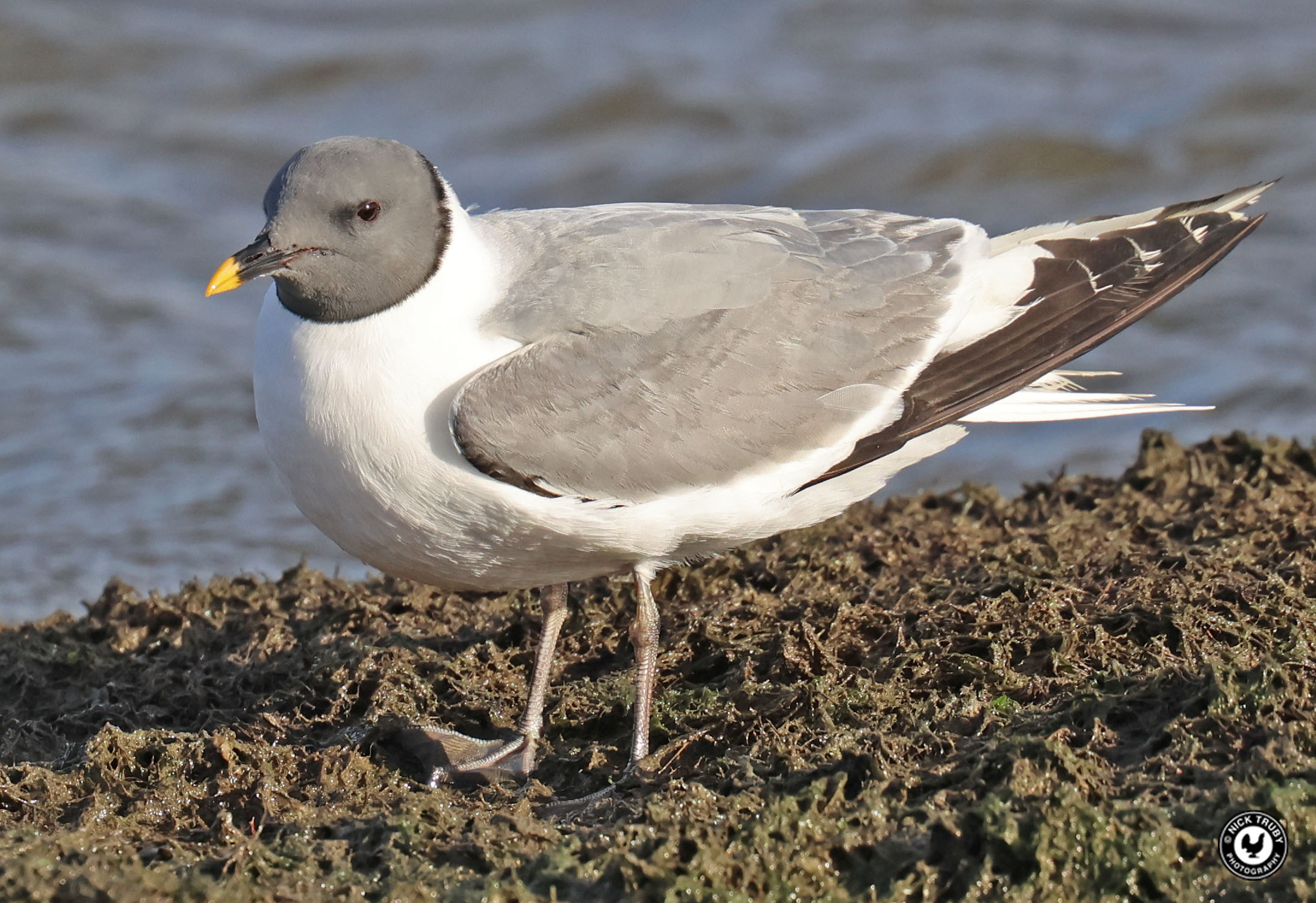
| Sabine's Gull (Xema sabini) |
I spoke to a chap I knew from previous twitches and he told me that the Gull had been resting like that for over an hour since he'd arrived. They had been concerned for its welfare and wondered if it was sick. However, it must have been waiting for us because just a few minutes after we arrived the Sabine's got to its feet (point about that later), flew a few metres and plopped into the water. Even with my rudimentary knowledge of how to use my new camera, I couldn't miss.


For the next ten minutes the Sabine's gull was active, flying in a loop around the brackish lagoon. Its direction was primarily into the stiff breeze, right to left as we watched, when it would fly closely above the water, occasionally dipping down to snare a food item. It would use the wind to fly rapidly back to its starting point then repeat the careful scrutiny of the water again. With every flypast a dozen or so cameras would go into overdrive including mine although you couldn't hear it of course.


There wasn't much time to study the bird owing to it being so active but I did my best to just watch it for a few minutes but in the end couldn't resist firing off more photos. What a belter of a bird too! Shape and jizz was akin to a Little Gull but it was a trifle larger although not Black-headed Gull sized as could be seen when it got too close to one and found itself a target of abuse.

 |
| Sabine's Gull & Black-headed Gull (Chroicocephalus ridibundus) |
The standout feature was the head and bill which for my money make the Sabine's gull the best looking of all the Gulls that I've seen. The head is a beautiful slate grey colour with a well defined black border at the neck de-marking it from a pure white collar and nape. The iris of the eyes is a dark red as is the gape of the bright yellow-tipped bill. The rest of the Sabine's was standard fare, a light grey back combined with black flight feathers. When unfurled the upper wing shows a grey-white-black pattern while the underwing is almost pure white. The tail is also completely white. This bird unsurprisingly looked a bit tatty around the edges but that didn't detract one iota from its overall beauty. The legs were pinkish-grey but the left foot appeared to be damaged and was turned to an unnatural angle and that injury may explain why the bird was here on the south coast of England instead of being much further north.


My new Canon R7 is capable of taking up to thirty frames per second but I had opted for a mere six. After just twelve minutes of photographing the Sabine's Gull I had taken almost five hundred photos. Afterwards I would reduce the speed to just two and half frames per second because I spend far too much of my life editing photos as it is. If I was a tad critical then I would admonish myself for over exposing the images a little, in the bright sunshine the white of the bird was gleaming but the finished results were a few steps up from what I would have achieved with my last camera so I was generally delighted with the images. We all have to learn how to use new tools. It had been my first workout with a bird in flight which the camera handled well although at times I did have focusing issues when the lens would "hunt" for the subject.


The major improvement with the R7 is the amount of "keepers". Apart from the frames where I had captured empty sky because the Gull had moved too quickly or was carried erratically away from the viewfinder on the wind, almost every image taken was in focus. I actually began dumping perfectly fine photos if they were near duplicates of others and at times, because of that fast frame rate, there would often be half a dozen near identical images. The increase in editing time required was the main reason for me slowing down the frame rate for next time. If I ever get the chance to take photos of Hummingbirds then I will increase it again.


After just twenty-five minutes since we left the car we decided that we'd seen enough and had become bored of being buffeted by the wind plus it was Friday so it made sense to head for home before the A34 became a big long carpark. It was also becoming busier and noisier by the lagoon with more and more birders arriving. The Sabine's Gull had risen higher and flown over us and out to the harbour anyway and although it was still visible, it was now further out over the water and viewing was directly into the sun. We took one last look at the fabulous Sabine's Gull and walked off.


On the way back to the car we did have a good look around and added a few more birds to our year list. Brent Geese were present in good numbers and the shore was busy with various wading bird species. Viewing into the sun wasn't easy however, and holding binoculars and the camera in the wind was very difficult so I never bothered to take any photos. I got briefly excited by a Pipit that was feeding along a small ditch on the marsh, a Water Pipit had been reported here but I was convinced that it was just another Rock Pipit. Water Pipit is definitely a bird I want to see well this year but this bird just wasn't one.
Year List additions;
69) Rock Pipit, 70) Curlew, 71) Sabine's Gull, 72) Oystercatcher, 73) Brent Goose, 74) Redshank, 75) Dunlin, 76) Ringed Plover, 77) Turnstone
Monday, 8 August 2022
7th August 2022; A Cape Crusade

Mrs Caley and I were toiling away in the heat of the mid-morning, trying to track down a couple of Great Bustards that had recently been found close to The Ridgeway near Wantage. We had tried and failed to find a reported Great Bustard in the same area before and now here we were again despite seeing one extremely well on the edge of a neighbouring village a couple of years back. The Bustards, being from a reintroduced population on Salisbury Plain, shouldn't really count on any lists either but are unusual and impressive birds to see and there was nothing else around to get for our year list (yes I know but we have to count something) owing to our recent good run of connecting with just about everything that we could.
We had received precise details of the Bustards likely hangout since a local birder and friend, Geoff, had found them a week or so before and had been keeping tabs on them ever since. Birding in the area is difficult though, the area of the Oxfordshire Downs is huge and even though, from high vantage points along the ridgeway, you can see for miles, there are still a multitude of hidden places that you can only see into by walking to them and those walks can be lengthy. Geoff had messaged me early to tell me that the two Bustards were still present and exactly where there were but despite that help I couldn't locate them so before long we tired of our task and began heading home. We would possibly try again on a cooler day, not that we get many of those these days, when heat shimmer would be less of an issue.
Halfway back to the car, messages began to hit my phone from a "Twitchers" WhatsApp group that I'd recently joined. WhatsApp seems to be the new preferred way of disseminating bird news, it's instant and many people can join in a discussion at once. The amount of traffic on the group declared that the potential Cape Gull that had been discovered at Grafham Water was interesting to say the least. It would be a first for Britain, a bird that had never been seen here before, so was sure to spark a huge twitch.
Grafham Water is a huge reservoir in Cambridgeshire close to the Bedfordshire border and is only around an hour from our home. So it was unfortunate that we were another forty-five minutes drive away on the wrong side and we were also a half hour walk away from our car. It was a no brainer though, we abandoned our fruitless search for the Bustards and decided that as soon as confirmation of the solid identity of the Gull was established we'd go for it. By the time we had reached the car, most experts were satisfied that the Cape Gull was the real deal and the countries keenest twitchers had galvanised into action and were firing up the collective Quattro's primed and ready to go.
It would be around a two hour drive from The Ridgeway so it was pointless rushing. Mrs Caley kept check on the WhatsApp gossip and updated me as we drove. We learned a lot about the Cape Gull, a bird that I am happy to admit, I had never heard about until an hour before! I had heard of Kelp Gull though which I knew was a species found in the southern oceans from South America through to South Africa and Australia. The Cape Gull (Larus dominicanus vetula) it transpired was one of five subspecies of Kelp Gull and was the South African version. Recently I learned that Cape Gulls had migrated northwards along the western coast of Africa and there were now breeding colonies in The Gambia and Morocco. Since that colonisation some Cape Gulls had been seen in Portugal and Spain and amazingly one had been found at a rubbish dump near Paris. So a few Gull experts had predicted that soon one would be found in Britain and here it was, a second calendar year individual, in middle England a long, long way from South Africa. It's records like this that helps to make birds and birding so fascinating!
We stopped briefly at home, snatched some snacks to eat and continued on the journey, arriving at a very busy carpark next to Grafham Water at around half past one. Birders were arriving en masse and we joined several on the ten minute walk to join another hundred and fifty or so already lined up at the reservoir wall. We found a gap in the throng and stared out at a very dry looking "beach" and some assorted wildfowl and a few Gulls that stood next to the water. It was obvious that the Cape Gull was there because pretty much everybody had a scope or camera trained on the birds. I didn't ask which one was the desired bird but instead scanned quickly through them. I had looked at a few photos online of Cape Gulls during our pitstop at home on the way so I knew that I was looking for a Gull with a dark black back similar to a Great Black-backed Gull. The fact that there was only one bird with such plumage on view meant that it must be the Cape Gull. Mind you, it didn't stop me confirming that fact with fellow Oxon birder and expert, Ewan (aka Black Audi Birding), even after I'd taken my initial snaps.


My initial reaction was that the Cape Gull was one big old bird, it looked nearly as big as the Canada Geese stood near it. Other than the black back, the bird, in keeping with most large Gull species, was mainly bright white. A small and beady looking dark eye was set into the pure white head and a huge yellow and pink bulbous bill was sported at the business end. The wings contained much white as well and it had noticeably long greenish-grey legs which gave it a very lofty look. Despite possessing these very obvious differences compared to Great and Lesser Black-backed I would still be hopelessly inept if I was to find this bird in the field. I have huge admiration for the person that decided this bird was different and equally applaud all of those involved in clinching the identity for lay birders such as myself. The broad white trailing edge to the wings was beautifully illustrated when the Cape Gull took a long wing stretch as it moved slightly along the beach to reposition, and to get away from one of the several Yellow-legged Gulls, for a while for a spot of preening.


The very welcome cooling breeze was blowing towards us, slightly alleviating the searing heat of the sun that bore down onto the concrete sun trap of the dam wall and road but because of that wind direction the Gull always adopted a stance facing into it and away from us watching from the wall. Hence I never once got a front or side on view of the bird except when it had stretched its wings skyward. Just eight minutes after taking my first photo the Cape Gull took to flight, veered to the left and flew to the southern end of the reservoir.


The Gull alighted on the embankment close to the tower where it had first been noticed earlier in the day and zealously feasted on a dead trout that lay on the concrete apron. I could see it through my scope and we watched it for a few minutes. Many of the twitchers charged after the bird including our good friend Jim who we had a quick ten second catch up with. Jim had only arrived thirty-seconds before the Gull took off so quite rightly wanted to get to it for a better look and to take some photos for himself. We'll have a better chat next time. His much better photos than mine are at The Standlake Birder. Having already walked a good section of The Ridgeway in the morning and having had a decent, if brief, fill of the Cape Gull we retreated back to the car's air-conditioning and home. We made it back to the carpark pay station one hour and one minute after we had arrived. That extra minute cost us an extra £2.90. I hate having to pay to park my car.
The Cape Gull is the first of its kind ever seen in Britain, our 260th bird seen so far this year and my 397th species seen in the UK. The magic numbers of 300 species for the year and 400 for life edged a little bit closer. I am still hopeful of achieving both of those targets before the year is out.
Year List addition;
260) Cape Gull

Thursday, 25 November 2021
OCD#5, End of August 2021

Apart from of a brief sojourn to Frampton Marsh to see our fourth Black Stork (see here), we spent the whole of August birding at our local reserves in Oxfordshire. It was a strange time for me because the new football season was up and running and for the first time for over forty years, I wasn't part of it, having relinquished my thirty-eight year old season ticket at the European Champions during the summer. I had first decided to give up football a few years ago because I wanted to concentrate on other aspects of life that I enjoy, with birding being a massive draw for me these days and a very viable alternative way to spend my time at weekends. The pandemic and enforced lockdowns when no spectators were allowed at public events gave me the impetus to give football up this year. I had lots of great times watching Chelsea and many more with my group of like-minded friends who I will no doubt miss at some point. But now, it's full on birding and twitching and I can no longer blame being at a match, or a hangover, for missing out on a good bird somewhere.
Sunday 22nd August; Farmoor Reservoir
We walked out onto the concrete perimeter road of Farmoor on a beautiful sunny morning. The reason we were here was to try and catch up with a very showy Caspian Gull but of course that was nowhere to be seen. There was lots of interest at the reservoir that day though, starting with a Little Egret that literally lit up the pontoons at the marina as itself was beautifully backlit my the rising sun.

 |
| Little Egret |
Freshly fledged juvenile Common Terns noisily scoured the shallows close to the causeway for breakfast while other younger birds waited impatiently on the concrete apron for their parents to deliver theirs.


 |
| Common Tern (juvenile) |
 |
| Common Tern (adult) |
The local feral Barnacle Goose flock, twenty-nine of them, slumbered on the embankment at the western end but were easily outnumbered by the local feral Snow Goose flock, sixty-nine of those, including four blue morph birds that were resting slightly further down the causeway.
 |
| Barnacle Goose |
 |
| Snow Goose (blue morph) |
 |
| Snow Goose (white morph) |
A further "Goose Fix" was available at the pump-house end of F1 with six Egyptian Geese reposing there. It was a good morning for Geese around the reservoir.

 |
| Egyptian Goose |
There had been no sign of the Caspian Gull so we opted for the complete circuit of F1 in case it was over the northern side. We met Peter (non-stop birding) who was also looking for the Caspian, in fact he'd already seen it but it had flown back towards F2. As we stood chatting and, for us, learning from his far superior knowledge of Gulls, a likely candidate for the Caspian Gull flew in and landed close to shore. Close inspection however, revealed a juvenile Yellow-legged Gull. We would have to wait a while longer for our Prince Caspian.

 |
| Yellow-legged Gull (juvenile) |
A couple of Great Black-backed Gulls added to the Gull mix. These are the real brutes of the Gull world and other birds definitely and wisely avoid them.
 |
| Great Black-backed Gull (2nd winter) |
Back at the Tower we had close up views of more resting and sleepy birds where Black-headed Gulls and Common Terns were lined up on the railings. A very lazy Sunday morning for Farmoor's birdlife!

 |
| Common Tern (juvenile) |
 |
| Black-headed Gulls |
Monday 23rd August; Farmoor Reservoir
A report of a juvenile Black Tern at the reservoir saw us return there after I finished work the next day. Incredibly there were no other birders around at all so we didn't have any leads on where exactly to look for the bird. We needn't have worried though since we found it easily enough as it patrolled F1 at a reasonable distance out from the bank. Black Tern is probably my favourite species in its family and I always enjoy seeing them so it felt very good to add it to my year list at this comparatively late stage of the year. On to #226 for the year now, a marked increase than at the same time last year.


 |
| Black Tern (juvenile) |
Wednesday 25th August; Farmoor Reservoir
A third trip of the week to the reservoir. Arriving at midday we were again the only birders to be seen anywhere around the basins, the others were hiding in the cafe out of the brisk wind. I wanted to get a look of the previously elusive Caspian Gull which I knew was still present thanks to the regular updates received from Ewan who birds the site regularly and does get news of the birds out to help the rest of us, unlike a few others that for some reason or another don't. It was a chilly for August, an overcast and breezy day but a surprise awaited at the western end of the causeway when a juvenile Little Gull suddenly dropped in. It spent a few minutes flying around F1 before climbing high and disappearing south-westwards. The Little Gull reappeared ten minutes later but flew off high again within minutes again.
 |
| Little Gull (1st winter) |
The Little Gull was possibly nervous because of the Peregrine Falcon that was flying high above the reservoirs.
 |
| Peregrine Falcon |
The Caspian Gull had been reported as to having a particular liking for the dead fish that are scattered around the reservoir and had been photographed at close quarters on the causeway. No such luck for us of course but I did find the bird eating a floating trout corpse out on F1. It had competition for the bounty from both Herring and Yellow-legged Gulls but easily defended its catch. Caspian Gulls are renowned for being aggressive members of their families and this bird was taking no prisoners.


 |
| Caspian Gull (juvenile) |
Even when the Caspian Gull landed on one of the floating rafts it remained far from passive whenever any other Gulls, or Cormorants, ventured too close.


Having seen the Gull, and hopefully learned a few ID pointers for future, although I doubt that because I have a mental block when it comes to Gull species, we returned to the marina end of the causeway. There along the grass embankment by the waterworks we found a small flock of birds feeding including a pair of each of Wheatears, Yellow Wagtails and Grey Wagtails.
 |
| Wheatear |
 |
| Yellow Wagtail |
 |
| Grey Wagtail |
At home later we were surprised to see the leucistic House Sparrow in our garden again. We first saw this bird last September but hadn't seen it since May this year. It had noticeably become less leucistic over the past few months with some of the male markings such as the black bib showing through the bleached plumage.

 |
| Leucistic House Sparrow & Starling |
Thursday 26th August; Northants/Oxfordshire border
I had been working for some time on a farm just over the Oxon border in Northants. Just a short way from the site driveway is an old dutch barn set close to a minor road. The road is lined on both sides by mature trees some of which are extremely gnarled and decaying. Last winter when I drove past the barn I noticed a Little Owl perched precariously on a single strand of wire that was stretched across the front of the barn. Despite looking every day onwards whenever I was working there I never saw the Owl again. Then earlier in August I began another stage of the work at the same site and saw a Little Owl again. The sighting was repeated several times over the next week so I started taking my lunch breaks at the barn and spent time watching the Owl. Today I decided to try for some photos so I drove the van to the barn and parked up in the gateway from where I could view. I remained in the van and used it as cover, ready to point the camera through the open window. Typically for fifteen minutes there was no sign of the Little Owl at all. Then, as I was thinking of going back to work, an Owl flew up from the base of the closest tree into the upper branches. Amazingly another three Little Owls followed it. I'd only seen the one there before so had no idea that there'd be more!

 |
| Little Owl (adult) |
Just as there were near Banbury a couple of weeks before this was a family party of two adults and two fledged youngsters. There was no direct interaction between any of the birds although it was clear that they'd all emerged from the same part of the presumed nest hole in one of the trees.

 |
| Little Owl (juvenile) |
I stopped alongside the barn again on my way home and enjoyed point blank views almost of one of the adult birds stood on a stanchion of the barn roof. Late in the afternoon the sunshine lit the Owl up beautifully. Others of the family were also resting up in the roof space of the structure.


The following day, I took Mrs Caley along to see the Little Owls which were slightly more elusive but we still managed to see three. It's been a good year for us and Little Owls and we've found and seen more than we ever have before. In fact it's been a good Owl year generally for us and we've had great views of all five of our breeding species, all of them locally too.


Saturday 28th August; Otmoor
A grey and overcast day where everything was elusive or too far away and when my camera remained largely holstered. Most of the same birds were still present, all three Egret species, the family party of Garganey and more but none were showy and I lacked enthusiasm. I have days like that sometimes.
 |
| Garganey (back left) |
The partially leucistic House Sparrow brightened up the gloom once more by greeting us back at home.

Sunday 29th August; Churn
Weather-wise, another of the same dreary and chilly for the time of year days. I tried to reinvigorate our birding by attempting to track down a male Hen Harrier that had taken up temporary residence on the Oxon/Berks Downs. Why do so many of the best birds in our area pitch up right on the borders of the county? One of my favourite oxymoronic walks is to go "Up the Downs" and there is usually something to see. It turned into a long walk, we didn't see the Harrier but did find a couple of the areas star birds that can't be named on here. The main show was provided by the Corn Buntings, including one with an odd cream coloured tail that was still fetching food for its chicks, and Skylarks which are bountiful on the arable farmland.

 |
| Corn Bunting |
Monday 30th August; Muswell Hill
That time of year again to check our local migration hotspot for migrant birds. In fact it isn't so hot but we can expect to find a sprinkling of our less common breeding birds up the Hill as they move southwards to avoid our winter. I'm ever hopeful of finding a Wryneck up here or a Yellow-browed Warbler later in October but so far I've only ever found Wheatears, Common Redstarts and Spotted Flycatchers. I even missed out on seeing a Pied Flycatcher that Badger found on a sunny afternoon a few years back. This walk brought us a large flock of mixed species, with Blackcaps, a Lesser Whitethroat, a few Willow Warblers and a Treecreeper keeping tabs with the more usual species.
 |
| Willow Warbler |
On the southern side of the hill we found a Wheatear and four Spotted Flycatchers in the usual spot, in the bushes surrounding a small paddock.
 |
| Wheatear |

 |
| Spotted Flycatcher |

Friday 3rd September; Muswell Hill
An afternoon walk on the Hill in better weather for a change. Birds were moving but mostly high up and we logged a Hobby, a pair of Raven and numerous Buzzards heading south. The hoped for Honey Buzzard must have been even higher up and it slipped by unnoticed! Twenty-five years ago a White-tailed Eagle graced this area and I'm always expecting the massive shadow of one to glide overhead now we have the reintroduced birds from the Isle of Wight wandering around, maybe next year.
 |
| Robin |
The Wheatear was still present but surprisingly uncooperative. The paddock held just a single Spotted Flycatcher but at least it posed dutifully for us.


After a good month of local birding it was now time for us to spread our wings again, rarities were awaiting!

Subscribe to:
Posts (Atom)