Saturday 23rd April; Farmoor for More Year Birds
On a breezy day fitting for the time of year we once again, with nothing better to do, opted for an easy walk around Farmoor and Pinkhill. Interestingly no other birders had the same idea so we had the entire causeway to ourselves as we strolled. I was hoping for an interesting wader or two but found absolutely none! So it was left to the local resident birds to provide some scant entertainment. I was hoping for some Swifts but it seems as if they're going to be late returning this year.
 |
| Great Crested Grebe |
 |
| Mute Swan |
There was an expected year tick when a Common Tern flew past us and it was quickly followed by another. Common Terns always form the vanguard of the Tern species for us. Over the next few months we'd hopefully see several more species of the family.
 |
| Common Tern |
The trees and bushes of Pinkhill provided us with a couple more year ticks although trying to get a photo of either the Garden Warbler or Lesser Whitethroat proved beyond me. Equally elusive was the Grasshopper Warbler that briefly reeled from deep inside a bush close to the Lock. We caught a brief view of it as it flew across the road but that was it. I felt that the look a Wood Pigeon gave me pretty much summed up the day so far.
 |
| Wood Pigeon |
The best birds were seen as we walked along the northern side of F1. Firstly we watched a Kestrel hunting for prey along the embankment on the Pinkhill boundary.
 |
| Kestrel |
Then we heard, and found, a Cuckoo by one of the settling ponds. We were able to watch the Cuckoo hunt and catch several Caterpillars and enjoyed fine views. It was great to see the Cuckoo, although we saw a distant bird at otmoor the week before, to sit and watch the antics of probably our most charismatic and certainly most unusual of summer migrants really nails home the fact that winter has gone. The small Warblers and Dunnocks that fluttered about the scrub will be less pleased to see the Cuckoo back.
 |
| Cuckoo |
On another of the settling pools was a single Common Sandpiper which bobbed along until an overflying Heron sent it packing. Common Sandpipers are frequently found at Farmoor at all times of the year except for mid-summer. This bird would likely be moving northwards to its breeding grounds beside a fast flowing river or a deep Scottish Loch.
 |
| Common Sandpiper |
 |
| Grey Heron |
On our way home we stopped next to a seasonal flood near Weston-on-the-Green where there were a pair of Curlew and a pair of Green Sandpipers. All in all, it had been a decent morning birding the local area.
 |
| Curlew |
 |
| Green Sandpiper |
Year List additions;
193) Common Tern, 194) Garden Warbler, 195) Lesser Whitethroat
Sunday 24th April; Exploring a New Place
There are birds that are considered reasonably common across some parts of the country but are still difficult to find in Oxfordshire. I had already seen one of these, Tree Sparrow, earlier in the year but another, Marsh Tit, had so far eluded me this year. I'd recently become aware of a BBOWT reserve in the south of the county that hosted both species so on a fine and breezy morning (every day seems to be windy these days) we headed off to Chimney Meadows where we'd never been before. To visit the reserve requires quite a long walk from the carpark through farmland to a mixed habitat site adjoining the River Thames.
Birds were plentiful along the access road, most notable were Grey Partridge and Green Woodpecker, but we were most interested in a small hide in a small woodland area where a friend of mine (thanks Jess) had seen both of our target birds during the previous week. We found the hide and looked out of the slats at a small pond, dense scrub with bigger trees beyond and two separate feeding stations. Initially there were no takers at the feeders at all and it was a good fifteen minutes or so before the birds began arriving. Then some of our common birds arrived, Dunnocks, Robins, Blue Tits, Great Tits and Goldfinches all fed at the feeders or on the ground beneath them and a Wren sang heartily from the reeds at the pond edge. All very nice but not what we had hoped for.
 |
| Blue Tit |
 |
| Dunnock |
 |
| Goldfinch |
 |
| Wren |
I could hear the chirping of Tree Sparrows off to our left but couldn't see them at all in the dense foliage. I could see nest boxes in the trees, presumably placed for them but there was no movement at any of them. Then with no warning a Tree Sparrow appeared in the tree containing the feeders to the left of the hide. It was joined by another but both were skittish and I had great difficulty in getting photos, not helped by the ridiculous height that the windows of the hide were placed. Over the course of the next hour or so up to four Tree Sparrows visited but all were equally furtive.
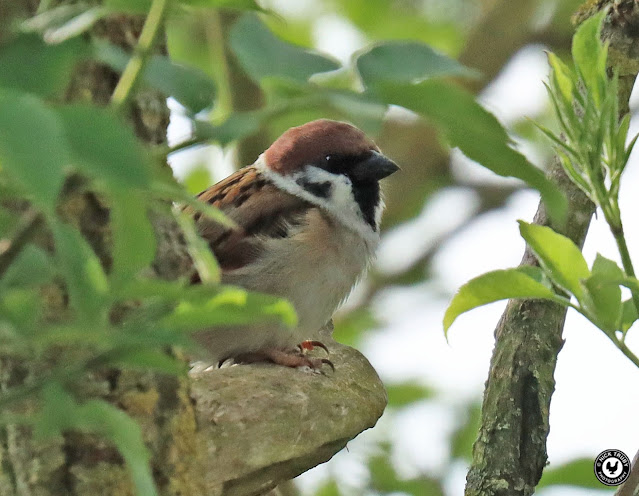 |
| Tree Sparrow |
The bird that we most wanted to see, for the year tick, showed much better. A pair of Marsh Tits regularly visited the trees and feeders. In the spirit of true photography snobbery, I was only interested in capturing the birds away from the feeders which required much effort and luck but eventually I had what I wanted.
 |
| Marsh Tit |
We took a walk to the river and looked off of the ancient bridge. A singing Cetti's Warbler was the best bird seen there. We made a note to visit again next year, possibly a bit later on in May. The whole area looks good for summering birds, many of which hadn't arrived yet.
Year List addition;
196) Marsh Tit
 |
| Common Whitethroat |
Tuesday 26th April; Whin Win!
The discovery of a Whinchat at our local Bicester Wetlands Reserve (BWR) saw us make a late afternoon trip to see it. The Whinchat had been found by our good friend Colin who was checking the site earlier in the morning and the unusual bird for the reserve was still present at lunchtime. The few hours that we were there would prove to be memorable but not because of the Whinchat.
The Whinchat had been found in the Cattle field at the southern end of the reserve. We arrived at just after three-thirty in the afternoon and headed straight to the field which was thankfully sans Cows. We spotted the Whinchat immediately on the fence line that borders the stream which links the main lagoon to the Cattle Bridge Pool (CBP). The Whinchat flew towards the pool so we followed it, taking the track alongside the railway line that leads to the hide and which overlooks the CBP. Halfway there I stopped suddenly and announced to Mrs Caley, "Listen. I can hear a Grasshopper Warbler reeling". Sure enough from the direction of where we'd first seen the Whinchat came the faint reeling song of a Gropper, our fourth in just a week. The Gropper would also be our first ever at BWR. We couldn't place it though and it went silent so we continued on to the hide.
From the hide we looked out at the small pool and noticed a pair of Little Ringed Plovers (LRP) close to the nearest bank. The two LRP showed great interest in each other and the, presumably, male bird was shadowing the female as she pecked away at the insects on the mud. Then in an instant the male was on top of the female and after a bit of shuffling into position the pair copulated! Plover Lovers making little, Little Ringed Plovers!
 |
| Little Ringed Plovers |
The bird that we'd come to see popped up onto a fence post at the far edge of the pool, close enough for a record shot at least. We usually either have to go to Wales or another upland area to year tick Whinchats or have to wait for passage migrants to turn up at Otmoor so to get one at our local BWR was a bonus. Not close and not a stonking male bird but they all count on a year, and site, list.
 |
| Whinchat |
I scanned back to the fence line by the stream and was amazed to see the Grasshopper Warbler stood on top of one of the posts. Even though it wasn't audible, it was clearly reeling. The Whinchat was in the bag and I'm a great fan of Groppers so I made my way back to the field and edged closer to where it had been reeling from.
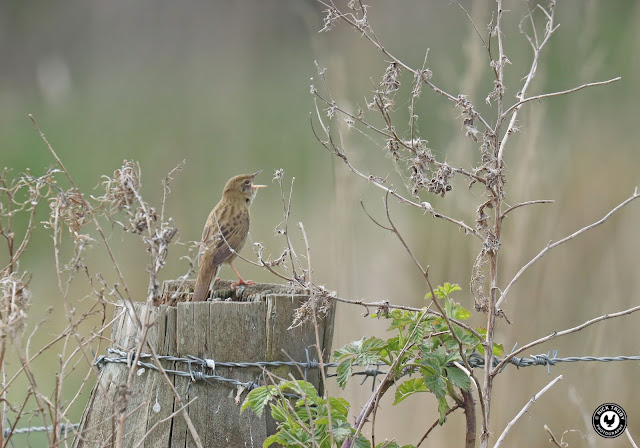 |
| Grasshopper Warbler |
Initially there was no sign of the Gropper so I located the post, which was located in a thick patch of bramble, and ensconced myself down into the long grass and waited. It was less than five minutes when the Gropper appeared into full view. It perched on the barbed wire fence and began reeling. Better still, it was only fifteen feet away. I couldn't miss!


The Gropper reeled away non-stop for a good five minutes before dropping down into the vegetation. I shifted my position slightly so as to get a more front on view to where the Gropper had sung from and waited again. In just a few minutes I was enjoying the best views of a Gropper since I found a pair feeding their chicks at Pinkhill by the Thames a couple of years ago. The difference here was that the bird was now stood atop the original song post and belting it out right in front of me. I've dreamt and wished for an opportunity just like this for years since seeing a reeling male very close up in my pre-camera days. What a bird! One of my favourites and I now have some special photos to lodge firmly near the top of my portfolio.
Year List addition;
197) Whinchat
Wednesday 27th April; More Chat
I returned to BWR the following evening hoping for more Gropper action but it was strangely reticent to pose. I guess the cooler and damp conditions kept it more subdued. Kev and Adrian joined me at the CBP hide and we all had good views of the Whinchat, much better than the previous day, even though the drizzle didn't help to improve much on the photography front. The Whinchat was finding plenty to eat and would remain for another couple of days before moving off.


