Showing posts with label Northumberland. Show all posts

Monday, 3 July 2023

One Good Tern Deserves Another, Part 2; Long Nanny, 10 June 2023


Originally this posting was going to be combined with Part 1, but it would have been too lengthy so I spit it into two parts. The two parts combined together give meaning to the title since each part is based around a particular species of Tern.

We had stayed at the Purdy Lodge next to the A1 at Belford and had enjoyed a relaxed evening after our long drive and boat trips of the previous day. The only disappointment was that we didn't hear any Quail singing in the large wheat field that lay outside our room window. Not that we expected to of course but it would have been nice. As it happened, our wishful thinking would actually come to fruition later in the day, so stay tuned. I had chosen to stay near Belford because from there it is only a fifteen minute drive to High Newton-by-the-Sea where you can park to visit the Long Nanny Tern colony. We had already been to the area this year, to twitch the first ever Grey-headed Lapwing found in the UK. You can read about that weekend during which we also drove to Fife to add another two birds to our life lists here.

So after an early and very fine breakfast, we parked up at Newton Steads carpark before eight o'clock. We did the same excursion last year to see the American Black Tern that had taken up summer residence within the primarily Arctic Tern colony, and you can view the account of that visit here. The Tern had returned again this summer and although a little less reliable since being rediscovered, it had been seen regularly over the preceding week so we were confident that we'd bag it for our year list once again.

Last year we had visited on a warm afternoon, hadn't known the way and had walked much further than we needed to. This time we would be sure to beat just about everyone else to the tiny viewpoint and would go directly to it, thus saving energy for the drive up to Speyside later in the day. The walk through the dunes takes you through prime grassland which is packed with Meadow Pipits and Skylarks. The Northumberland coast still has lots of common birds and reminds me of a time when there were lots in Oxfordshire too. That memory is becoming rather distant now though. I stopped a few times to photograph some Skylarks which proved that they don't just deliver their delightful songs when in flight, and quite happy to serenade from a bush or the ground.


Skylark (Alauda arvensis)


We were at the Warden's Hut overlooking the Tern colony by twenty past eight. Arctic Terns were everywhere although I felt that numbers seemed to be down on last year. An assistant warden told us later however, that numbers of nests were actually up on the previous year. Goes to show that appearances can be deceiving sometimes. Ten minutes of scanning the colony and the air and sea didn't reveal the American Black Tern however. I did find a few Little Terns, new for the year, sat resting on the sands of the Long Nanny burn mouth. Last year a couple of Little Terns graced us with a flypast, there wouldn't be a recurrence this year though. I resisted the temptation to take long distance and useless shots of the birds resting on the beach.

I remained confident that the American Black Tern would indulge us, and it was only ten minutes later when I spotted it flying in from the South. It flew right past the viewpoint before I had time to prime the camera correctly, returned going back the other way and dived into the marram right in front of us but landed out of view. I managed to grab a couple of images as it flew back. I count the bird on my year list although I realise that it's the North American counterpart and a subspecies of (European) Black Tern. It's my list.

American Black Tern (Chlidonias niger surinamensis)


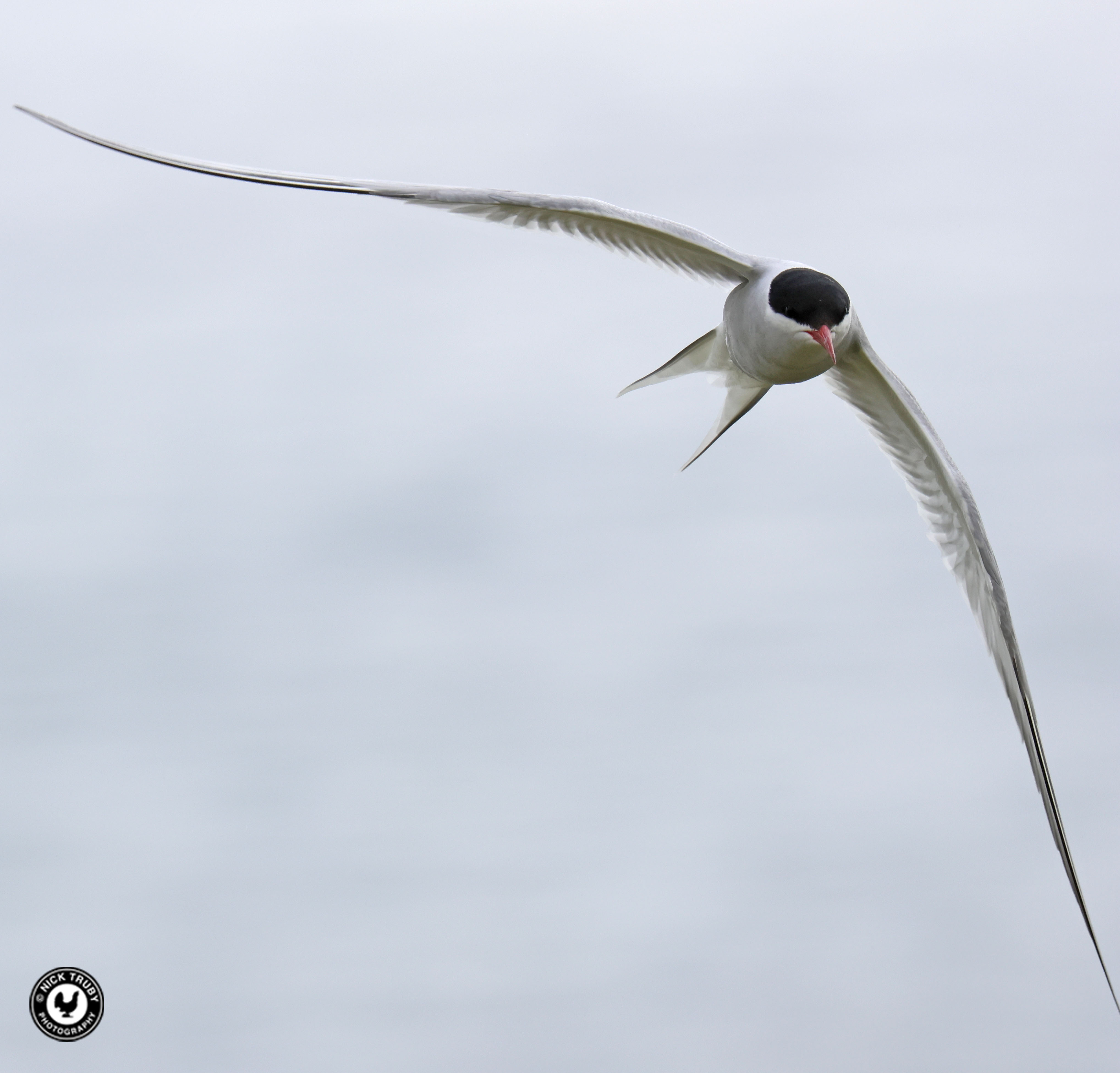
While we couldn't see the Black Tern, I watched the antics of the Arctic Terns that nest right next to the hut. I spent more time watching than photographing because I'd been here before and didn't need many more photos of the Arctic Terns. I did try to photograph one of the chicks though but that was tricky because of the grass stems and because the adults kept their offspring hidden for most of the time.


Arctic Tern (Sterna paradisaea)


Only ten minutes passed before the American Black Tern (ABT) flew into view again. Once more from our right as we looked eastwards towards the sea. This time the Tern put on a display for a good few minutes, flying up and down over the colony and affording extremely good views. It took me a while but eventually I began to tune in with the camera and gain some better photos, although still not as good as they should have been. We were generally viewing the bird against the light. The Tern rewarded my efforts by flying straight out to sea!


We were joined at the viewpoint by one of the volunteers who do a sterling job in looking after the colony. When we here last year we witnessed at first hand the efforts they put in to protecting the nesting Terns when two volunteers had to drive off an unwanted incursion onto the estuary by four people and two dogs. There is plenty of signage on both sides of the Long Nanny burn to indicate to folk that they should stay out of the area and yet some still choose to ignore the warnings. Maybe they couldn't read. I gladly added a few quid to the donation box. 

It had been twenty minutes since the ABT had flown out to sea. We heard it before we saw it flying in from the south, the direction it always appears from. It announced its return by uttering its toy-trumpet bi-syllabic call. I thought it translated a bit like, 'I'm here, I'm here!' When the bird flew past we could see that it was carrying a fish, it continued, 'Got fish, got fish!'


The Tern continued to fly back and forth above the dunes and frequently flew right past the wardens hut and sometimes right over it. It continued to call so even if it couldn't be seen we knew where it was and if it was coming towards us. The subtle differences of the plumage between the American and European Black Terns is discussed and summarised brilliantly in a BirdGuides article here but essentially the ABT is "blacker" throughout its body and that contrasts more with the paler wings, particularly the underwing. The ABT also has a white leading edge to the wings which is very noticeable.


Apparently this is the fourth summer that the ABT has spent in the Long Nanny Tern colony, for the first two years it had been reported as a European Black Tern, which would be a rare enough occurrence in itself. Plenty of Black Terns are seen in the UK every spring but one staying in a potential breeding area is extremely rare and a returning bird even more so. The local birders that questioned the birds origins were right on their game!


I had fantastic views and photographic opportunities last year, this year was just as good. My only grumble was that my arm started to ache from holding the camera aloft so much! The usual exposure problems had to be overcome, and my skills aren't the best, with the jet black bird against the lighter background of the sea and sky. The best photos of birds show the eye and highlights or reflection on it but it isn't always easy to see a black eye in a black head.


My best shots were achieved when the ABT flew lower and in front of the grass which gave a darker background, allowing for more contrast. Because the bird was always flying so close to us, the background always blurred right out so the sea and sky resulted in the same grey wash.


At times the ABT passed so closely past us that my camera grabs couldn't even catch the whole bird. I guess I should have zoomed out but of course you don't get time to think about stuff like that when photographing fast moving birds.


The ABT had flown around continually for fifteen minutes, and for all of that time it had carried its fish presumably in a vain attempt to attract one of the Arctic Terns attention. At times it almost felt as if it was offering the fish to us. The call, "Got fish, got fish" continued. As the Tern approached and flew directly towards us, I took one last volley of it in head-on profile. Those shots probably just about surpassed last years efforts that can be seen here.


The American Black Tern had obviously had enough of charging around and landed in an unseen spot on the beach. I took a few more photos of Arctic Terns and headed off. We'd been on site for just about an hour. As we left other folk began to arrive so from our point of view, having the Tern to ourselves had been a big bonus. There isn't too much room at the viewpoint.




A Linnet sang heartily from one of the ropes that separate the off limits sections from the path. It's not often that I get such a close view of one of our more common and familiar birds. A little further along the sandy walkway, a Meadow Pipit also adorned the rope. Both species are present in good numbers in the dunes and coastal belt of Northumberland.


Linnet (Linaria cannabina)

Meadow Pipit (Anthus pratensis)


I paused on the way back to the car to photograph the field that the Grey-headed Lapwing graced five weeks before. Not sure why I did it but I guess it was for nostalgia. The bird was in the field beyond the cattle and we viewed from the trees on the left.


There was still time to aim the camera at some more Skylarks. It's hard to resist Skylarks when they're performing their song from on high. I've learned though that shooting them when they're high up is a waste of time. I now wait until they descend towards the ground or when they've just taken off and are in level flight.


Year List addition;

242) Little Tern, 243) American Black Tern

Monday, 8 May 2023

Three Lifers in less than a Day! Northumberland & Fife 5-6th May 2023


While we were wandering quite happily around our favourite woodland in Wales and devoid of any internet or mobile signal on May Day, an extremely rare bird had been discovered in Northumberland. We only got wind of the Grey-headed Lapwing when we stopped for a coffee near Llandovery after having had our annual fix of the special welsh woodland birds (details in another blog to come). My first reaction was, what's a Grey-headed Lapwing since it wasn't a species I could ever recall of hearing about. It was unsurprising that I didn't know of it either since it was apparently the first ever record of the species in Britain and the bird  hails from the Far East, breeding in northeast China and Japan, and wintering in India and Cambodia and places in between. My friend Jim had messaged me frequently throughout the day asking if I was on my way to Northumberland but of course I never received any until it was too late. By the time I had replied to his texts it was mid-afternoon. The next message I received from Jim had a photo of the Lapwing attached that he'd taken after he'd instantly taken a punt and gone for it!

Of course, with the Bank Holiday weekend over, it was back to work on Tuesday and I rued the gods of fate who had decreed yet again that a mega rare bird had to be found at a time when I couldn't possibly travel to see it. So for the next few days, while hourly reports of the birds presence was being announced by all of the lucky folks who did have the time to spare to go and see it, I conjured up a stock reply to anybody who asked if I would be going, and that was that it was too far away and, no I wouldn't be travelling. But the rare Lapwing became the number one thought in my skull and by Thursday evening my resolve had been completely dissolved and I hatched a plan. That plan also involved going to twitch another couple of very rare birds, a couple of Scoter ducks, that had been discovered amongst a large flock of mixed Scoters in Fife. I just had to get Mrs Caley to agree to a night away. In the end she agreed readily to the plan, concurring that with all the stress we've endured recently that a couple of days away would be just what we needed.

In the event we still took it calmly on the Friday morning, and didn't head northwards until we'd done the weekly grocery shop and sorted out a few pressing matters. By the time we were ready to hit the road at just before eight, the Grey-headed Lapwing had been reported again, and if true to its previous form it would stay in the same field all day so seeing it should be a formality although you can never take anything for granted in the birding game. When the Lapwing had first been found, it had been fairly close in on a grassy bank behind the scrapes at Low Newton-by-the-sea and Jim had managed to grab some really nice photos (see here). However, after being at the scrape again on Tuesday morning, the bird had flown off but fortunately had been rediscovered later on farmland a mile or so away at Links Farm, High Newton-by-the-sea, but the views of it there were initially from much further away. The farmer subsequently and very helpfully, granted access to a track that allowed better access to view the field that the Lapwing favoured but it was still far more distant than the original site.

The motorway traffic northbound at least was light and we made excellent progress. I chose to continue on the M1, and avoid the M18 and A1 which I detest despite it being a few miles shorter that way, in any case I knew that there were roadworks on that route. Everything was hunky-dory until we hit the mother of all rainstorms just north of Sheffield. Combined with low fog the monsoon-type conditions slowed traffic to a crawl until we emerged into lighter rain once we'd passed Leeds. Whilst there was little traffic on our side of the motorway the southbound carriageway was much busier and when we joined the A1(M) there were some lengthy queues heading south. It was of course the King's coronation weekend and I wondered if the traffic was all headed towards London for the festivities there. A stop at Wetherby services confirmed that was indeed the case, the whole site was heaving with folk clearly heading down to the capital to watch the various goings-on. I couldn't think of much else that personally I wouldn't want to do, but I guess that we all have different boats to float.

We pulled into Newton Steads carpark at half past one. We'd been here before, last May, when we visited the Long Nanny Tern colony to see an adult American Black Tern that had joined the Arctic and Little Terns for the summer there (read here). The walk along the farm track and past some very nice looking holiday cottages took ten minutes before we arrived at the designated viewing spot, a rough compound of sorts where rusty tractor parts and old sheds stood forgotten. A wall of earth had been built around the compound which gave us an elevated view over the fields. We joined just three other birders on the mounds and instantly connected with the Grey-headed Lapwing which was stood in the middle of the field exactly as it had been doing for almost three days. I erected the scope for some good views and fired off a very ropy record shot or two.

Grey-headed Lapwing (Vanellus cinereus)


I committed the cardinal sin of taking my eye off the ball (bird) when I reviewed the shots on the back of the camera and when I looked up again the bird had disappeared. Luckily the chap to our right announced that the Lapwing was flying towards us. I managed to locate it and fired off a whole volley of frames. A Rook had taken exception to it and was harrying it across the field. Luckily for us it chased the Lapwing closer and the flying bird, and consequentially a much bigger target, actually improved my chance of getting some much better photos.


After a couple of circuits of a waterlogged area about a hundred metres or so away the Grey-headed Lapwing landed by a small weed fringed pond. It was still a bit too far away for my lens to reach but Mrs Caley and I now had ample opportunity for good views through the scope. I often bemoan carrying my Swarovski ATX95 scope because its heavy and I rarely make good use of it, but on this occasion I was extremely happy that I had it (the following day I would be even happier to use it to view the Scoter flock). Now the bird was grounded again we could really enjoy an attractively plumaged bird. It was aptly named too, grey-headed described that part of the bird perfectly because its head, and neck were indeed grey! The grey top was bordered by a black breast-band and the belly was white. The upper parts were plain brown but concealed the black and white patterned wings (as shown in the flight shots) and a white tail with a broad black bar. Most striking was the long yellow legs and a yellow bill with a black tip. All in all a very distinctive looking bird and only superficially resembling our usual Northern Lapwing of which there were a couple in the same vicinity. It was much more akin to the White-tailed Lapwing that we saw last year (read here), which is also an Asian species.


The brief burst of activity was as good as we got though since the Grey-headed Lapwing decided to walk behind the rank vegetation of the scrape and was concealed from view. Over the next half hour we could only see the bird on occasion when it stretched up to reveal its head or its wings when it opened them. Many other birders were arriving and all would have to wait for the bird to show again. We had only paid for two hours parking, you need a mortgage to park for longer (the carpark is run by the National Trust after all) so by three o'clock had to consider moving on. We were rewarded by staying right to the last moment of paid for parking time when the Lapwing suddenly burst into the air and was pursued once again by Rooks. It called as it flew past but unfortunately my view was obscured by some trees. When it turned and flew back almost overhead I pointed the camera to fill my boots and nothing happened. The camera battery had chosen that exact moment to die and even though I had two spares in my pocket there was no time to change it before the Lapwing had settled down in the middle of the field again. Such is my luck sometimes!

On that note we signed out. Of course, I was happy to have seen my latest life bird, my 406th in the UK, but I will likely rue that missed opportunity of some really good flight shots for a long time to come. I tried to shrug the battery fiasco off and paused to take some photos of some captive Guinea Fowl, Peacocks and Cockerels in the farmyard. I had calmed myself by the time we'd reached the car. A few miles away in Beadnell there is a really good cafe, a nice flat-white and a slice of rocky-road would ease the pain. While enjoying those we confirmed that we'd head on into Scotland and thanks to the wonders of modern technology I was able to select and book a hotel for the night for just a reasonable outlay in Glenrothes (a name I know because there's a Glenrothes whisky although that is distilled in Rothes in Speyside and not in the town in Fife). The drive along the A1 through the borders and past Edinburgh was as good as the drive up earlier until we neared the Forth Road Bridge and encountered quite thick fog. The crossing over the bridge was distinctly surreal since we could barely see the stanchions of the structure and it almost felt as if we driving through cloud. The Best Western Balgeddie House hotel was excellent, entirely comfortable and we enjoyed a very fine meal and a couple of celebratory drinks that evening.


Year List addition; 

217) Grey-headed Lapwing (life #406)