As always when we visit the Highlands of Scotland there are a few birds that we just have to see while up there. Some of those specialities require hard work to see, not least the birds that live and breed high up on the mountains, namely Ptarmigan and Dotterel. In recent years it has become even more difficult to connect with the montane species, climate change definitely seems to be driving a decline in their numbers. But the only way you can see the two aforementioned species is to climb one of the mountains and we generally choose to take the route up Cairngorm Mountain itself since that has usually proved the most productive.
Hard on the heels of the uphill walk and longish drive of the day before which ended in disappointment when we dipped on the Short-toed Eagle, we really didn't plan to traipse up another big hill so soon. However, walks into the hills have to be undertaken with an eye on the weather and Tuesday promised to be fine and sunny while later in the week was forecast to be less settled with rain and increasing winds. Thus over breakfast we decided that we may as well go for it and make hay while the sun shone.
There is much going on at the Cairngorm Ski Centre, where you park for accessing the mountain, not least because of ongoing work to repair the funicular railway. Although the carpark itself was fairly empty, possibly because of a recently introduced parking fee, there was plenty of noise and bustle being generated from the builders compound and by various vehicles going to and fro from the road that leads from the centre to the Ptarmigan restaurant and station high up the mountain. We used to take a long walk in the direction of Ben Macdui, the highest peak in the Cairngorm range, via Cairn Lochan but abandoned that and changed to the most direct route up Cairngorm Mountain itself when the sightings of our target birds decreased on the former path. The Windy Ridge path leads steeply up from the carpark and we made our way to where the path leads away. Except that with the building work the start of the path has been moved and signage to the new access point is poor. Thus we found ourselves being berated by a construction worker who pulled up alongside us in his pickup and told us that we shouldn't be on the road. We had to walk through the mountain garden to a designated crossing point across the road to the repositioned start point to the path. A party of sixth-form students accompanied us on the early stages of the walk. They were being guided by some RSPB staff and were undertaking an ecological study of the mountain. Despite the group of students stopping frequently to study a plant or an invertebrate, they still managed to overtake us regularly. Mrs Caley and I have to get up the mountain in our own time and sometimes we feel that we'll never make it to the top but it's pleasantly surprising that even at our pace, and using the old adage of, "Putting one foot in front of the other", we will get there eventually.
 |
| Cairngorm ahoy! |
There is little of interest, bird wise, to see on the lower stages of the walk especially now with the construction work having made the area around the ski centre less appealing to Ring Ouzels. The only birds we saw in the first hour of our walk were Meadow Pipits and a lone male Red Grouse. As the Ptarmigan restaurant came into view a Wheatear appeared on the path ahead although it soon disappeared again.
 |
| Wheatear (Oenanthe oenanthe) |
The restaurant is sadly closed while the railway is being repaired but we had our own sustenance with us and we stopped with our backs to the mountain and with the full vista of the walk we'd already taken beneath us and Loch Morlich and Aviemore further away in the distance. I took some photos of the view with my mobile phone even though I knew they would be rubbish, they always are. Good landscape photography requires great skill and is another facet of the hobby that I'm hopeless at. I also don't think it's possible to realise the full effect of a place via a photo, to fully appreciate that view then you really need to be there and enjoy it for yourself.
As we unpacked our lunch, I could hear an unfamiliar, yet almost familiar, bird song. I knew it wasn't a Wheatear but couldn't quite place the song although I thought it was from a similar species, one of the other chats maybe. It took me a few minutes to track the singing bird down in the vast landscape, even seemingly bare mountain sides have lots of hiding places and noise carries a long way in the thinner air. I was surprised to find that the songster was a fine male Black Redstart, not a bird I was expecting to see on this walk. Black Redstarts do breed in the UK, usually on brownfield sites in big cities like London and Birmingham, or on large industrial sites elsewhere such as Sizewell Power Station in Suffolk. As I watched the Black Redstart, I recalled that a pair of the species bred in the Highlands a few years ago. On the continent they are typically birds of montane habitat so I guess I shouldn't have been so amazed.
 |
| Black Redstart (Phoenicurus ochruros) |
The Black Redstart flitted around the restaurant area but proved very hard to pin down for any decent photography. Our best views were achieved when it settled on one of the ski-tows and sang from there. We were joined by the RSPB guided group and I shared the sighting with them but not before testing them if they knew what the bird was that they could hear singing. To one chaps credit, he guessed correctly but only at the third attempt. The others were as baffled as I first was.


There was another bird in and around the ski-tow area, in fact there were a pair of Ring Ouzels feeding amongst the short grass and rocks. Normally Ring Ouzels can be found around the visitor centre buildings hundreds of metres below but with the ongoing construction work it appeared as if the disturbance had forced them higher up the mountain. We watched the bolder male bird hunt for his lunch as we ate ours. One very happy sixth-former was delighted to see the "Mountain Blackbird" when I pointed it out to him.
 |
| Ring Ouzel (Turdus torquatus) |
We left the restaurant area and continued on uphill. We avoided the extremely steep path that leads directly up to the top of Cairngorm and chose the more meandering path to the top via the "Maharajahs Well" instead. We have had great success in connecting with both Ptarmigan and Dotterel along that path in the past, indeed on our last walk up this way pre-covid we watched four of the latter at length (see here). On this walk though there was nothing, no Ptarmigan and no Dotterel. There has been much talk about how the warming of our planet will adversely affect our mountain birds and perhaps those forecasts of doom are now coming true. Equally though the Ptarmigan may also have been displaced by the building work and gone to other hills in the area and it may still have been too early in the summer for the Dotterel to have returned. Whichever, or whatever, is true, we would see none of those two special birds on this walk.
 |
| Mountains get steeper towards the top! |
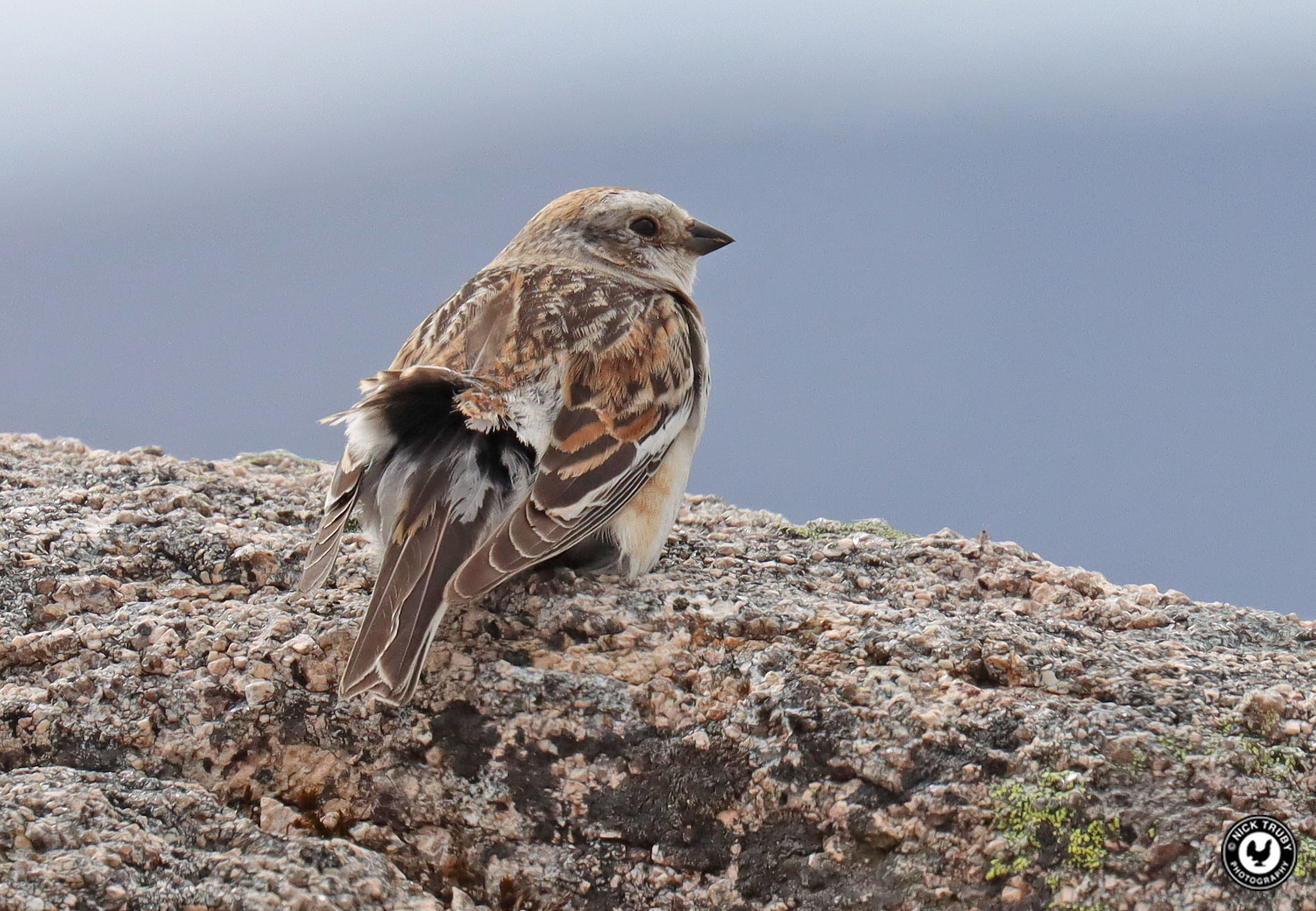
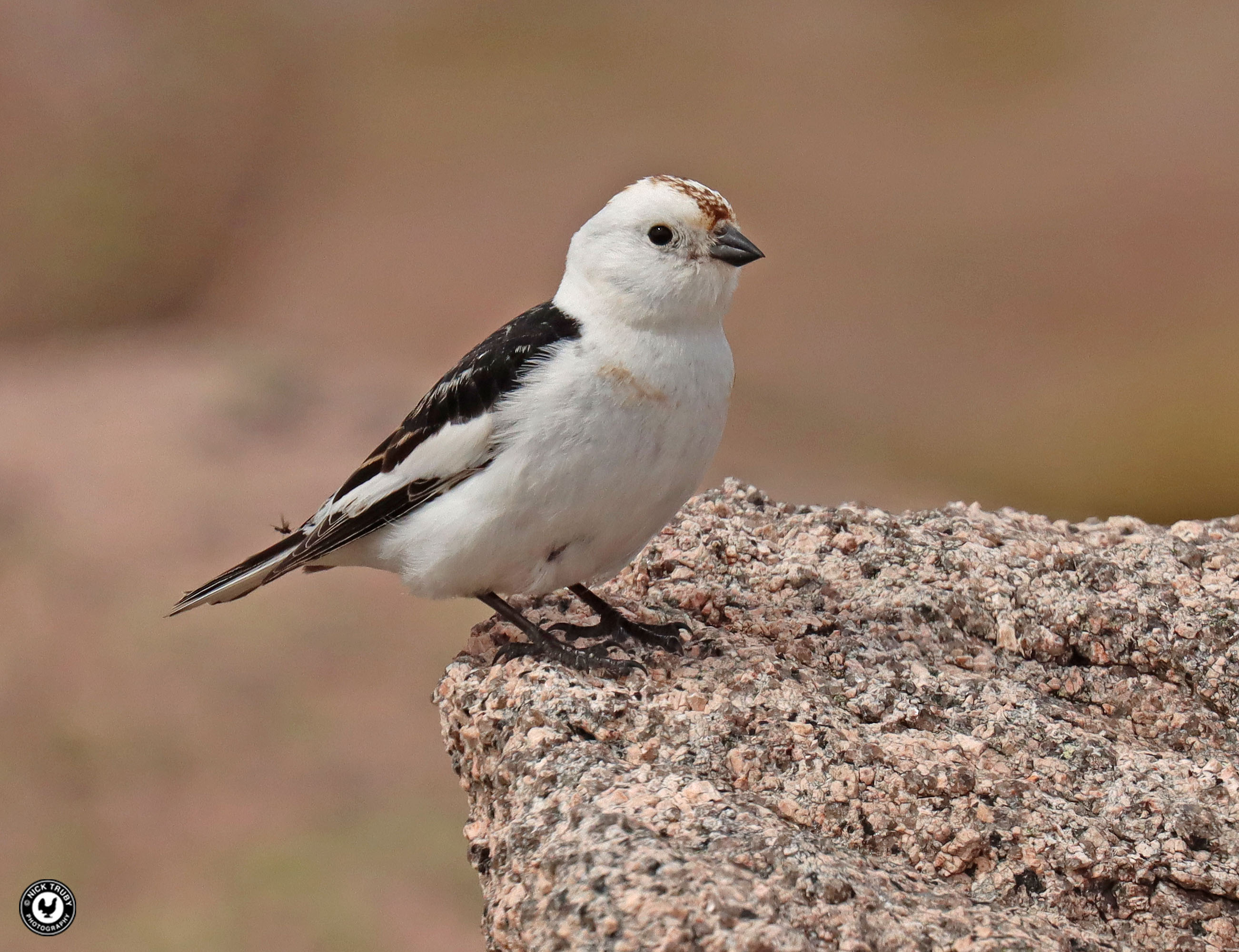
Luckily our efforts were rewarded right at the top of Cairngorm. We had settled down to enjoy our second lunch break, using the weather station as a barrier against the wind. I looked around, there was nobody else around at all which in itself was very unusual since there are usually quite a few hikers around bagging Cairngorm to add to their haul of Munro's. That newly installed parking fee and barrier must be affecting the amount of folk visiting the area. Still the tranquility is much more enjoyable. One of the birds that I had always wanted to track down for good views while in Scotland was a Snow Bunting in summer plumage. We'd seen some males in their black and white finery before, a couple on Hermaness in Shetland a long time ago still sticks in the memory, as does one that breezed past us once while walking around the Northern Corries a mile or so away from where we now sat, but none of those birds had stayed put for long enough for me to photograph. We'd seen lots of Snow Buntings during the winter, when they are easily approached on coastal headlands and beaches but those birds while still being extremely beautiful, are garbed in a more subdued non-breeding garb. So the two birds that I spotted adorning the stone cairn that marks the highest point of Cairngorm fulfilled that dream. I took a few record shots of the two birds, both were males although one was far more advanced into breeding plumage than the other.


 |
| Snow Bunting (Plectrophenax nivalis) |
The more advanced summer plumaged male was interested in what we were eating and fluttered over to peck away almost at our feet. We willingly shared the last of our bread rolls with him. We've watched a small flock of Snow Buntings at the picnic tables in the carpark in winter before so these birds are well used to supplementing the meagre offerings of the high altitudes with our scraps. I was happy to give the birds, a female had joined the male, some crumbs of comfort (groan).


Record shots secured I set about gaining some close-ups which is never a problem when photographing Snow Buntings anywhere owing to them being pretty much fearless and confiding birds. I studied the female bird first. She is decked out in subtle shades of brown, grey and white which allow it to blend in perfectly with the rocks of the mountain tops. I had a hunch that the birds were either nesting within the cairn or had intentions to nest there which is pretty amazing when one considers just how inhospitable the conditions can become at the top of Cairngorm where wind speeds can reach well over a hundred miles per hour. It really is incredible how birds as small as Snow Buntings can be in their element in such places.


In summer the male birds turn black and white for breeding, not so cryptic but still pretty well camouflaged amongst the rocks. Like the Ptarmigan they change their plumage in winter but whereas Ptarmigan acquire a white plumage so as to mimic snow cover since they remain all year round on the mountains, the Snow Bunting conversely change to a uniformly beige and brown plumage because they spend the winter near the coast and on beaches. Except for those that stay on the mountain of course which forsake a bit of camouflage for staying at home and taking the easy pickings of tourist picnics.
For the next half hour or so I took many photos of the Snow Buntings. I was extremely happy to have finally gotten my wish of seeing the species in the mountains in summer. One day I will venture up the mountains later in the summer months and hope to see some young Snow Buntings which are essentially grey birds. In all plumages, Snow Buntings are beautiful birds much admired by all birders.
We watched the three Snow Buntings flitting from rock to rock, preening, yawning, pecking at biscuit crumbs and more. I knew it was almost time to return to the carpark but I still crammed in as much photography as I could. Until some walkers came striding noisily up to the cairn almost an hour after we first arrived at the top, we'd been alone with the birds.
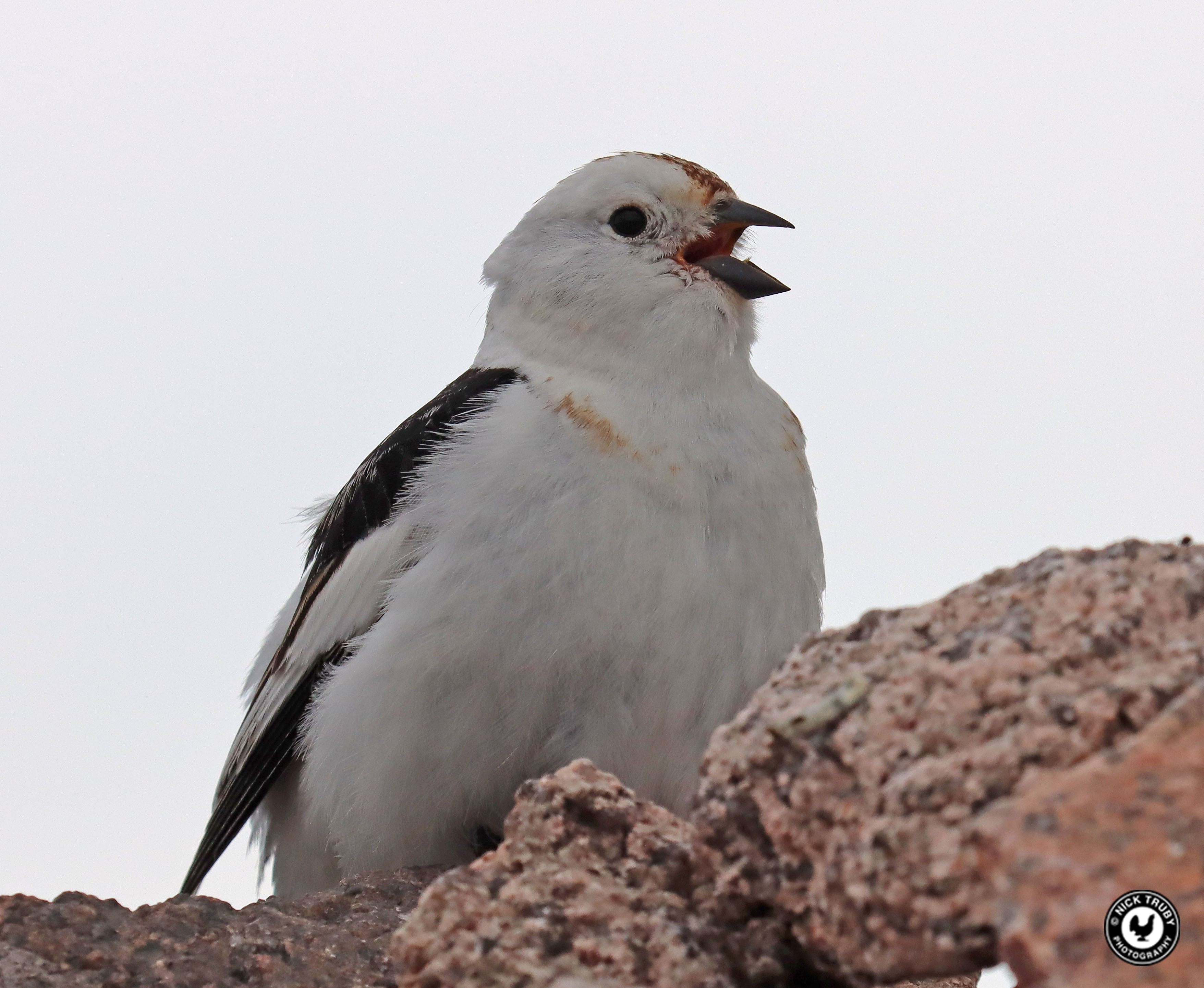
A male Snow Bunting had perched right on the top of the cairn and even when the group of walkers gathered around the stone pile it remained there, totally unfazed by the goings on around it. It was as uninterested of the tourists as it was in the small gnats that whirred around the cairn. It even began singing and when we left it was still warbling away, its clear and flutey song following us down the track as we went.


The walk up the mountain is tough going for someone as unfit as me but I'd still rather walk uphill than down since every step down jars my knees which after nearly forty years of scrabbling around on the floor in the pursuit of making a living, are not in the best of shape. Rather than descend the way we walked up we used the road to get off the mountain. This saves on the punishing drops between the steps of the Windy Ridge path but is still as hard on my knees. To make things worse this time, we have used the road several times before, the grit surface was very unstable and keeping ones footing was a task in itself. We took a breather not far below the Ptarmigan restaurant, still dreading the rest of the trip down when the same construction worker in his pickup van, who had berated us earlier for walking where we shouldn't have done, pulled up alongside. He wound his window down and I feared that we going to get another telling off. So when he shouted across and said, "Would you like a lift to the carpark?", I was gobsmacked. In an instant we were climbing into the vehicle and extremely grateful for the offer. The chap was as convivial as he was kind and we enjoyed an interesting natter on the drive down about the funicular and the reasons why it needed such extensive repairs. I often bemoan our luck but in meeting Andy that day was certainly some of the better fortune that we could have hoped for. Thank you Andy!
As is our custom we retired to the Pine Marten bar at Glenmore for a drink and some food. Slightly less tired than usual because of the lift down off the mountain and happy that we'd spent time with the lovely Snow Buntings. But, and it was a big but, we hadn't seen the target birds, Ptarmigan and Dotterel. So over our meal, we decided that we'd have to go up the hills again before our fortnight was up, and it would need to be soon. We'd just have to get our legs going again first.
Year List addition;
233) Snow Bunting