Our room in the hotel in Trearddur Bay had a balcony that overlooked the bay and we sat there in the beautiful sunny morning while waiting for the chef to get up and cook our breakfast. You can't do that in Bicester although we do have a balcony of sorts but ours doubles up as a garage roof and has a thirty degree pitch so isn't really much good for sitting out on. You'd also need a telescope the size of the Hubble to see the sea from our house. However with the first meal of the day taken care of, this really was an enjoyable few moments. Being midsummer the birdlife out on the bay was limited but we saw Sandwich Terns fishing and Oystercatchers, and a Grey Heron, feeding from the rocky islands which are supposedly a good spot for Purple Sandpipers during the winter months. At the early hour of six o'clock there were even a couple of swimmers braving the surf. I wasn't tempted into joining them, I didn't want to get the local Whale conservation groups alarmed.

I had drawn up an itinerary that would take us to a couple of very well known Anglesey birding hotspots and we were hopeful of adding quite a few species to our year list. Seabirds are very infrequent visitors to Oxfordshire so we have to go out of our way to see them. A trip to the seaside has always been an adventure for a landlocked Bicestrian such as myself so I always look forward to watching seabirds. After breakfast we drove the couple of miles to South Stack RSPB reserve and pulled into the deserted carpark. It was still only seven-thirty and in contrast to the warm conditions of the day before, it was decidedly chilly in the clifftop breeze. The birding starts immediately once outside the car in a place like South Stack. A quick scan of the sea added Gannet, Razorbill and Guillemot to the year list, the latter bringing up the 200 for the year. It took us until the 1st of August to reach that figure in the covid affected 2020 so despite being denied a holiday, or any trips to Norfolk or Cornwall, so far this year, we seem to have done pretty well. We started down the steep steps towards Ellin's Tower and a view of the seabird colonies and lighthouse. In stark contrast to home there were birds everywhere. Linnets were feeding recently fledged youngsters, Goldfinches twittered and Stonechats scolded their own young, ordering them to stay still and hidden as we passed. This was going to be a day of hundreds of photos!
 |
| Linnet |
 |
| Stonechat |
We reached the Tower and watched more Stonechats, one of which was helpfully guiding us on our way. Meadow Pipits were adorning the bracken and heather. And we had the whole site to ourselves!
 |
| Meadow Pipit |
 |
| Stonechat |
The cliffs are impressive at South Stack and the lighthouse lies at the bottom of a huge flight of stone steps. In order to get close to the breeding colonies it's necessary to take that walk down to it. We considered it for a second or two and then decided, no! Too much effort so we'd stay on the clifftops and look down on the birds that were loafing on the sea. Kittiwakes and Fulmars were quickly added to the year list but to begin with we couldn't find any of the nations favourite seabird. I prefer other birds such as Arctic Skuas and Black Guillemots, but most other folk love the Puffin and I spotted some close in right at the bottom of the cliffs below. Like most birders, I have lots of lovely Puffin photos taken in places like the Farne Islands and Skomer so didn't feel the need to take even more here and was satisfied with a few record shots to embellish this blog.
 |
| Puffin |
 |
| Puffin, Guillemots & Razorbill |
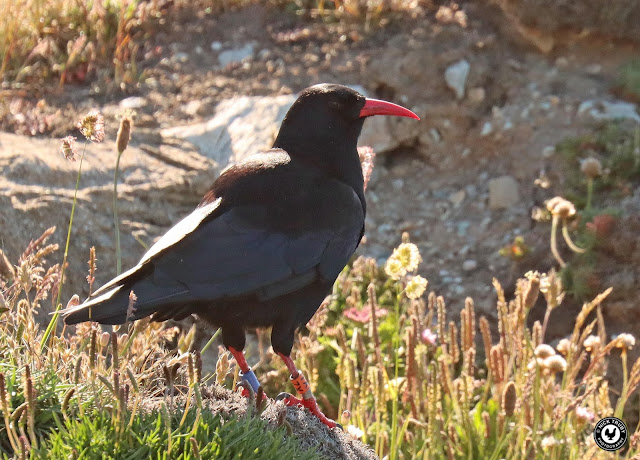
We returned up the path back to the car thinking we'd walk along the clifftop road and scan the lighthouse colonies and the northern cliffs from there. A Raven flew over and landed on a rock and Magpies cackled as they followed it. Back at the car, I scanned the land below us while Mrs Caley retrieved a bottle of water. I followed the coastal path along and right at the furthest point that I could see from where we stood was a bird that we had specifically come to South Stack to see. In fact there were five of them, a family group, I turned to Mrs Caley and shouted, "Choughs!". This meant of course, that we would now have to retrace our steps again down the steep path and back onto to the cliff edge. We did this as quickly as we could and soon came upon the Chough family. The adult birds were busy looking for food while the three juveniles stood idly on the cliff edge and shouted encouragement at their parents. Choughs are, I think, rather comical looking members of the Crow family (or Corvids for the initiated) with a curved bright red bill and matching red legs and feet. The juveniles have a shorter but still curved yellowish-orange bill and feet and their "Chow, chow" calls are higher pitched. The sleek silky black plumage of the adults isn't quite matched by the juveniles whose feathers have a more scaly appearance. We were able to take a seat on a conveniently placed bench and watch the Choughs at length.



 |
| Chough |
The two adult birds and a couple of the youngsters suddenly flew off down the cliff leaving just one fledgling behind. By the calls the other four birds weren't far away but had gone out of view so we were left with just the one juvenile to study. It didn't seem at all bothered by our presence and in fact bounced along the cliff edge until it was just a few metres away. We had never seen young Choughs before so to get such a good look at them was a very appreciated first. Of all of our Crow species, the Chough is the rarest and is a very localised species. They invariably nest and live right on the coast frequenting high cliffs and sea-caves and using short cropped cliff top fields and vegetation on which to feed. Thankfully they are expanding their numbers and range and are now found in the south-west of England, Wales, Northern Ireland and a few Scottish Islands. I took a few shots of the young Chough stood in front of us and actually did a "David Bailey" by altering my own position and shuffling along the dusty cliff edge to engineer different backgrounds to the bird. I still contend that I'm not really a Togger though!


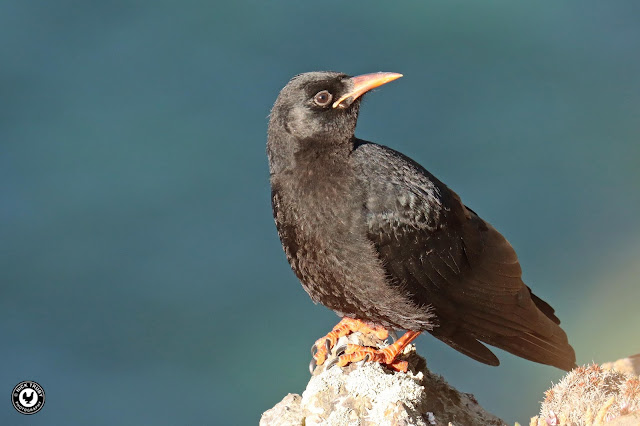 |
| juvenile Chough
|
After some time the young Chough dropped down off the cliff edge, "Chowing" as it did so, and rejoined the rest of its family. I followed it as best as I could but then my attention was captured by another species of Crow, a Hooded Crow that was stood atop a rock just a little further along the path. We had known that this "Hoodie" had been seen at South Stack for a few days but hadn't really expected to find it since reports of it were very random but here it was. I laughed out loud because I couldn't believe our luck. The Hooded Crow was our 205th species of the year and a big bonus. Usually we'd have go to Northern Scotland to see Hooded Crows where they replace the Carrion Crow as the dominant species. Hooded Crows are also the resident Corvid species of Ireland where the Carrion version is as unusual as this Hoodie was at Anglesey so it seemed reasonable to suppose that this bird had come from across the Irish Sea rather than from further north.
 |
| Hooded Crow |
I had only rattled off a few shots before the Hooded Crow flew past us but luckily it landed on the cliff edge again for a while so I had another chance to take a few more. Hooded Crows manage to look both handsome, with a grey body contrasting with a black head, shawl, wings and tail, and yet menacing at the same time. They are pugnacious too and I recall watching a couple of them escort a White-tailed Eagle out of their territory while I drank a pint at the Stein Inn on Waternish, Skye. The Hoodie spied us warily and bellowed out its harsh "Krahh, kraah" calls.

A third species of Corvid (the fifth of the day already) was also present in the same small patch of clifftop, with a couple of inquisitive and mischievous Jackdaws strutting along just metres away. Jackdaws are common birds of just about everywhere but love the cliffs just as much as the Choughs and large flocks will be seen in every clifftop locality. They are also the most approachable of our Crow species. Actually it's the other way around and they are the species that are most likely to approach us, the birds we watched as we sat on the bench walked straight past at less than six feet distance!
 |
| Jackdaw |
We started on our way back to the car. The Hooded Crow landed very briefly on the same rock as before allowing me to get another atmospheric shot or two before it flew back towards the Range, another part of the reserve where there are more seabird colonies. We had been very lucky to get such good views of the Hoodie, although it had been seen regularly, most sightings had only been of the bird in flight as it passed the cliffs.

The last time we visited South Stack, in March 2017 we watched recently arrived Wheatears as we walked along the cliff path. Today the main interest, other than the Corvids and seabirds, were Stonechats which were literally everywhere. Stonechats are a birders and photographers dream owing to their propensity to be fearless and to perch so openly. I counted at least ten in the few hundred yards walk back to Ellin's Tower. Interestingly all of the Stonechats were males and all adopted the same pose! Even though I have zillions of Stonechat photos, they are hard to resist so I now have a few more in the portfolio.


At Ellin's Tower we found another expected year tick when two Rock Pipits flew around the cliff top. We waited for a few minutes for the birds to settle which they duly did. It seems incredible that we were over halfway through the year before adding the species to our year list but then we hadn't until now been to any suitable habitat for them. The Rock Pipits, busily feeding and chasing each other, were the 206th bird on that year list.
 |
| Rock Pipit |
The carpark was filling up, it was just past ten o'clock, and the noise of people and dogs filled the air that previously had only contained the calls of seabirds. We'd had a fabulous couple of hours, blissfully alone together (get in there!) and in a fantastic setting too. When the people come out then we tend to leave, and besides we had other places to go and other birds on our hit list. We did linger overlooking the lighthouse and seabirds again and I watched a couple of other photographers that were taking photos of the same Linnet and Stonechat families that I had earlier. Watching other birders and toggers gives me an insight into what I must look like when I'm in full birder-togger mode. I wondered if the couple I saw now are as happy (or as disappointed) with their end results as I am. They were so engrossed with the finches and chats that they failed to react when the call of a Chough came echoing around the cliffs. I was ready though and grabbed a couple of flight shots as an adult Chough passed by.

We were bound for Cemlyn Lagoon where there is a large colony of breeding Terns of several species. I'd heard and read a lot about Cemlyn although had never visited before. The main colony consists of Sandwich Terns but there would also be Common and Arctic Terns to see. None of those would be new for the year but in recent days a scarce visiting Tern had shown up in amongst the colony in the form of a Roseate Tern, and I already knew that it was still present. We'd usually see Roseate Terns in Northumberland, at Coquet Island or on the Farne Islands, but we'd not been able to get there for a couple of years now (apart from a day trip twitch to see an Asian Desert Warbler last year). In fact just earlier in the week three Roseate Terns had pitched up at Cemlyn but as far as I knew just the one had remained. It had been associating with a Common Tern and had been pretty much resident for the past few days. We had plans to grab a coffee and some food at a nearby cafe so were disappointed to discover that the "Jam Factory" had closed down, another victim it seems of the pandemic. Anglesey it appears has suffered badly during the various lockdowns and it is now hard to find anywhere for sustenance away from the main tourist areas (which we avoid like the plague). So it was sandwiches and bottled water from a filling station instead and we looked forward even more eagerly to our evening meal.
There are two carparks at Cemlyn, one at each end of the shingle (and large flat pebbles) beach. We chose the closer, obviously, western area and joined a surprising number of fellow birders. Up until arriving at Cemlyn we hadn't seen any other birders apart from the few at South Stack so I guessed that the Roseate Tern was proving quite a draw to local birders as well as us. Apparently the carpark and the small access concrete bridge can disappear under water under high tides which was also surprising since during our time there, the sea was well out in the bay and far below the level we stood at but as we all know the sea is a powerful thing. It was a lovely sunny day still but the temperature, as we trudged through the shifting pebbles to gain the viewpoint to the Terns, was considerably chillier than it had been earlier at South Stack.
The sky ahead and around us was full of Terns either flying out to sea or returning to nests on one of the small islands. The noise was fantastic, loud happy shrieks filled the air as each returning bird located its partner with a loud "hello" and was greeted similarly. To begin with it was difficult to know which way to look since the birds were everywhere, there must be a thousand birds or more in the colony but we had decided to find and see the Roseate first and then settle in to watch the Terns at length and for me to take photos. Sometimes I like to find birds myself, on other occasions it doesn't hurt to ask somebody, particularly if it looks as if it may be difficult to locate the target bird. When confronted by a lot of very similar looking birds, and to save time, I approached the warden who was stood opposite the main island and asked as to the whereabouts of the Roseate Tern. The answer was slightly disconcerting when he told me that he could have told me a few minutes ago but, just before we got there, the Roseate had flown off!
Normally news like that would have me cursing my luck (and feeling sorry for myself) but a quick chat helped to ease my fears since it seemed that the birds absence would only be temporary. Having spoken to the warden I now knew where to look for the Roseate Tern, right at the left end of the island as I viewed it. Two minutes later the bird flew back in and settled down in the exact spot. The Roseate was our 207th bird of the year and our 5th Tern species in less than 24 hours. Heat haze was a big problem, it was now past midday so my initial (or later) photos weren't great but I was delighted nonetheless. The Roseate Tern did indeed appear paired up with a Common Tern and they had been seen copulating on previous days which proved that the Rosy was a female. She was also ringed on her right leg so would have come from one of the monitored colonies, probably in Ireland where they breed in good numbers. Roseate Terns are slightly smaller than the similar looking Common and Arctic Terns but differ in having a shorter and all black bill (base is red when in full breeding mode), longer and bright red legs, a very light grey back and mantle and a rosy blush to the breast. In flight they appear more compact, with shorter wings but with long tail streamers and have quicker wing beats although a bit of practise is required to "get ones eye in" in order to distinguish then compared to the other Terns.


 |
| Roseate Tern |
The large rocks that edge the islands provide a useful resting spot for the Terns, and comparisons between species can be drawn and the species separated. The non-breeding birds congregate on the stones as well.
 |
| L-R, 1st summer Arctic Terns, adult Common Tern & adult Arctic Tern |
Terns are dynamic birds, masters of flight so it was the birds pouring overhead that grabbed my attention. I've spent many a happy hour watching and photographing Terns in flight and with the Roseate on the list I turned my attention skywards. Sandwich Terns are the most numerous species at Cemlyn and provide great entertainment as they fly over. They leave the colony empty billed, shrieking a goodbye as they go, return with a Sand-eel or other fish firmly snared in the bill and rejoin their mate and chicks at the nest with more shrieking. I took hundreds of photos of them!
 |
| Sandwich Tern |
Trying to anticipate the flight path of the incoming Terns was fairly easy since they fly directly into the colony. The problem was is that they hurtle in at great speed so keeping the camera focussed was far from easy. The sheer number of incoming birds, reminiscent of a swarm of insects whooshing past, made it tricky to actually select an individual bird to track. The Terns themselves didn't have it easy either since once back at the lagoon many had to run the gauntlet of several Black-headed Gulls that were keen to relieve them of their catch. It is such a fantastic spectacle that at times I just let the camera hang idle and allowed myself to be marvelled by the birds. It really was an enthralling event to behold, an extravaganza that I'd never experienced before and definitely one that I want to enjoy again one day.


I turned my attention to the Common and Arctic Terns that also were busy flying sorties in and out of the lagoon. Unlike the Sandwich Terns which flew quite high overhead, the smaller Terns would fly out at low altitude, skimming just above the pebbles and fly back in even faster. After a while of taking blurry photo after blurry photo, I decided to lay low on the pebbles and photograph the birds from a prone position which put them against the blue sky and thus easier to capture, which probably caused a few other folk present to wonder why a Seal had hauled so far up the shingle beach. It was uncomfortable laying on the ever moving disc shaped stones but at least I was now able to take some better photos of both Common and Arctic Terns.
 |
| Arctic Tern |
 |
| Common Tern |
While I was engrossed in the Tern bonanza (two words ending in "za" in the same blog, ha!), Mrs Caley was actually doing some proper birdwatching and alerted me with, "I've got a Merganser and it's heading this way". Sure enough a female Red-breasted Merganser, #208 for the year, was swimming lazily towards and then through the Tern colony. Any images taken of birds on the lagoon were severely hamstrung by the heat shimmer though so my photos did the duck no justice whatsoever but you can just about see the transient features.
 |
| Red-breasted Merganser (female) |
Shortly after Mrs Caley decided that she'd had enough of the biting cold wind and retreated back to the car, can't say I blamed her either, despite the sunshine it was perishing at times. This, of course, put me on borrowed time so I concentrated on the Roseate Tern once more. The Rosy, along with its Common Tern "mate" could always be found right at the extreme end of the main island, only moving when knocked out of the way by the larger Black-headed Gull chicks or when flying up with the rest of the Terns when a Herring Gull flew too closely over the island. As with the Little Terns the day before, the sight of hundreds of Terns trying to ward off a potential predator is amazing, and the massed accompanying shrieking equally so. It just doesn't capture too well on photos so I didn't bother trying but watched instead. I didn't see any Gull take any chicks. After a few of the chaotic aerial fly arounds I became adept, to a fashion, at tracking the Roseate Tern. Once familiar with its different flight action and appearance it became relatively easy to follow it amongst the other birds. I couldn't do anything about the heat haze.
 |
| Roseate & Common Tern "pair" |
It was time to go, I'd been at Cemlyn for nearly two hours and there was still other birds to find plus lunch would be a good idea. It took me a long time to walk back the quarter of a mile though, not because of the ever moving pebbles into which you sink a bit with every step, but because I just couldn't resist taking more photos of the Sandwich Terns. Usually when presented with a full hand of Terns to photograph, I tend to ignore the larger "Sarnies" but here it's just impossible to resist them. They pass by so closely and appear oblivious to the people stood watching them. And they are very beautiful!
Back at the carpark, I watched Sandwich Terns bathing in a smaller pond. After taking a dip the birds would always fly straight out to sea and never into the nesting area. I guess they need to rid themselves of the flies and parasites that also make the Tern colonies their home and that diving for fish requires feathers in pristine condition.

It took us a while to vacate the carpark after one of the modern day scourge of tourist areas, a mobile home, became a vey immobile obstacle when its driver didn't manage to reverse down the narrow lane particularly well and got temporarily stuck. Eventually he did turn the van around and we were able to follow, turning the other way rather than follow him at a T-junction, even though we had no idea which way we were going, but at least we were going! We couldn't find anywhere for lunch and had to suffice with a garden centre cafe coffee and cake instead. After a previous visit some years ago, we knew of a place on the east coast of Anglesey where non-breeding Eiders remain all summer so we headed towards Penmon Point. What we had forgotten is that the site of an old monastery also lies on a Toll Road and we were asked to part with a princely sum of money to enter. I really don't like paying for parking or driving along a half mile stretch of road just to make somebody else richer so promptly turned around and decided that we'd see Eiders somewhere else later in the year (bah, humbug!). On our way out we stopped in a lay-by that overlooked the Menai Strait and checked the birds on the beach. I spotted Oystercatchers and Shelducks but Mrs Caley came up trumps once again when she directed me to a small raft of Ducks further along the shoreline. She had found some Eiders, such a clever woman is my wife! There was a carpark almost opposite where the Eiders were loafing at the mouth of a small stream so we drove around and parked there. The Eiders were distant and the heat haze worse than at Cemlyn earlier but a record shot of our 209th species for the year was obtained.
 |
| Eiders |
We'd had enough so headed back to the hotel (where later we'd have a very unsatisfactory meal only livened up by a fire alarm which was probably set off by the chef burning our food). On the drive back a Jay flew across the road, nothing too surprising in that, but I reckon it was the first time that we'd ever seen 8 species of Corvid in one day. The wonder of Wales indeed!


