Tuesday, 15 February 2022

End of January 2022; Hawfinches, a Grey Dip, Beans and a Queen!


Friday28th January; Chocolate Box Birding!

Just before Christmas a small flock of Hawfinches had been discovered and reported via the Bird News Services in North Oxfordshire frequenting trees in a couple of neighbouring villages close to Banbury. The birds proved to be very elusive and despite being searched for on subsequent days by several local birders, including ourselves, nobody was able to pin them down. Fast forward to the end of January when intrepid local birder, Mike Pollard, found presumably the same flock feeding in Yew trees in Great Tew, around five miles away from the original sightings. Great Tew is a quintessentially English village with charming cottages, a huge Manor House with vast gardens and country estate and locally famous (and very expensive) pub and cafe. It is usually a very popular place for American tourists to visit and the village can become very busy, particularly in the summer, but tourism is very muted owing to the pandemic so for the time being the village is reasonably quiet and undisturbed.

Our quest to see the Hawfinches began on Friday morning. We knew where Mike had seen the birds although he had said that they were very mobile and I know Great Tew quite well having worked there a few times over the years. Our home is only fourteen miles away, about twenty-five minutes by road. We planned on stopping at a pub in another village on the way that from experience produces excellent breakfasts but incredibly as we walked into the pub at 09:15 we were told that they were full! So with no other viable local options available, we thought we'd try the Great Tew village cafe. As with many "posh" cafes these days, the Quince & Clover offered what I think of as "weird" food for breakfast and wasn't really to my taste, I'm far from posh and don't see the problem with a "proper" breakfast and to my mind, Avocado and Broccoli shouldn't be on any breakfast plate but maybe that's the dinosaur in me. The coffee was excellent but maybe something stronger should be offered to relieve the shock at the size of the bill which was as heavy as the ones possessed by the Hawfinches!

A couple of other birders were also on site and we said a few hello's as we wandered around the village. Every tree was scrutinised for any bird that looked like a Hawfinch but the only ones that we saw were flyover birds, first two then a single and finally three birds. None of them settled although I did see the lone bird fly up from a tree as soon as I spotted it. 


Later in the afternoon we made a quick visit to our local wetlands reserve and managed to conjure up our first Green Sandpiper of the year.

Year List additions;

122) Greenfinch, 123) Hawfinch, 124) Green Sandpiper

Saturday29th January; Another Dippy Dippy Shrike!

We had spent Saturday dipping a Great Grey Shrike close to Cambridge but went on to "save the day" by getting some fine views of a small group of nine Tundra Bean Geese at Welney WWT in the afternoon, all in some very blustery weather. A fine Merlin also helped to ease the disappointment at missing out on yet another Great Grey Shrike which must be the species that we dip the most and far more often than we don't. They are difficult birds to pin down. The Shrike had been present since November and had shown virtually every day until Saturday when it was nowhere to be seen and of course it turned up again in the same place the next day. That is so typical!

Welney doesn't quite have the allure of Slimbridge, it lacks the variety of habitat and consequently the spread of birds that the flagship reserve has, but is still a great place to visit. We've seen a singing Bluethroat and a Pallid Harrier at Welney in the past so it holds many good birding memories. The nine Tundra Bean Geese were resting sleepily on the main island when we arrived in very windy weather mid-afternoon. Fortunately a couple of them awoke and went for a quick paddle and drink allowing some good reference points to be taken.

sleepy Tundra Bean Geese


To rouse the rest of the flock though needed a close flyby by a Marsh Harrier although the Geese were big enough to stand (or sit) their ground. It took a helicopter flying over to get the Geese to leave their slumber and fly off.


Welney is of course a hugely vital staging post for thousands of waterbirds and we enjoyed good views of them all, not as close as you can at Slimbridge perhaps but nice all the same. The only slight disappointment was missing out on a Barn Owl, too windy maybe for them to fly early, but that's par for the course for us recently, after seeing all of our resident Owl species in the first fortnight last year, this time around we are struggling. We did see a Short-eared Owl but that was hunting very distantly on the far side of the floods.


By contrast our friends Kyle and Kev had spent some time chasing the Hawfinches on Saturday and despite having the same trouble in pinning them down as we had the day before, they had at least had the good fortune to see one feeding in a Yew tree that enabled Kyle to get some really nice photos (see them at Birdwatch Britannia). My pique was reignited for the next day!

Year List additions;

126) Grey Partridge, 127) Tundra Bean Goose, 128) Merlin

Sunday30th January; More Finches!

So, fired up by their success, Mrs Caley and I returned to Great Tew early on Sunday morning. We parked up in the same place, this time the road was devoid of cars and we had the run of the place to ourselves. We had left the car for less than a minute and walked less than ten metres from it when a Hawfinch flew out from the hedge on our left and alighted in a Bramble on the other side of the road. It then briefly flew into a tree above the Yews by the car. Although it was still very gloomy, it was only just eight o'clock, I managed to grab a couple of half-decent record shots.


The Hawfinch departed but other birds were around to keep us occupied, especially a Goldcrest that was working its way through a beech hedge by the path. The tiny little sprite was animated too and was regularly "flaring" its orange-red crest feathers, which briefly had me thinking that I'd found a Firecrest. It was a Goldcrest however, and we followed it as it fervently hunted its microscopic insect breakfast. 


I thought I saw a Hawfinch fly into one of the Yews so we decided to return to the car and watch from within it. A vehicle acts as a good hide especially if birds are as close to a road such as these promised to be. We were helped by the sun bursting forth from behind the up to now heavy clouds and even if the Yews remained in shade the grassy bank on which they stood were suddenly illuminated. There was no obvious sign of any Hawfinches but other birds were on hand to entertain. The two smallest Yews were being guarded by a pair of Mistle Thrushes although they were as furtive as the Hawfinches. Woe betide any other Thrush species that ventured into those trees. Redwings were particularly dealt with aggressively by the Mistle Thrushes but that animosity was also extended towards Blackbirds and Song Thrushes, and to a lesser extent to Greenfinches too. Song Thrushes knew their place, and that was on the ground beneath the trees.


A female Bullfinch appeared on a small Bramble bush behind the trees and commenced nibbling away at shrivelled up Blackberries to extract the seeds. Bullfinches are messy eaters but that bill wasn't developed for decoration but for dealing with hard seeds and stones and the fleshy pulp of the berries isn't the part that the bird wants. Hawfinches, that have even bigger and more powerful bills than Bullfinches, are similarly untidy diners.


The female Bullfinch was joined at the banquet by the more brightly male although he seemed to be less interested in eating. Bullfinches are many peoples favourite birds, they bring a taste of the exotic into many gardens and when lit up by the low winter sun they look stunning!


Mrs Caley noticed some movement in the darkest part of the shadiest Yew tree. The bird responsible for the movement took some finding but there secreted within the tree and very difficult to see behind the fronds was a male Hawfinch. Taking a photo of the bird was even more tricky, not only because it was so dark in the confines of the tree but locating the bird in the viewfinder was almost a task too far. When I did eventually get on it I thought that I was just seeing its face between the needles and yet the edited image shows almost the whole bird proving just how well the bird blends into its habitat. Hawfinches are much easier to observe when they perch high up in the surrounding trees.


Fifteen minutes later I noticed some more movement on a branch that extended out towards the lighter side of the Yew but it was still shaded by overhanging and taller trees behind. It was another Hawfinch, this time a slightly more muted plumaged female, that was moving very gingerly through the branches. It settled almost in full view giving me a good chance at a few better shots. Unfortunately I had the same problems as before with locating the bird through the viewfinder and then actually focussing on it (which I failed to do). How I wished that I'd get a similar opportunity with a bird in full sunshine and not hidden away in the shade.


Monday31st January; Just Can't Get Enough & A King (Queen)

I had yet another day off so we headed back to Great Tew once more to have another go at claiming a good view of one or more of the Hawfinches. We resolutely stayed in the car this time, partly because of the blustery wind and associated rainy squalls but also to maximise our chances of seeing without disturbing any Hawfinches. That weather put paid to any chance of getting those decent views although I did find a Hawfinch feeding very quietly tucked away within the often violently shaking branches of one of the Yews.
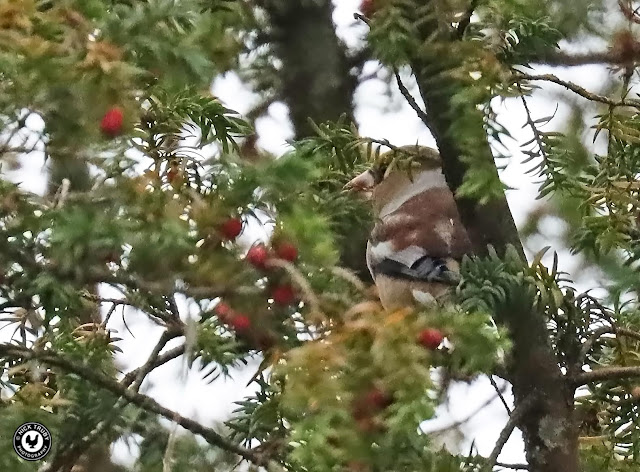


More violence was exhibited by the resident Mistle Thrushes which were even more protective than before and just about every other bird than the Hawfinch were ousted in some style by them. Being larger the Mistle Thrushes were able to cling on to the outer branches more easily and posed more readily for photos. But what I really wanted was for a Hawfinch to pose that openly and I guess that Hawfinches just don't do that, certainly not for me anyway.


There was no further sign of the Hawfinches although a few Greenfinches and other smaller birds ran the gauntlet of the Mistle Thrushes. The greenfinches were quite difficult to pick out amongst the similarly coloured Yew leaves.


We stopped for a coffee at Yarnton on our way through to Oxford where I wanted to have another go at photographing the Kingfisher there. The week before I'd not been able to see the female Kingfisher, distinguished by having a red lower mandible to the bill as opposed to the all black bill of the male, at all since she had flown off before I knew what was happening. This time, given the opportunity I would exercise a bit more fieldcraft and hopefully do better. On arriving at the carpark, I instantly spied the female Kingfisher perched in a similar place as before. This time though I was keen not to frighten her off so exited the car carefully. Unfortunately she wasn't perched in a very accessible spot and the shots were obscured by many small branches. Then to compound the problem a large dog went bounding straight down the bank and into the water right next to the favoured, now vacated branch since the Kingfisher had unsurprisingly fled downstream. Birding in urban environments has many interruptions, not least having to answer the inevitable question of, "What are you looking at?". "Nothing as it happens, thanks to your dog!"


I sat in the car with Mrs Caley enjoying the warm rays of sunshine that had replaced the earlier inclement weather and wondered whether it would be worth returning to Great Tew again but I felt that it was probably only a temporary lull in a cycle of more rain to come. I also felt sure that the Queen-fisher would come back to her favourite fishing spot as soon as she felt the coast was clear and it was safe again. A few minutes later I looked back towards the river and noticed that she was indeed perched there again. Kingfishers usually fly close to the water surface so it had managed to steal back in without me noticing. It had also obligingly chosen a less cluttered branch. I had also had the foresight to keep the camera on my person so didn't have to leave the car to photograph the bird which was only fifteen feet away. 
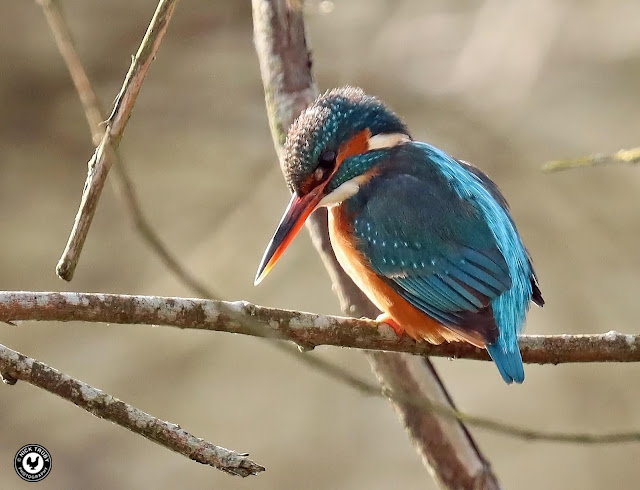


The female Kingfisher then obliged me even more by diving in after a fish. I didn't see the actual entry into the water because I was constrained by the car and my view was restricted but she did pop onto a partly submerged log in which to devour her catch. Images were difficult to get owing to me having to lean partly out of the car window to take the shots and hence they weren't my best.


When the (Queen) Kingfisher flew up to a higher branch to scour for its next fish it was obscured by more branches again. I didn't want to disturb it so moved the car away before getting out and finding myself a better angle for a few more photos. My fun didn't last too long though when the bird was once again put to flight, this time by an over enthusiastic couple who wanted some smoochy selfies next to the river. Like I said, there are many disruptions when urban birding.


Thursday3rd February; Score Finches!

I have been working just a few miles from the Hawfinches and had popped in a few times on my way to and from the site. I don't take my birding kit to work however, the temptations to skive off would be far too great, so had to make do with my old (and first) pair of Kowa binoculars which were never that good and certainly no comparison to the expensive ones that I use these days. I met a few of my birding friends there through the week and all had enjoyed some views of the Hawfinches. On Thursday Mike, the original finder of the birds had reported more than twenty of the birds centred in and around the church area, a spot that I had neglected to look at myself so far. I finished work at lunchtime and walked through the churchyard scanning the skies, the tall trees and the many Yews that grew there. A flock of around fifteen Hawfinches flew over my head and alighted in one of the tall trees. I had cracking views though they were poor through the rudimentary "work" bins. I should really invest in a better pair to keep in the van. And of course I had no camera. Thankfully there would be time for me to return home and collect my gear and Mrs Caley and return by three o'clock.

Mrs Caley thought better of it so it was just me. I was alone at the church too because the other birders that had been present earlier had left. Unfortunately there was no sign of any Hawfinches either, in the hour or so I'd been gone the birds had seemingly shipped out as well. I wandered around for a while and then remembered that Mike had said that he'd had really good views of several Hawfinches in a pair of Yews within the estate grounds but which could only be seen from the Ledwell Road. I walked around to the spot and peered over the six-foot high wall that protects the garden from oiks like me. The two trees, set amongst many other ornamental trees, were around fifty-feet from the road. Luckily there is a strip of grassy verge on which to stand otherwise I'd have been taking a huge risk with the traffic trundling in and out of the very upmarket Soho Farmhouse country club just a few hundred yards away. The Yews were illuminated by the late afternoon sun but appeared empty of birds. I watched a Nuthatch peck away at a dead tree next to the Yews and then, after ten minutes or so, noticed a very pale coloured bird fluttering along the right hand Yew. It was a Hawfinch!


A few seconds later I noticed another Hawfinch. With the sunlight making the birds appear so bright there was no problem in getting some nice images this time despite the increased viewing distance. The two birds were behaving quite strangely. Instead of sitting in the Yews patiently selecting berries or seeds to eat they both energetically flew up, down and around the outer branches, only settling temporarily, as if they were flycatching, which I'm pretty sure they wouldn't have been because they are hardly built for that type of feeding.


My best guess is that the Hawfinches must have been striving to get to the ends of the wispiest branches which were then unable to sustain their weight so it was a case of snatch and grab. The birds were on view sporadically, sometimes they'd disappear into the unseen parts of the trees but over fifteen-minutes I had some nice moments to watch them and take photos. It must have been some sight to see the whole flock feeding in those Yews as Mike had done earlier that day. Then the Hawfinches flew up to the top of one of the Yews and departed back towards the church. I was happy and thrilled that I'd finally been able to get some clear views of them.


Thank you for reading the blog!


Monday, 7 February 2022

Sunday23rd January. The Specific Pacific Twitch!


Late on Saturday evening when I was already slumbering, my good mate The Early Birder called me with some news and advice. Basically he said that if I wanted to go and see the long staying Pacific Diver in South Wales then I should go soon because a new fence was being erected around the reservoir to keep unwanted folk out. Unfortunately birders were classed as some of those "persona non grata". It's a long story why birders are not welcomed into the Eglwys Nunydd Reservoir near Port Talbot and I don't have the full details of why the exclusion order was implemented in the first place but it applies even to local birders. Local people do gain access to the reservoir, which is owned by TATA Steel, a company that has huge steelworks and other factories in the Port Talbot area, but they do so by negotiating a tricky little diversion around the main gates into the site which are protected by padlocks that only members of Angling and Sailing Clubs have. TATA also employ a security firm to patrol the reservoir and they, in the case of a few unlucky birders who had visited to see the Diver before the turn of the year, have the power to evict people from the site if they are not fishing or sailing.

Mark's message was to tell me that the "back way in" was being sealed off by the erection of a new two-metre high metal fence and within a week or so there would no longer be guaranteed access by using the "cheats" entrance. Of course having gained entry still wouldn't be an assurance that you wouldn't get kicked out once inside. I had a tentative "life tick" Pacific Diver from a sighting in Penzance Bay some years ago. I say tentative because I was stood next to a local birder who informed me that the third blob from the left in a loose raft of a dozen other blobs (apparently Great Northern Divers) was a Pacific Diver. Through the scope I could see a slightly more defined blob although to my eyes still undistinguishable from any of the other blobs but I was assured by the other birder that it was the real deal even though no real discernible features could be made out other than the fact that it was a Diver and was smaller than the other attendant Divers. So it went on the list but was one of those records that was pencilled in with the faintest pencil imaginable. The South Wales Pacific Diver was found at the end of November and would show to hundreds of birders as closely as "six-feet" away but I remained unmoved especially when the horror stories of the difficulty of access and the fact that getting chucked out was a very real possibility. After all I had that tentative tick to keep. Then a few of my own peers started to post some excellent photos and write blogs of their own trips to see the bird and my own pique was reignited. A couple of weeks before we had made (tentative) plans to travel to see the Diver but a wet weather forecast had put us off. Now it seemed we had to move fast, or miss out, whatever the elements threw at us. I (tentatively) put the idea to Mrs Caley and was answered with a "no way" and "we've already been out for the day and I don't want to travel three hundred miles again, thank you" which was fair enough. The reproach didn't stop me making (tentative) plans for the following morning though, like checking the route, how long it would take to get there and the access details that I'd received from a couple of friends who had been. It was to my absolute surprise then in the morning, when Mrs Caley walked down the stairs to join me in the living room and said, "Come on then, let's go, I know you want to!".

The weather wasn't great but we were ready and on the road by seven o'clock with a two and a half hour journey ahead of us. Mark was also going and would arrive ahead of us so would update us on any problems and to where the bird was. It should be an easy twitch because the Pacific Diver had taken to feeding at the end of the reservoir closest to the entry point. When it had first been found it was at the far end so a long walk was required to get good views, the water body measures some mile and a half long by half a mile wide, about twice the size of the largest basin at Farmoor. For some reason the SatNav wanted to send us via Gloucester and the Forest of Dean, I assumed that the ongoing road improvements around Swindon had necessitated road closures on the normal route. I ignored the advice of the automated traffic assistant and made my way down to the M4 at Newbury anyway and turned right, bound for the Severn Bridge. I couldn't work out why the SatNav tried to send us off at every junction and why the remaining miles to our destination was increasing with every mile we travelled. There were no issues on the route ahead whatsoever. As we passed the A49 just before the bridge when the SatNav was suggesting a seventy mile detour around the Severn estuary it suddenly dawned on me that I'd altered the settings the day before to avoid toll roads since I didn't want to be directed on to the M6 toll on my way to Carsington Water. The SatNav therefore was trying to get me to avoid the Severn Bridge. The fact that there are no longer any tolls to pay on the Bridge and that Wales now has free entry was lost on the system since obviously nobody had told it. Therein lies a problem with a factory fitted SatNav, they don't get automatically updated from the internet as your TomTom would. So once over the bridge and the SatNav finally accepting that we wouldn't need to drive around it anymore, the miles left went from one hundred and thirty to sixty odd! 

Our next "drama" came when we were around twenty miles from Port Talbot. Mark called and incredulously said aghast, "It's gone!". "What do you mean?", I replied, "The Diver, it took off from the middle of the reservoir, flew up high and disappeared over some pylons in the distance" and again, "I'm not joking mate, it's flown off!" At first I couldn't believe what Mark had said, I'm not sure I had taken it all in. A bird that had been present for nearly two months in the same place had seemingly decided to leave on the day we'd travelled to see it. I'm glad he wasn't joking because I was failing to see any funny side of what would be one of the biggest kicks in my twitching teeth since the Thursley Common Rustic Bunting (that had been present for almost four months) did a moonlit flit the night before we were finally set free from our Lockdown chains, we had taken the very first opportunity to go and see it and arrived about eight hours too late. We needed a break for the necessities and so pulled into a service area and discussed our next move while we had a coffee. We were only fourteen miles from Margam where we'd park so we considered that we may as well continue on our way and see if the Diver had returned to the reservoir. I've seen supposedly well established birds look as if they're flying away for good before, the American Black Tern in Dorset flew off high just after we arrived to see that and disappeared but came back an hour later, and I figured that the Pacific Diver which spends the majority of its time swimming on and under water had to sometimes exercise its wing muscles to keep them in working order. So I was fairly hopeful that it'd be there when we got there. Mark called again to say that he and his mate had given up and were leaving to go and photograph a Black Redstart in Somerset!

Now for the tricky part, getting in to the reservoir! As I mentioned I was armed with precise details of where to go but of course they were written by somebody who knew where to go. Relating those directions to somebody who didn't have the foggiest where he was and getting them to act on them can be hard. Quite often when twitching, it can be initially difficult to decipher directions and many false starts are made before somebody comes along to help. On this occasion it didn't seem too difficult, if we could work out which way to go from the cemetery carpark that is. I don't approach any task lightly and had studied the aerial map of the reservoir and its surrounds many times over to get an idea of what lay ahead. But on the ground everything looked very different. We (I) managed to go off in the wrong direction twice before finally finding a gap in the hedge which would take us to a gap in some tall trees which took us to a road and to the gate where privileged folk could gain access. From there we had to find a telegraph pole, surprisingly only thirty metres from the gate, negotiate a small piece of South Wales Bayou, without Wellington Boots you would probably get swallowed up by a mud gurgling swamp monster, find and follow a concrete culvert, and then climb up a bank and go through a gate to emerge at the edge of the huge reservoir, all theoretically easy but in reality not. Oh and don't forget that while navigating our way in we had to avoid the frequent security sweeps by the TATA secret police. Phew!

Mud Gurgling Swamp Monster Habitat

The Culvert to the Pacific

Eglwys Nunydd "Pacific" Reservoir

In the event we, and another chap who had no idea where to go and who was very ill-clad in training shoes and thus ended up looking like half a mud gurgling swamp monster, made it to the reservoir almost unscathed and intact. There was no sign of the Diver but because of the news imparted by Mark earlier I had carried my scope in so I set it up and scanned the furthest end of the reservoir. The very first bird I spotted looked distinctly like the Diver shaped blob that I'd been shown in Cornwall all those years before. I squinted a bit more and pulled the scope into full zoom and yes, I was pretty sure that it was the Pacific Diver. Well, I was pretty sure it was a Diver, it definitely wasn't a Grebe, but at that distance it could have been any type of Diver and it wouldn't be right just to assume that it was the Pacific one plus we'd driven a long way to see it. So we elected to run the gauntlet of the security forces and walk around the reservoir to get a closer view and therefore a positive ID and of course decent views and photos. I made a stop and scan of the far end of the water every hundred metres or so and halfway there finally convinced myself that the bird we were looking at was indeed the one that we wanted. I phoned Mark and gave him the good news which he didn't take so well since he was already thirty miles away on his way to Somerset!

Can you see it? Nope.


Two other birders had seen us walking around the reservoir and had caught us up, most people do, and inquired if we'd seen the Diver. Nobody else had a scope so they wouldn't have been able to see the bird since it was still the best part of a mile away. I assured them that the Diver was indeed present but was right under the bank at the far end and that we'd need to get much closer to really appreciate it. We were all a bit nervous but I always think that the worse thing that can happen to you, if you're somewhere you shouldn't be, is to be asked to leave and walk back the way you've come. Unless there are big dogs (or cows) involved then you might have to run part of the way and Old Caley isn't really built for running these days. We pushed on, narrowing the visually indeterminable distance step by step. Now I was sure that the target bird was in sight I gave up scanning for it and just concentrated on getting there. I was well aware that stood up on the surrounding track above the water we were very visible not just to other folk but by the Diver as well so when we got to around fifty metres away I sat Mrs Caley down on some steps and erected the scope so that she could enjoy fine views of the bird. I intended to sneak around closer using the steep embankment for cover as I often do at my local Farmoor. Our three fellow watchers however, failed to lower their profiles and the Pacific Diver sailed slowly out further from the bank. Time to take some record shots in case it flew again.

Pacific Diver (definitely)


Before I left Mrs Caley alone with the scope, I scanned around the reservoir and was delighted to find a Slavonian Grebe, a very pleasant surprise year tick. The Grebe looked tiny set against the grey and bleak vastness of water. The last Slav we'd seen was at very close quarters at Furzton Lake in Milton Keynes just before Christmas and was our last year tick of 2021. This year we have a June holiday booked for Scotland so it'll be good to see them in their summer breeding finery again rather than the nondescript grey and white dress that all Grebe species (and Divers) sport in the winter. Slavonian grebes always have that piercing red eye though but that was hard to discern at the range we were watching this one. For just a few seconds the Grebe and the Diver met up, preened mutually and then parted ways.


Pacific Diver & Slavonian Grebe


The Pacific Diver was swimming towards the bank, presumably to resume its diving and fishing again so I took my leave and walked around the embankment, keeping my profile below the skyline. I was attempting to judge when I'd be alongside the Diver and when I thought I was I crept up the grassy bank and popped my head over the top. My first two attempts failed because the Diver must have been submerged and I couldn't see it at all until it popped up a little further along from my position. I struck third time lucky when I emerged right in line with it although it was still a fair way out. 


Using my noddle a bit more, I waited until the Diver dived under and then moved along to where I thought it would resurface. This time I'd got it spot on and a minute later was staring into the eyes of a Pacific Diver from no more than twenty-feet away. After the distant Cornish blob this was a thrilling encounter. Obviously because my head was above parapet the bird instantly became aware of my presence and quickly turned tail and swam away but I hurriedly took a few shots.


My next tactic was to walk a bit further around the reservoir and settle down on a concrete ledge that runs around the wall so that my profile would be softened against the masonry background. A Grey Wagtail flew in and landed close to me so I must have been far less visible. 


Grey Wagtail


The Pacific Diver surfaced from its latest fishing sortie, a little way off than my encounter of a few minutes ago but significantly it looked at ease this time and didn't appear to realise that I was there. Pacific Divers are essentially the North Pacific version of our more familiar Black-throated Diver but differ in a few subtle ways. In winter plumage such as this bird was in, a Pacific Diver doesn't exhibit a white flank patch that a Black-throated Diver would (in fact the white flank patch is considered diagnostic for identifying a Black-throated in winter). Other differences are so minor that good views really are necessary and luckily for the finder and for most of us who have seen the bird since, this bird has shown very well indeed. The head shape of the Pacific Diver is more rounded, the neck thicker and the bill is small, almost dainty in fact. The bird I was watching fulfilled all of these criteria.


What happened next though left me well and truly gobsmacked and grinning from ear to ear when the Diver suddenly appeared so close to me that I could have almost cuddled it! I actually jumped a little bit when the superb creature surfaced and looked directly at me but still didn't appear to register my presence. Others had said that if you get low down onto the concrete then the Diver would happily feed close into the bank with no qualms at all and how true that proved to be. I rattled off a whole volley of shots over the thirty-seconds or so that the bird was in front of me. Blob well and truly banished and that faintest of pencil entries in the life list could be permanently inked in, in the darkest ink available!


When the Diver had swum past me and dived again I didn't see the need to follow it so I just sat there and watched it from afar once again. I had had my thrill. My phone rang, it was Mark again and he asked, "Where is it then and where are you?". He had sensibly turned around and returned to the reservoir to get his photos of the Diver. Leave it to me Mark, I'll find it for you! We passed him and his mates about halfway back, check his blog for some superior photos.

The walk back to the swamp was uneventful although we did spy a police car driving down towards the sailing club. We had another unexpected year tick in the shape of a Common Sandpiper that flew rapidly, as they always do, across the reservoir as we approached. The walk back through the sticky mud seemed easier now we knew where we going and we refound the car without any trouble. I'm glad that we made the belated effort to see the Pacific Diver which when seen as closely as we had seen it, is a very fine bird indeed and certainly not just a blob!

Year List additions;

119) Pacific Diver, 120) Slavonian Grebe, 121) Common Sandpiper


21-22 January 2022; More Top Birding!


Friday21st January; Celebrity Snub

On the River Thames in Oxford where the main channel has been split into several parts so that folk with boats can navigate shallows and fast moving stretches of water, is a bridge that crosses one of the shallow sections. This is "Morse" country, until recently plagued by zillions of eager tourists who have read the books or watched the TV show, but now thankfully only blighted by thousands since international tourism isn't really a thing any more. The short stretch of river between the bridge and a weir downstream has become the well known spot, amongst local birders and photographers, for seeing a pair of Kingfishers.

I have seen lots of really excellent photos of the Kingfishers taken on the river as it winds its way through Port Meadow, the open flat grassy floodplain that provides the citizens of Oxford with a calm and tranquil space in which to jog, walk their dogs and generally enjoy whatever noisy pastime they get their pleasure from. Even birders grab some fun out there and the Meadow is a well known hotspot for scarce county bird records, most recently a wintering Dotterel was found there and before that a Pectoral Sandpiper, which incidentally was my first county record of the species. Despite the ease of access and that it's only a dozen miles from home I have hardly ever visited Port Meadow for birding although my apparent disregard for the place may need some rethinking in future. Most studies of Kingfishers are of a stationary bird perched motionless on a branch, while it waits for a fish to swim close by that it can catch. However, there is always the opportunity to capture the Kingfisher in mid-dive as it plummets towards the water, or even the moment when the bill spears the waters surface. And of course you can photograph the bird when it has a captured fish in its bill ready for consumption. Images of a diving Kingfisher are difficult to capture though, the bird doesn't dive from a great height like an Osprey would, so it is quick to hit the water once leaving its perch. It also gives no warning as to when it will dive and most fingers on camera buttons are not fast enough to react once the bird has left its perch. Hence the well known and very dubious method that some professional photographers have engineered of placing captive fish in a tank and putting that in the water, a practice that I entirely and wholeheartedly abhor, and using motion sensitive camera shutters to capture the moment. In my opinion if photography of birds can't be one hundred percent natural then what's the point? None at all to my mind.

Anyway on the Friday morning after the toils of a supermarket sweep, I made my way to the designated carpark to try my arm at gaining a good view and maybe some nice photos of my own of the celebrity Kingfisher. We parked right at the river end of the carpark, jumped out of the car and booted up, excited and hopeful of seeing the Kingfisher. Then the plans unravelled right before my eyes. As I lifted the camera strap over my head, I noticed the Kingfisher on a branch over the river no more than twenty feet away. I was not expecting that at all and maybe related the fact a bit too loudly and excitedly to Mrs Caley. As I raised the camera to take a shot, the Kingfisher turned tail and fled tootling away down river. It wouldn't have mattered anyway since I hadn't even switched the camera on! We never saw the supposedly showy female Kingfisher again that morning!

It wasn't for the lack of trying though. We walked downriver and back for a mile or so (twice) checking all the spots and perches that the Kingfisher favours (Port Meadow regular and ace photographer, Jessica had kindly supplied me with detailed info) but we never pinned her down. We did however, see a male Kingfisher but he was fishing off a mooring pontoon right over the side of the river and at one of the widest points too so there were no close frame filling views of him.

male Kingfisher


We watched from the bridge for a while, another good spot to watch from, but had to make do with an unusual view from directly above of a Grey Wagtail that was carefully doing its own fishing of a sort on a shallow ledge of the bridge supports and a plethora of Goldfinches feeding in the tops of tall trees (alders I think).

Great Wagtail


With no more luck with either Kingfisher we gave up but we'd had a nice walk on a chilly morning and I had learned a bit more about the meadow. I had also done an important recce for further visits.

Cormorant


Year List addition;

114) Kingfisher

Saturday22nd January; Red-necked Willow Tree!

We didn't make it Carsington Water the week before having been put off by the foggy weather so decided to go for it this time. At just under two hours drive away, the huge reservoir shouldn't really be on the agenda unless travelling to or back from a twitch further up north but there are special birds there that are hard to see locally. There was also the added attraction of not one but two Red-necked Grebes present, a species that I didn't see at all last year.

It was still a bit gloomy, and very cold, at eight o'clock when we parked up in the Millfields carpark. One of the Red-necked Grebes was supposed to hang out by the inlet tower close to the carpark so it should be a snip to see it. The carpark also has bird feeders where a couple of the other target birds of the day come to feed on seed. I drove around the carpark looking for the said feeders but couldn't find them at first but on my second sweep noticed them by the first parking bay that you come to! I parked up right next to them and immediately saw a couple of Tree Sparrows on one of the hanging seed feeders. Tree Sparrows have become increasingly tough to see in Oxfordshire and are thinning out in neighbouring counties too. Seeing them here will save spending time looking for them back at home although it would be far more exciting to find some there.

Tree Sparrow


We walked along the path to the reservoir, bracing the very chilly wind that whistled across the water. It's a very exposed site and always feels cold, we've only just warmed up after a visit last November to see a Snow Bunting, so we had made sure that we were well togged up. I checked the immediate part of the reservoir but only found common waterbirds plus a nice "herd" of eighteen Whooper Swans that were noisily "whooping" away to each other.

Whooper Swans


I cast the net further, and further out from the bank but still no joy. Another birder came towards us walking from the other end of the dam. He told us that both Red-necked Grebes were at the other of the reservoir and could be seen from the Lane End hide but should just about be viewable with a scope from the slight kink in the dam wall which was about half a mile from where we stood. Rather than return to the car and drive to the Sheepwash carpark and walk for half a mile to the hide we (foolishly) decided to take our chances from the dam, after all one or both of the Grebes could choose to return to the Millfields end of the reservoir. I made frequent stops as we walked along the dam and made scans of the water for the Red-necked Grebes. On one scan I found a Great Northern Diver almost out in the middle of the reservoir. After the very close views we've had recently of a juvenile GND at Farmoor, I didn't waste any time trying to gain useless images of this one. As we reached the slight bend in the dam wall, I scanned one last time and immediately set eyes on one of the Red-necked Grebes. Half a mile out but a year tick and comparable to the last one we saw at Rutland Water in 2020. I was happy to see it though, safe in the knowledge that I have some satisfactory images of the bird that spent two spells of a few weeks duration at Farmoor in 2016, once in full breeding plumage and then later in the year in winter garb as per the bird seen here.

Red-necked Grebe, Rutland 02/11/2019


Happy that we'd at least seen a Red-necked Grebe we returned to the carpark and studied the bird feeders and the trees in which they hang. The trees and feeders were now illuminated by the low winter sun so any photos that I'd take would be much better than when we first arrived. To begin with I just watched the comings and goings of the various bird species that visited the feeders. Both of the special  birds that we had hoped for were seen. Willow Tits frequently flew in to grab a seed before either flying off to the wooded areas to eat it (or cache it for later) or occasionally they ate it while still in the feeder tree. Pinning one down for photographs took a while but I succeeded in the end.


Willow Tit


Tree Sparrows were less frequent at the dining table but once there they tended to sit on the feeders for a prolonged period. By exhibiting time honoured photography snobbery, I refused to take photos of the birds eating at the feeders since I wanted shots of birds in a more natural setting, that is in the tree itself. Eventually, well after waiting for around fifteen minutes anyway, a Tree Sparrow indulged me by doing just that by perching beautifully above the feeders and I had my authentic images to take home.


While waiting for the Willow Tits and Tree Sparrows to feed there were plenty of other birds around to keep me occupied. Great, Blue, Coal and Long-tailed Tits (as many as a dozen of the latter crammed onto one nut feeder), Chaffinches and Goldfinches, a Nuthatch that stole in and out as quick as quicksilver, Blackbirds and Pied Wagtails on the ground underneath the feeders, and even a small gaggle of Mallards all fed heartily at the offerings. A few afforded some really good photo opportunities.


Long-tailed Tit

Coal Tit


I finished by photographing a couple of Willow Tits that stayed longer than most in the tree to eat the seeds that they had gathered. Getting unobstructed views was the only difficulty in obtaining easily my best ever images of our rarest breeding Tit species, other than the highly localised Crested Tit in Scotland. My thanks go out to the couple who arrived bearing more seed and nut gifts for the birds. I don't know if they fill the feeders out of their own pockets or whether they do so on behalf of the local wildlife authority but I and every other birder who visits to see the Willow Tits, Tree Sparrows and other birds that feed on the handouts owe them a huge amount of gratitude. 


We had plans to drive across country to Eyebrook reservoir near Rutland to add another scarce bird to our year list so left so that we'd have time to get there and find the birds. We found a cafe halfway and pulled in for refreshments, almost left without having any such was the poor standard of service and the time we had to wait, but still made it Eyebrook by three o'clock. There have been up to eighteen Smew at the reservoir this winter so it was surprising that it took us nearly half an hour to find any of the smart winter visiting ducks! We had had a similar problem when trying to year tick Smew at the reservoir two years ago but on that occasion it had been almost dark, today we had bright sunshine to search in. The problem was that the sun was largely against us making identification of any birds at distance tricky. Add to that the fact that Smew dive a lot so are not always on view and you may realise why I was struggling. It was only when we moved around to the opposite bank and found a gap in the hedge to view from that we found some Smew above water. Once we'd found one, others quickly followed and we ended up seeing five males and three of the very different looking females.


male (above) & female (below) Smew


The range of wildfowl on offer was well represented with Goldeneye, Pintail, Wigeon, Teal and Tufted Ducks all present in varying numbers. There was even a couple of Avocets sifting through the shallows. We had set out with four target birds in our scope and had seen all four so it had been a successful sortie into the Midlands.

male Goldeneye

Avocet


Year List additions;

115) Tree Sparrow, 116) Red-necked Grebe, 117) Willow Tit, 118) Smew