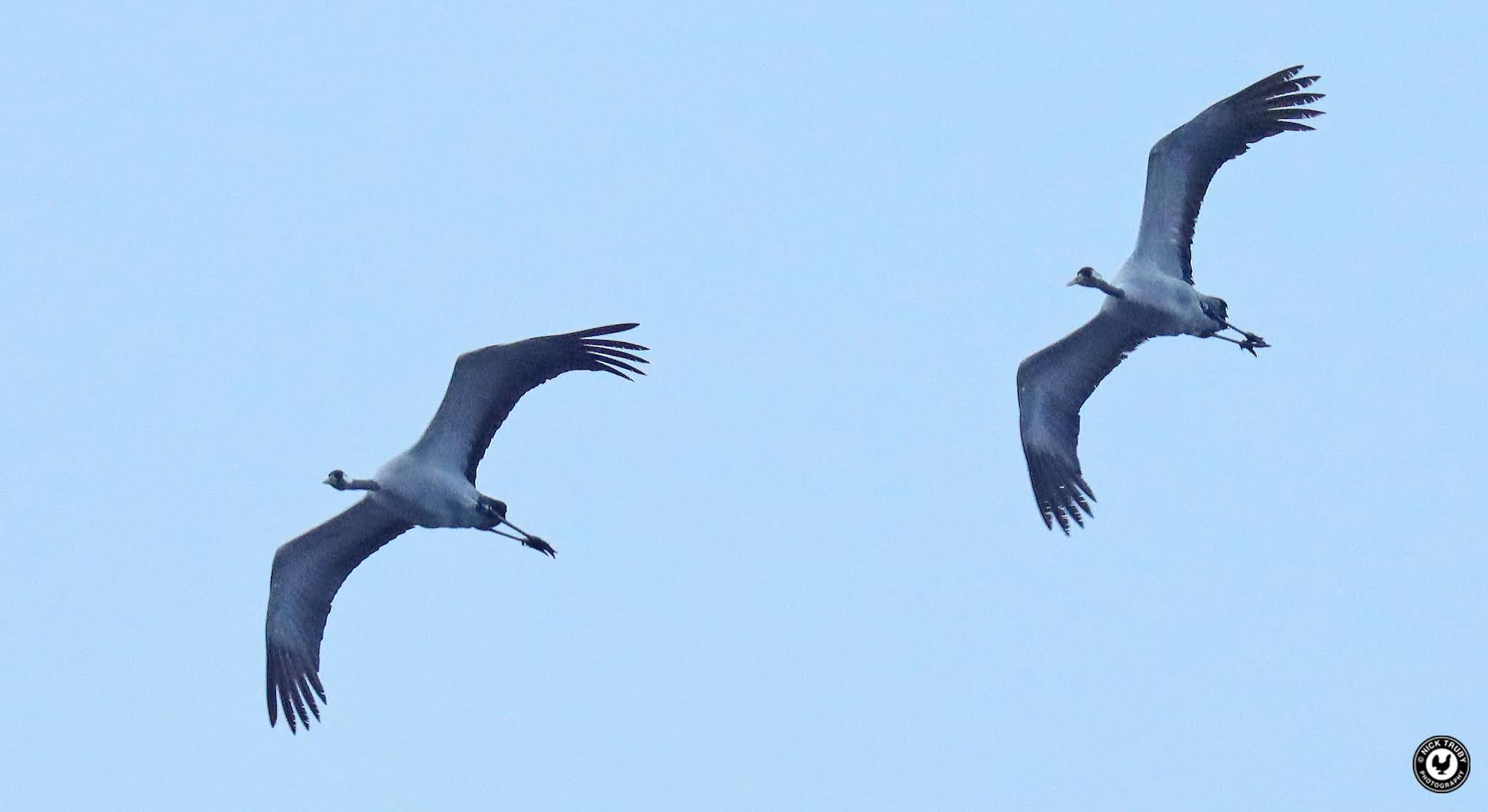
A lot of the rest of February was spent looking upwards! A few of the Isle of Wight reintroduced White-tailed Eagles were on the move and had been tracked, courtesy of the satellite transmitters carried by the birds, both flying over and roosting in Oxfordshire and the neighbouring counties of Buckinghamshire and Bedfordshire. Incredibly very few sightings of the birds were actually submitted proving that even birds the size of Eagles can move around surreptitiously. Needless to say the Eagles managed to evade The Old Caley's.
But things were looking up despite the freezing cold temperatures. The end of Lockdown was only three months away and in just six weeks time, some of the travel restrictions would be lifted, although that is still a long time to keep fingers crossed in the hope that some of the scarce and rare birds, presently in parts of the country that are off limits, will stay long enough for us to see them. Many of the more popular nature reserves, such as those owned by the WWT and RSPB will be reopening almost as normal in April which will give us a chance of getting out of Oxfordshire and bolstering the year list.
After failing to find a Tawny Owl a few weeks before, on the morning of the 20th we were able to add the bird fully to our year list, replacing the half a tick of a heard only Tawny with a full one. I was tipped off about a roosting Tawny Owl not far from home by a friend. We had already looked once but the Owl was either absent or tucked up fast in slumber within the tree hole but early on the Saturday we returned and found the Owl sat half in and half out of the hole. The roosting hole is high up, probably seventy feet off the ground, in an old tree but close enough for a record shot. As with most Owls found roosting, it's not worth staying long since the Owl won't do anything and every view and photo will be the same. So after just a few minutes we were on our way to another local site for a complete mornings birding although rain soon set in for the day so we didn't stay out for long at all in the end.

Sunday morning was overcast and light rain fell persistently. We were back on Otmoor, our mainstay during the Lockdown period, hoping to get a couple of year ticks. We still hadn't seen a Peregrine yet this year and there should be movement of some early returning wading birds. The deserted feeding station didn't augur well for the day though and our trudge along the muddy bridleway was only rewarded with a flypast by one of the Common Cranes that will hopefully remain in the area and breed successfully for the first time.

We sat at the first screen and watched the Marsh Harriers which are a constant feature of Otmoor these days. I have tried for years to get decent photos of Marsh Harriers here and have yet to be fully satisfied with any of my results. Sometimes I wonder why I bother since the birds never come quite close enough to the viewing point. In fact I believe that if they spot my camera then they deliberately tease me by staying just out of reach. There is also an inverse correlation between the quality of light and the proximity of the Marsh Harriers. If it's sunny then they don't come within half a mile, if it's dull and rainy, like this morning, then they fly closer because they know that the photos won't be any good in such poor conditions. A couple of the Harriers did then fly close to the screen and engaged in a bout of aerial tussling and I of course sent the camera into overdrive even though at the back of my mind I knew it was largely a waste of time. The back of the camera shots looked fine, but then they quite often do, but I still knew that come the uploads later then most, if not all, would be trashed. And they were.

Still it was fun watching the Harriers and their antics and one female bird kept venturing along the reeds to the left of the screen and at times was only fifty yards or so away which would have been great had the sun been shining and I didn't need an ISO setting of 2000 just to get 1/800 second shutter speed. I persisted though, as I always do, and took lots of frames especially when the Harrier flew right across the lagoon in front of us. Yes they were nice action shots and atmospheric because you could see the falling rain but ultimately disappointing again owing to the noisy indistinct images. One day I will own a real high end camera and lens and get much better shots but I bet I'll still not be happy with my Marsh Harrier photos.


We were joined at the screen by Kyle and chatted away about all things Oxon Birding. We had seen Kyle the day before in a secret corner of the county where we looked for a secret resident species of bird of which the details of are, of course, a secret. A Cetti's Warbler scolded from the hedgerow behind us but refused to show itself. The leucistic Pochard was cavorting with his normal congeners, spring is in the air for ducks it seems, and a few Tufted Ducks were milling around too. Mrs Caley and Kyle were engrossed in discussing the previous days outing, we had kept the statutory distance apart at all times, as we were now, and I made countless sweeps of the reedbed, mainly hoping that a Bittern may be prowling around. On one of the scans, through the Pochards and Tufted Ducks, I suddenly announced, automatically too since it registered immediately, there's a Ring-necked Duck! The chatter stopped abruptly and I was asked 'where?'. The duck had dived of course and for the next twenty-seconds I doubted that I had actually seen it but then the Ring-neck surfaced again, it was a handsome drake and the white flash on the grey flanks was unmissable. Even then it took another couple of dives and resurfaces before I'd got the others on to it. After twenty odd years of birding at Otmoor I had finally found a bird worth finding! Hallelujah!
 |
| Ring-necked Duck with Tufted Ducks and Pochards |
 |
| Ring-necked Duck and Leucistic Pochard |
I alerted Peter, Mr Otmoor, to the find and notified Jason who put the news out more widely. I know Ring-necked Ducks aren't the rarity that they once were but it still felt good to find a noteworthy bird for a change. It wasn't even a year tick though because we'd already seen the long staying pair near Abingdon! Kyle wondered why he hadn't spotted the bird himself, he was just looking at the same spot moments before I noticed it, and Peter admitted that he hadn't even bothered to look at the Tufty flock as he passed the screen earlier. With patch birding you have to look at everything that you can, the rewards are there, well sometimes anyway, and actually about once every twenty years in my case.


We watched the Ring-necked Duck for half an hour or so then, as more people arrived at the screen, made way so that they could enjoy it too without anybody having to compromise on the accepted White-tiled Eagle wingspan distance apart, or if you prefer the 28 or so Goldcrests, which seems far too few when considering how tiny a Goldcrest is next to an Eagle but I guess gives an idea of how birds are mainly all about wings. We walked to the second screen, me with a big smirk on my face and revelling in my new found glory since I actually received a couple of text messages congratulating me on my find. I dreamt at how it must feel when you find something really rare that sets the keenest twitchers in motion like the Northern Mockingbird that somebody had found recently in his Devon garden.

The lagoon at the second screen was almost deserted but did provide a year tick when a Curlew, #110, flew past over the distant Flood Field calling loudly as it went. Curlews, sadly just a few pairs these days, are a feature of the Moor in the summer as they breed in the tall grasses of some of the fields. We found three Ruff way out on the Noke Sides but the Peregrine roosting tree was vacant so we'd have to wait a bit longer to see them this year. We returned to the first screen, a major local twitch was in progress with as many as five people looking for the Ring-necked Duck which unfortunately had disappeared. It would show sporadically through the day but had gone by the next day. We didn't linger and went home happy.

Mrs Caley and I spent the penultimate day of February back looking skywards. The weather was crisp and fresh and would be perfect for birding. I've been working for a client who has a fabulous woodland attached to his property and he very generously allowed for me to have unlimited access at anytime except on days when he would go into the woods himself. He was interested to know what birds were in the wood in addition to the visible raptors that soared above the trees. As we neared the trees a Raven flew past kronking loudly. My attempts at photography were hindered by my own inadequacies because I'd forgotten that last time out was a drab grey day and hence the settings were all wrong for the sunshine.

We could hear some Common Crossbills calling and it didn't take long to find a pair in trees lining the access path into the wood. The female in particular was very showy and was nibbling buds on a lower branch so I was able to secure some more level eye views and photos than is normal. We've done well for Crossbills this year and have seen many in our local area.


I spied a Kestrel shoring above the adjacent field. We now had the trees for cover so maybe it didn't see us because it then flew directly towards and past us allowing for a superb view. It's more likely of course that it saw us clearly and just flew in for a closer look at us attempting to hide in the trees.


There were birds within the woods but all were difficult to see, we heard and saw Jays and Great Spotted Woodpeckers and the common woodland birds were well represented. I was hoping that one of the many Holly bushes would contain a Firecrest but we only found a single Goldcrest. Firecrests are an increasing winter resident in the UK and I feel that there must be some hiding in an Oxfordshire wood somewhere. Crossbills flew overhead frequently, one flock contained at least twenty birds.

We left the wood on the opposite side and walked around a field, remember we were granted free access. It was extremely muddy and hard going but we rewarded by a low flying Common Buzzard, a soaring Sparrowhawk and a jet propelled Carrion Crow!


The Crossbill pair were still at the edge of the wood where we had first entered and this time it was the male that showed the best. Male Crossbills are a beautiful salmon pink colour (some would say that are red but I don't get on with that colour so look for better alternatives) and very striking. They also tend to be more wary than the females so the fact that this one allowed us to approach reasonably close was an added bonus.


Later on in the day we went for a walk at Somerton, along the canal, where a Barn Owl had been seen the evening before. We didn't see the Owl despite staying until dark but did surprise around thirty Common Snipe from the field next to the towpath which then careered around us before landing in the rough patch on the opposite side of the canal where I'd seen the Barn Owl hunting (in the video posted via social media). We've had mixed results with Owls this year, missing out on a few occasions now with all species although we do have all of the UK breeding Owls on our year list bar Short-eared Owls of which there have been no local reports and all of the ones that I know of are out of county and would mean breaching Lockdown restrictions to see.

A lovely drake Mallard offered my only real photographic opportunity as it marshalled its female partner out of harms way. Mallards are often overlooked or ignored because they are so common but they are also handsome and the last of the days sunlight dripping through the overhanging trees helped to illuminate the beauty.


The last morning of the month was spent back on Otmoor. We left our home in wonderful wall to wall sunshine which promised well for the rest of the day. By the time we had driven through Beckley and arrived at the completely empty carpark we were engulfed in a thick blanket of fog and could barely see more than twenty yards ahead! The MOD didn't choose Otmoor as the base of a major supply depot for nothing, knowing that the frequent fog would hide the stores from the Luftwaffe flying overhead during the Second World War. Birds are also savvy and use the fog, not only as a veil to hide in, but also as a way of teasing birders and photographers alike. Just as Marsh Harriers know to stay out of the way in sunshine but will happily venture closer to the observer in poor weather, Cetti's warblers will shun sunlight and hide in the shadows but as soon as fog descends they will happily explode into full song in plain view just yards away knowing full well that you'll have trouble enough to even find them in the camera viewfinder let alone manage to take a decent photo. All of which leaves you wishing that, 'if only they'd perform that well in good light'. Which they never do!


We made it to the first screen and peered out at the impenetrable fog. It was very cold too and we huddled up in the sheltered corner wondering why we had even bothered to venture out that morning. We couldn't see the reeds to begin with and the only birds on the lagoon were Coots. There was probably a veritable feast of Bitterns, Marsh Harriers buzzing around unseen in the reedbeds, although in reality I would imagine that the birds would be as fed up as us on such a dank start to the day. We sat there shivering for an hour, it just didn't seem worth moving until the fog began lifting, alone together (oxymoron) since nobody else was daft enough to be out in such conditions. I tried to see another Cetti's that I could hear right next to the screen to no avail, and in that time the fog only lifted slightly which at least brought some Pochards, including the leucistic male, into view. Finally and almost two hours since arriving on the Moor we saw the pale disc of the sun attempting to push the gloom aside and present us with the warm sunny morning that the weather folk on the telly had promised.
We decided to stroll to the second screen, not with any great anticipation now, but hoping that one or both of the Peregrines may be resting in their favoured tree. We still needed Peregrine for our year list and had somehow managed to miss them so far on the Moor despite them being reported all the time. We stopped and looked but couldn't even see the tree! Then as we sat down at the second screen the fog just dissipated as if somebody had lifted the curtains on a stage. Except the show wasn't any better because there wasn't a single bird to be seen! I pondered on where the birds could be and guessed that wildfowl don't like being exposed (or not, in fog) in open areas when they can't see around them any more than we do. Slowly a few Coots and Tufted Ducks emerged from the reedy edge of the lagoon and a Marsh Harrier swung by over the bund that separates the Flood Field from the Reedbeds. The day was on at last.

At least we were able to warm up in the weak sunshine and the bright conditions reinvigorated our enthusiasm. With little avian activity though we didn't stay long and I was more keen in checking the dead tree again now that we'd be able to see it. Firstly though we had two other welcomed year ticks in the form of two Common Chiffchaffs that were harrying each other through the trees by the screen and a Redshank that flew over the reedbed announcing its presence with a loud whistle. Soon after we had our Peregrine, species 113 for the year, when we saw the male perched and preening in the "Peregrine tree". Taking photos of the Peregrines is largely pointless because the tree is roughly about two hundred yards away but, as is my want, I took a few anyway. Just as well I did too because as I focussed on the male, the female flew up from an unseen position lower down in the tree and perched openly at the top. Having the two birds in view close together now allowed a direct contrast to be made between them which showed just how much larger and darker coloured the female is compared to the male. The Peregrines, in keeping with everything else, had obviously decided to stay tucked up in bed until the fog had dispersed. After ten minutes the female was warmed up enough and flew out of the tree and headed off westwards, probably to the wet meadows at nearby Water Eaton. The male hopped up the tree and took the position where the female had stood and then a few minutes later followed her. Just the bare and empty dead tree was left once again awaiting the time when the Falcons returned.


The first screen and the scene in front of it was now restored to its full glory and the birdlife had returned to normality. Coots squabbled over potential mates while the male Tufted Ducks chased the females while uttering their sweet but curious bubbling calls. Luke the leucistic Pochard was optimistically chasing the female Pochards around but it seemed as if he wasn't having much luck and after a while gave up and swam off and took company with the Tufted Ducks. I was checking the Tufties regularly but there was no sign of the Ring-necked Duck that I'd found the week before.

Birds of Prey were now very active above the reedbed, the warming air providing perfect conditions for them to soar and glide. We counted six Red Kites and two Buzzards as well as all five Marsh Harriers. The Marsh Harriers, true to form, were all flying well out over the reedbed out of reach of my lens, it was perfect conditions for photography now after all. One of the Buzzards did fly over the screen as a reward for our patience.


One of the female Marsh Harriers was showing a particular interest in a particular spot within the reeds and was seen carrying in sticks and reed stems. We are lucky to have breeding Marsh Harriers on Otmoor and it's also great to actually have a success story with a species in contrast with the gloomy story surrounding so much of the country's avifauna. The selected spot isn't really close enough for my camera set-up but I tried anyway and the bright conditions at least allowed me to have beneficial settings for a change.


Just the week before I bemoaned (I'm good at that, you may have noticed) on social media, repeated in this blog several times, at how I've never managed to take an image of a Marsh Harrier that I was truly happy with. They are a bit of a nemesis bird for me when it comes to photography. So when one of the Harriers started flying slowly and directly towards the screen I could barely control my excitement. The thrill would help explain why the first few shots taken were blurred but I managed to get my act together and take some decent shots as the bird passed overhead as it rode a thermal with a couple of the Red Kites which I totally ignored because I have hundreds of shots of those.


It had been an interesting morning and ended a pretty good months birding in our local county. We still longed to be let off the leash though and travel out further to see some rarer birds but that desire would need to be kept in check for a while longer so instead we had early returning spring migrants to look forward to in March.