Wednesday, 15 August 2018

Fill those Wading Boots, Part 2, 5th August

(...continued from Part 1...)

Having spent the previous day checking a couple of our local hot spots, we decided over breakfast to branch out and head somewhere slightly more exotic. We chose the Wildfowl and Wetlands Trust (WWT) reserve at Slimbridge where some different wading birds had been seen throughout the previous week. The best of these were a pair of moulting Curlew Sandpipers which were still sporting a large part of their red summer plumage and a Wood Sandpiper that had shown closely in front of one of the hides. We made our way straight to the hide in question and were greeted by, nothing! Well almost nothing since there were a couple of Lapwing and a few Teal but there was certainly nothing more interesting. I checked the Slimbridge Sightings twitter feed which is updated once the wardens have been out and about and saw that a Wood Sandpiper was indeed still present but at the Rushy Pen hide and not where we were. We got to the Rushy hide and were surprised to find only one other birder present and before he had the chance to tell me what's about (a bug bear of mine, I like to look for myself first) my quick glance around had already netted me the Wood Sandpiper. Mind you it was almost as far away from the hide that it could have been without being in the next county but through the scope it looked great.  I like Wood Sandpipers and this followed on from the one seen at Frampton Marsh (see Frampton Marsh, 23rd July) recently. I would like to see one really close up mind.


Wood Sandpiper
I studied some of the birds that were considerably closer to our viewpoint. An Avocet was very protective of it's family of youngsters and frequently chased off anything that it took a dislike to, which was pretty much every other bird since in turn it pursued Black-tailed Godwits, Coots and even Mallards until they were a safe distance away. The Avocet would then enter an uneasy truce with it's neighbours until some unseen spark started it off again. That old Sparks song began reverberating in my head, "This town's not big enough for the both of us"!


Avocet family
"Gerrout of it!"
"OK, who wants it?!"
The Black-tailed Godwits in contrast were largely relaxed and uninterested in any other birds but soon turned tail and ran if the Avocet demanded it. In between bouts of feeding the Blackwits would rest, preen, often standing on one leg, and stretch their wings. One bird even found time to yawn and demonstrate the curious ability of Rynchokinesis whereby a bird can bend its bill backward showing just how flexible a beak can be. Such sensitivity is a great aid when sifting through water and mud in search of food.


Rynchokinesis in action


There were also Green Sandpipers, Common Snipe and Ruff present but generally they were feeding distantly alongside the Wood Sandpiper. At one point the Sandpiper cousins met up and it was nice to note the comparison and differences between the two species.

Wood Sandpiper (left) with Green Sandpipers
I concentrated on a Lapwing for a moment that stood on a much closer island. The vibrant colours of the Lapwing are wonderful, they look as if they've been dipped in petrol (not a nice thought I know but you get it, right?).


Lapwing
Right in front of the hide a stream runs down from one part of the Rushy Pen into another and this attracts many birds for a dip and spruce up but also for a drink. A fabulous male Greenfinch, all too scarce in my part of the world these days, was one customer and he was followed by adult and juvenile Goldfinches, Pied Wagtails, a juvenile Grey Wagtail, House Sparrows and a Starling.


male Greenfinch
juvenile Grey Wagtail
juvenile Pied Wagtail
A young Jackdaw was more interested in what lay under the carpet of daisy's and a first year Black-headed Gull also strode around but sadly appeared to have a damaged wing.


juvenile Jackdaw
juvenile Black-headed Gull
Several Wood Pigeons landed at the mouth of the stream and began bathing. Their method was to lay down and soak up the water, Pigeon feathers act like sponges. One bird curiously raised one wing aloft and held it there for quite some time, I have no idea why. A passing Moorhen looked completely disinterested and just walked on by.


Wood Pigeon
Moorhen
I returned to studying the Wood Sandpiper which was still miles away but it had at least waded out into open water, not that it helped the photos much. I willed the bird to come closer but it remained well out of reach and even the converter made little difference at such range.


Wood Sandpiper
The Wood Sandpiper was then photobombed by a juvenile Common Crane and its parents! These giants of the bird world emerged from reeds and vegetation, strolled casually across the lagoon and promptly disappeared into the reeds on the opposite side. I was amazed how such big birds could just melt into the plants and render themselves invisible.


Photobombed Wood Sandpiper (bottom right)
juvenile Common Crane
adult Cranes
We gave up on hoping that the Woody would come closer, it clearly wasn't going to, and headed off to the South Lake where the Curlew Sandpipers had been seen all week. Of course today they were somewhere else having chosen the previous night to continue their southerly migration. They must have known that I was coming! But we're off to Frampton Marsh again next week and we'll probably see some there so I wasn't too bothered. I was more perturbed by the amount of noisy children and their equally irksome parents that were charging around the Slimbridge grounds. The trade off with this place, especially on a warm and sunny Sunday morning, was the visitors that come for the "zoo" birds and the child friendly attractions. Great work by the WWT in raising funds but hardly conducive to good and relaxing birdwatching. How much noise can small people make? A lot, I can tell you! I made a quick scrutiny of the wild birds on the Lake, noting some nice Ruff in various plumages as well as another family party of Cranes, apparently the parents are "Oakie" and "Skye", two of the three Cranes that graced BWR a couple of years ago, an event that only Mrs Caley and myself were witnesses to.


male Ruff
"Oakie, Skye & Cotton", Bicester Wetlands, 3rd May 2015
A Lesser Black-backed Gull landed on a post and made a racket of its own making, I just about heard it over the ambient din. A Kingfisher whizzed through quickly, no doubt seeking some peace and quiet of its own.


Lesser Black-backed Gull doing it's best to drown out the din of small people (and failing)!
I couldn't bear it any more and we made for the sanctuary of the Zeiss hide which overlooks a quieter part of the site. Here are truly wild birds but they are always distant, although you can relax and search through the Dunlin flocks for anything rarer. I couldn't find anything more interesting though other than the summering, and presumably feral, flock of Barnacle Geese.


Barnacle Goose
We had added only 2 species of wader to the weekend list making it 11, still a paucity compared to those East of England sites. As I drove away I made a firm note never to visit Slimbridge on a Sunday or during a school holiday ever again. Unless there's a really good bird around of course!


Monday, 13 August 2018

Fill those Wading boots! Part 1, 4th August

With the weather looking a bit more unsettled and with the onset of Wader passage season there seemed to be a fair chance of finding a few interesting Wading birds at some of our local haunts. Indeed a couple of Black-tailed Godwits (could have been the BWR birds of last week moving on) had been seen at Farmoor and a Greenshank had been found by the warden at BWR on Friday so as we stepped out onto the Farmoor causeway we were ever hopeful of something reasonably inspiring. Even as we left the car we could hear the loud "peeeep, peeeep" of an Oystercatcher and that was clocked flying fast over F2 towards F1. At the top of the causeway I spotted it stood on the embankment so I sidled up as close as I could without startling and took a few shots. A few steps closer though and the Oystercatcher went hurtling off across the reservoir back towards F2. We'd meet up again later.


Oystercatcher
Next we came across a lone Dunlin, stood resting on one leg, and a pair of Redshanks. Redshanks are always wary birds at Farmoor and after a few images they were startled by a jogger and flew away further down the causeway.


Redshank
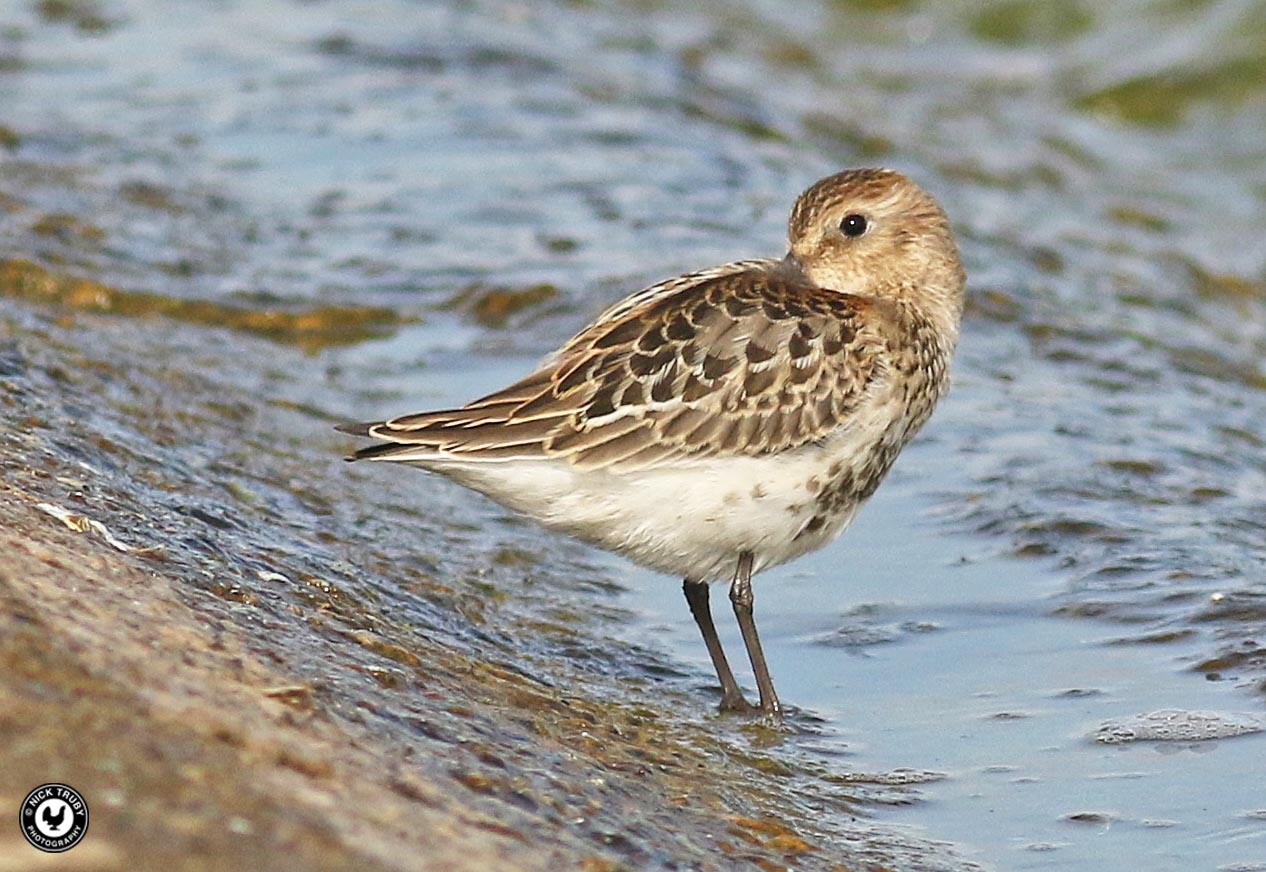
The Oystercatcher was now looking after the Dunlin but was also very wary and the Rangers car sent it scurrying away over the reservoir once more. On the F1 side we spotted 2 Dunlin feeding along the edge, an adult and a juvenile. This was the first juvenile Dunlin that I'd seen this year. It's always good to see this years young birds come through. By sitting quietly on the wall, I was able to get some nice close views of the Dunlins as they approached reasonably carefree and untroubled by our presence. It was interesting that whereas the adult Dunlin was very assured and firm footed, the juvenile by contrast was having difficulty in gripping the slippery surface of the embankment and frequently slithered down towards the water. I guess young birds have to learn to walk just as much as we do!

Oystercatcher, Dunlin & Coots

juvenile Dunlin
adult Dunlin
The Redshanks had settled nervously again on the edge of F2 and a group of 5 Dunlin (containing the original 2) crept along the bank of F2. The joggers and walkers still disturbed them frequently but with patience some decent views were achieved of all of them.

Redshank

juvenile Dunlin
At the western end of the causeway I spotted 2 Sanderling some way off but before I could get closer they had flown off and back past us joining the Dunlin "flock". We discussed walking around F1 to see if anything was on the settling ponds but decided against it after a few hundred yards and turned back. We'd found another, and very obliging, adult Dunlin taking the tally up to at least 6! 


adult Dunlin
We were passed by the complete group of Dunlin and the Sanderlings as we walked back towards the marina allowing for flight comparison shots to be taken.

Dunlin (middle) & Sanderlings
Dunlin
Sanderling
The Sanderlings, still sporting much of their breeding finery, were now feeding around the bird hide and were more settled. A good tactic at Farmoor is to walk past birds on the opposite side of the road so that they can't see you and then creep back to the wall ahead of them, sit or kneel and then wait for the birds to approach. That way you can get good images since the subjects are not disturbed and cone to you in their own good time. It paid off as the Sanderling came within 20 metres before being disturbed by a jogger once again.


Sanderling
The Redshanks were once again stood on the edge of F1, warily watching anything that moved on the land, water or in the air. They must have spent all day moving from one part of the reservoir to another since they were still reported long after we had left.


Redshanks
The final wader of the morning was encountered close to the marina when a Common Sandpiper took off from the waters edge and alighted on the pontoon. These are incredibly difficult birds to get close to at Farmoor, in direct contrast to their habits when breeding in Scotland.

Common Sandpiper
As we arrived at the boat club a Yellow-legged Gull flew past eying us with a particularly piercing stare and a young Common Tern went in the other direction.

Yellow-legged Gull
juvenile Common Tern
We decided against a coffee and drove back to Bicester for a look in the Wetlands and to see if the Greenshank was still around. The hide overlooking the main pool revealed very little so we walked up to the recently installed Cattle Bridge Pool Hide (well it's only been around for a year!). This hide, as it says on the tin, overlooks a shallow pool which is churned up daily by wallowing cattle and hence has very muddy margins which in turn have the potential to attract wading birds. I have found a Wood Sandpiper here before but today it held 6 Green Sandpipers, a single Common Snipe and the Greenshank. All were feeding too far away from the hide for photos though so I was grateful when a pair of Stock Doves landed on the closest patch of mud. A much overlooked and under appreciated species, the Stock Dove is a beautiful bird adorned in subtle soft hues of pink and grey with a striking iridescent green flash to the hind neck.


Stock Dove
All bar one of the Green Sandpipers left noisily for the main pool leaving the Greenshank to entertain us. After a while the much taller bird had made its way around the pool into range of my lens. Every time a train came through on the adjacent tracks it would startle and run back to the edge before settling down and beginning feeding again.


Greenshank
Whenever the Greenshank was too far away on the opposite banks of the pool we watched the antics of many juvenile swallows that were flying low over the water. Periodically they also rested on the wire fence in front of the hide where their newly acquired plumage shone brightly in the sunshine.


(mainly) juvenile Swallows
The swallows were joined on the wire by a Common Whitethroat and a House Martin landed on the mud presumably gathering material for nest renovations.

Common Whitethroat
House Martin
The Greenshank was edging closer to our position again allowing for better images. Eventually it arrived right in front of the hide although still about 30 metres away. I've never really gained good images of Greenshank before so my camera went into overdrive. Still I could have done with being a little bit closer but I'm grateful, both for the views and for the new hide that allowed me to get them.


Greenshank
The sole remaining Green Sandpiper had followed the larger bird and was also now close enough for some photos. A Common Sandpiper that flew in and dropped down at the far side of the pool had also arrived close to the hide but controversially via an anti clockwise route, all the other birds had circumnavigated in a clockwise manner!

Greenshank & Green Sandpiper
Common Sandpiper
The Greenshank then tucked its head away into its back feathers and dozed. It was soon awakened by another passing train though and flew away once more to the far side of the pool.

Greenshank
We left, mildly surprised by the sight of at least 20 juvenile swallows adorning the tops of nearby bushes since they looked a bit incongruous in such a setting. 

("Tree") Swallows
It had been a good day with 9 species, Lapwing being the other not previously mentioned, of wading bird seen. Doesn't compare with places on the east coast but this is inland birding after all.