Friday, 18 March 2022

5-6th March 2022; The Lesser and Not So Common!


February Dipping Blues

We had been struggling, our birding luck was right out and, since seeing the American Robin and Hume's Warbler in Eastbourne (see here) and a Ferruginous Duck just south of Oxford (see here), we couldn't even buy a bird. The fortnight that had followed had been hopeless. The first weekend 19-20th February had been a total washout with almost constant rain as one storm after another battered the UK so our attempts were largely confined to birding from the car and a few minutes spent at BWR. I spent most of that weekend watching my fence while crossing my fingers in the hope that it survived. We saw almost no birds at all.

The following weekend, 24-26th February, in better weather we did at least get out and about but still failed in our efforts to see most of our target birds. We began that weekend on the Friday at a local raptor watchpoint, an exposed site where conditions were more than a little bit chilly in a brisk northerly blow. We saw the raptors and a surprise Corn Bunting, new for the year, but didn't stay long. 

Common Buzzard


On the Saturday we headed up to The Priory Country Park in Bedford to look for a Green-winged Teal. It was a lovely sunny day and our spirits were high as we parked up and walked down to the floodplain of the River Ouse. The North American cousin of our own Eurasian Teal was frequenting a lake close to the river and had been present for over a month so it should be a shoe-in. It wasn't and we spent three, largely frustrating, hours looking for the bird that we just couldn't find even after we realised that for half of the time we had been looking in the wrong place. When a report was posted that the bird was still present just an hour after we'd left my mood darkened a bit more and I started to doubt my own abilities once again. To be fair the Teal group spent all of the time while we were there, sheltering in overhanging vegetation and were hard to observe at distance across the lake in choppy conditions. I guess we were just unlucky that the Green-winged version didn't venture out of its hiding place until after we'd left. The failure was softened slightly by finding our first Oystercatchers of the year plus a White-fronted Goose (the Russian type but we can't hold that against it, it's not its fault) that appeared far too pally with a small group of Canada geese for my liking. I'll have to underline that sighting with a trip to Slimbridge to see the totally genuine flock there.

Oystercatcher

White-fronted Goose

Barnacle Geese

Egyptian Goose


The next day, spurred on by Kyle (Birdwatch Britannia) and Kev's sighting of a fantastic Lesser Spotted Woodpecker, we left home early to travel the hour to the RSPB reserve at Middleton Lakes near Tamworth. The two "K's" had had stonking views of the small Woodpecker in trees directly opposite the carpark. We stood standing in the cold staring at those trees for three hours and didn't have a sniff! Our luck was definitely out. We do have another site for Lesser Pecker's though and it usually produces the goods so we'll be on the case. Middleton Lakes is an excellent reserve offering a variety of habitats and bird species but we didn't have the heart to look any further than the immediate area around the carpark. The Grey Herons building nests in the Heronry nearby provided the only real entertainment and the only photo I took was of a passing Sparrowhawk.

Sparrowhawk


Year List additions;

137) White-fronted Goose, 138) Oystercatcher


Marching on at Last!

Thankfully, if much effort is applied, the birding gods don't oppose you forever and eventually the tide will turn and the birds will come again.

Saturday morning, the 5th, dawned dry and clear so we made our way to our (not so) local hotspot for watching Birds of Prey again. I'm ever hopeful of obtaining a crippling view and photograph of one of our rarest Raptor species which up to now I only own distant shots of. I didn't get those shots on this visit either although I did manage to see a brute of a female as it flew past distantly. Two flyover Crossbills were a surprise addition to the year list and a Hawfinch whirring rapidly past a few minutes later hinted that our drought may have been short lived and over.

Goshawk


The weather on Sunday morning wasn't conducive for watching small birds flitting around tree tops but it was really our only opportunity to have another tilt at finding a Lesser Spotted Woodpecker. We were looking in our favoured spot in Northamptonshire where we've seen them for the past five years after finding out about them through doing some online detective work. The wood we look in is small and never busy with birders, even though many folk know the Woodpeckers are there. In fact we've only ever met a few folk with similar ambitions as ours.

An early start is usually required to see Lesser Peckers and we were alone in the wood as we wandered through the trees, staring up as you have to do while listening for the high pitched calls and rattling drumming of the birds. It was a very grey and murky morning so if we found the birds I wouldn't be taking any stunning photos this time around but we just wanted to get a fix of the charismatic little Woodpeckers. For almost an hour there was no sign of any Woodpeckers of any description and my recent frustrations at failing to find any of my target began bubbling up once more. Our luck turned when a couple of chaps joined us. I answered, "No" even before they had asked the question of whether we'd seen a Lesser Pecker or not. Then almost straight after one of them said, "I can hear one drumming" (and probably thought that I must be deaf). Well, all I can say is that he clearly possessed far better hearing than I do and I always pride myself on having good ears despite the tinnitus that blights my life whenever I remember that I suffer from it. The two of them marched towards where the sound of drumming (the sound made by a Woodpecker banging a hollow branch with its bill) was supposedly coming from but there was no sign of any Woodpeckers, and no further sound of any either. I had my doubts that he'd heard a drumming bird at all and when a Great Spotted Woodpecker flew in from our left, the opposite direction from where he had heard it, I was pretty sure he hadn't, and even more definite when the Greater Pecker was followed closely by a male Lesser Pecker a moment later. The pair of birds alighted in the top of a tall tree some fifty metres away and we had our Lesser Spotted Woodpecker once again!

Lesser Spotted (top) & Great Spotted (bottom) Woodpeckers


We had witnessed similar behaviour the year before (read here) when the smaller male Woodpecker had interacted with the larger bird. My guess is that it was a territorial dispute since I know that the breeding tree that the Lesser Pecker uses was quite close to where the two birds were. I also knew that the Lesser Pecker wouldn't be happy until the Great Spotted had been ousted from the area. It was hard to pick the birds out in the mangled mess of bare branches that form the canopy but at least we could see them, in a month or so the leaves adorning those branches would make it nigh in impossible to get a view of the Lesser Pecker.

The two birds flew out of the tree and past us but none of us saw where they went. Luckily the Lesser Spot was then heard drumming quite closely to our position. I zeroed in on the source by using the rather odd practise of cupping one's ears, which might look stupid but does actually work, for me anyway. I had the bird pinned down to a certain tree but could not find it at all, none of us could. After a few minutes the Lesser Pecker gave itself away by flying to another adjacent tree where it showed reasonably well although it was still high up.

male Lesser Spotted Woodpecker


When the Lesser Pecker flew again one of the other birders managed to follow it and then found it again in a Silver Birch tree. Now it was much easier to see as it pecked away at a slender branch. The conditions were gloomy and there was drizzle in the air but no matter the weather, Lesser Spotted Woodpeckers are a total delight to see. We could hear drumming from another part of the wood and our fellow birders speculated whether there were two males in the area but female Woodpeckers also drum from time to time so it could have been the prospective pair keeping in touch with each other.


The male bird then obliged us further by shimmying up the main trunk of the Silver Birch and pausing right at the top giving us more clear views. How I wished the sun was shining!


When the Lesser Spot flew strongly out of the tree we made to leave, there was another bird in the local area that we wanted to see. However, as we neared the path that would take us out of the wood, I spotted some Lesser Redpolls feeding in the top of a Silver Birch. I pointed Mrs Caley in the direction of the birds but was agog when she said she was watching a Lesser Spotted Woodpecker instead! For the next two minutes I frantically searched the tree to see what my wife could see and couldn't find the Lesser Pecker anywhere. Then it started to drum and I still couldn't find it! According to Mrs Caley the bird flew out to the right and I just caught a glimpse of it as it landed in another nearby Silver Birch. This time I could see it and had extended views of my own as the bird, presumably the same male as before, spent some time staring towards the heavens, probably wondering when the rain would stop.


When the Lesser Spot flew off back towards the original part of the wood where we'd first seen it an hour or so before, we did finally make our way back to the car. As we drove towards our next destination, the sun appeared through the clouds, how I wished it had done that when we were in the trees earlier. Oh well, it's not every day you see a Lesser Spotted Woodpecker so I'm not complaining, not much anyway.

I was acting on a report that a Common Scoter was frequenting the main lake at Storton Gravel Pits, a wildlife trust reserve in the shadow of Sixfields Stadium, the home of the mighty Northampton FC. I knew nothing about the area birding wise although I did go the football ground once, when it was brand spanking new, to watch Chelsea in a pre-season friendly when there was expectation that Ruud Gullit would play. The lake, also known as Sixfields Lake was easy to find and had a carpark right next to its western edge. There was a choice of either walking along the northern bank or the opposite southern one but that entailed skirting along the carpark end first so we opted for the shorter northern track, even though the sun would be shining directly at us if it reemerged from behind the clouds which had settled across the entire visible sky again. I loaded the scope onto my shoulders ready to gain decent views of the Scoter should it be distant but as we walked around the lake it was evident that it probably wouldn't be required because it was only a hundred metres or so from one side of the lake to the other. Halfway along we came across a young Cormorant taking time out and drying off on a branch that overhung the lake. Cormorants look positively prehistoric and must be directly descended from the flying reptilian group, the Pterosaurs.

Cormorant


I scoped the furthest reaches of the lake, I had carried it so I may as well use it, but could only find Great Crested Grebes, Tufted Ducks, a large flock of Herring Gulls and a few Black-headed Gulls. We walked on trying to find places to get a clear view of the lake since the shore was mostly protected by trees and bushes. We arrived at a bridge which led over the adjacent River Nene that flowed over a weir beneath the bridge. That was supposed to be the place where the Scoter was likely to be seen from so I scanned again. This time I saw the duck, only fifty metres away, as it resurfaced close to the side of the lake that we were on. I took a few record shots.

Common Scoter


We walked steadily towards the Scoter which had now dived again so that when it resurfaced we had halved the distance between us and it. We waited until it dived again and then made our final approach so that when it popped up again, we were close enough to get probably our best and closest ever views of a drake Common Scoter. But now I was cursing the sunshine for appearing since it was now shining full on directly at us and meant that the bird was mostly silhouetted against it.


From our elevated position above the water the Common Scoter appeared unconcerned of our presence but I strived to get a lower perspective to my photos so after waiting a few seconds for the bird to make another dive, I slid down the bank and crouched behind a tree. The bird surfaced very close to the bank and better still was facing directly at me. Adjusting for the harsh light and after a lot of tinkering later on the computer, I was more than satisfied with the resulting shots which showed just what a handsome creature a male Common Scoter is. Usually we see Common Scoters in large rafts (the term given to a flock of sea ducks) at distance offshore and it's difficult to discern any features. Up close though, like this bird was, the uniform jet black plumage, a feature of males in all Scoter species (females are a brownish colour), could be appreciated and it acted almost as a colour sink, so none of the array of purples and blues that other more familiar black plumaged species have (like Crows) were evident, just black. Common Scoters are impressively built ducks with a large round body and a strong looking head and bill. The bill is the prominent  feature with a large bulge on the upper mandible. Just below that bulge is the only bit of colour on the entire bird, an orange-yellow patch that forms a saddle.


The Scoter was continually diving and would often have strands of weed adorning the bill when it surfaced. That weed is not the preferred food of a Common Scoter though, they mostly eat molluscs, aquatic invertebrates and small fish most of which must be consumed underwater since I never saw it with any larger prey. The duck only remained at the surface for a few seconds before diving and it would stay under for probably thirty-seconds or more. 


While the duck was hidden from view I tried to get into a position so that the sun had less effect on my photographic efforts but without any great success. We could have walked around to the opposite shore but after being out all morning already we lacked the legs so I accepted the fact that I had already vastly improved on my Common Scoter portfolio. It was also good to have two Scoter species (Velvet the other) on the year list at a very early stage this year and both had been seen on local lakes saving the need to travel to the coast to see them. I took a few more shots before we left but another birder arriving and venturing out onto a fishing platform had already disturbed the Scoter and it had swum further out.


On the way back to the car a pair of Ravens flew closely past, one of which was close enough for a quick shot or two. We'd had a good day in Northamptonshire and it was good to actually achieve our aims after a frustrating couple of weeks.

Raven


Year List additions;

139) Common Crossbill, 140) Lesser Spotted Woodpecker, 141) Common Scoter

Sixfields Stadium


Tuesday, 8 March 2022

Fudge a Duck! Saturday 12th February 2022


The last Ferruginous Duck that I saw in my home county of Oxfordshire was on Otmoor in March 2013. That bird was difficult to observe from the second screen and I only got the briefest of views since the duck spent most of its time tucked up in the reeds bordering the far side of the northern lagoon. So the drake that Geoff Wyatt found on the Allen Pit close to Dorchester-on-Thames on Tuesday was long overdue and it would be good to get another chance at seeing the species in Oxon. Trouble was that owing to a heavy workload I wouldn't get my chance until the weekend so it was an anxious wait through the week in the hope the bird stayed.

The provenance of many Ferruginous Ducks, or Fudge Ducks as birders colloquially refer to them, can be difficult to ascertain and thus many are often dismissed as being escapes from collections. There are also many hybrid ducks that can superficially resemble a Ferruginous Duck but which have some trait of a parent bird of a different species and are thus rejected as being the real deal. Thankfully the bird that Geoff had found looked one hundred percent nailed on for a genuine bonafide textbook example of a proper Ferruginous Duck so there would be no issues with adding it to the year list. The finest example of a Ferruginous Duck that I've seen, other than those in captive collections, was one at Helston Boating Lake in Cornwall but unfortunately that individual was deemed to have been released from a private collection. I have, however, seen quite a few genuine types over the years.

Ferruginous Duck, Helston, 15/10/2019


I'd never been birding at Dorchester-on-Thames before either except for pausing in a lay-by by the side of the ring road to scope a Long-tailed Duck once. Allen Pit, where the Fudge Duck had been discovered is a privately owned body of water set in the flat flood plain next to the River Thames. The owner had very graciously allowed birders access to the pit via a private farm track. After parking in the village we made our way along a corridor of muddy and well walked paths before turning onto a wider farm track. Apart from a flock of active Black-headed Gulls swirling around about half a mile distant, there was no visible sign that a pit was even there. The wind was bitingly cold in the exposed flat farmland blowing in from the direction of the river. Just a few hundred yards short of the site we finally clapped eyes on the pit which looked particularly bleak in the greyness of the day. Fellow Oxon birder Tom was the only other birder present but before joining him I stopped and scanned the pit to see if I could find the Ferruginous Duck myself. After perusing all of the available Ducks on offer there was no sign of the target bird at all so I succumbed and asked Tom if he'd seen it. Apparently he'd had the same problem with finding the Fudge Duck since it was hugging the furthest shore and when not submerged, it only surfaced for a few seconds before diving again, was hard to pick up in the choppy water. With his help and after erecting and using my scope, Mrs Caley and I got our views, albeit of a very distant blob!


We steeled ourselves against the wind, which appeared to be strengthening and getting colder, there was even a few flecks of sleet, and crossed fingers in the hope that the Duck would swim closer to our side of the pit. The Duck didn't seem to want to leave the far bank though. Tom left and we were joined by another friend, Simon who wisely didn't bother wasting time looking for the duck himself and instead asked where it was. While we chatted we watched a good sized flock of Fieldfare that were feeding in paddocks on the village side of the track. Typically as I lifted the camera to take some shots a low flying passing Red Kite frightened the whole flock and they were gone. 

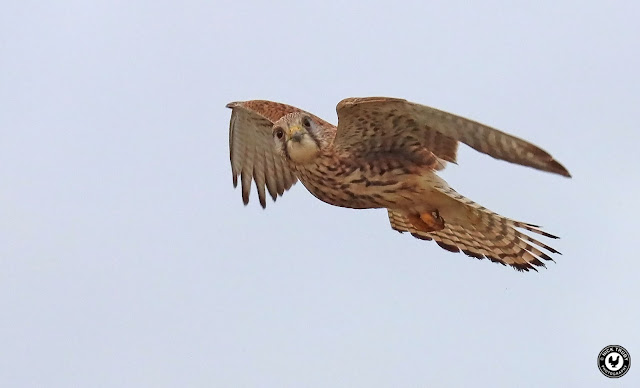
We had better luck when a female Kestrel floated into view and hovered in the wind over the closest edge of the pit. We watched the mastery of the Falcon as it battled to stay steady but of course it possesses great prowess when it comes to flying. The way the Kestrel kept its head fixed on its target while staying aloft maybe twenty feet above the ground was awesome to watch so closely.


The noise of mine and Simon's camera shutters rattling off must have interested the Kestrel because on a couple of occasions it turned its head to stay directly at us. The resulting images were extremely pleasing. Satisfying enough for me to submit a couple to the weekly BirdGuides Photo contest and I sincerely thought that I'd get at least a "Notable Photo" recognition. That notion was rather foolish of course and I should have known better. The photos were passed over yet again and instigated a bit of an Old Caley meltdown, the outcome of which was me vowing (definitely) to never post a photo onto the site again and a promise (maybe) to myself to change allegiance to another bird news service when the renewal date arrives. I don't know who judges the photos these days but its clear that myself, and plenty of others like me, are wasting their time trying to impress those adjudicators since every week the merit is given to the same small group of people, many of whom are akin to professional photographers anyway and have distinctly much higher end kit than I'll ever own. I've never been that competitive and if I can't compete then I don't so I give up. At least my photos won't be used for free in the weekly roundups. I posted in the hope of a "Notable" only to receive a "Not Able" once again. I feel better already and I haven't even looked at the "Photo of the week" competition winners since. Blow them!


The Kestrel also managed to ignore me once it had posed for the shots, "Your photos are crap mate" and dropped to the ground. It hopped along into the reeds, presumably to keep hold of its own capture, and a few seconds it emerged with some unfortunate four legged creature. The Kestrel sped off across the lake to consume its meal somewhere away from prying eyes.


The owner of the pit was walking his dog around the perimeter of the water, which would normally have raised my ire up a few levels, but on this occasion he was actually doing us a favour because the wildfowl, and in particular the Ferruginous Duck, were disturbed enough to seek refuge in the middle rather than the furthest bank. This brought the Fudge Duck much closer to us and meant that I could at least get some identifiable images that proved it was one hundred percent nailed on for a genuine bonafide textbook example of a male Ferruginous Duck.


Happy that I'd got some record shots of the Fudge Duck, we opted out of lingering in the cold any longer and made our way back towards the car. The walk to the pit had been a bit frigid but the walk back directly into the wind was absolutely Arctic! I couldn't resist stopping to photograph some of our lesser appreciated birds, Jackdaws and Rooks, that were probing for food in a lush grassy field. I'm a big fan of Rooks, to my mind they are a beautifully ugly (ha!) bird and in good light their feathers shimmer with so many hues of blues, purples and blacks. Jackdaws are mischievous, the imps of the Corvid family, and always appear to be getting up to tricks and into trouble.


The following day was a washout, with persistent rain putting paid to any serious birding although we did try for half an hour at the local wetlands but quickly decided to go and drink coffee instead. At least fair weather birders stay dry and warm. My mind remembered that awful wet afternoon at Pitsford last autumn when we almost drowned in our efforts to see a storm blown Leach's Storm Petrel. It takes a really good bird to get us out in downpours.

Year List addition;

135) Ferruginous Duck


Friday, 25 February 2022

Friday 11th February; An Eastbourne Trinity!


The "Bird of the week", the bird that gets a lot of birders excited, was an American Robin that had been found in a quiet cul-de-sac on the edge of a housing estate in Eastbourne. The bird had been discovered on Tuesday although the consensus was that it had been around for almost a month feeding on berry bearing bushes and trees in residents gardens. I already had American Robin on my UK list but Mrs Caley did not, I had coerced my mate Trevor to make a detour to Grimsby from our route to Scarborough where we would watch Chelsea struggle to deal with a non-league side in the FA Cup fourth round at the end of January 2004. The American Robin was feeding on a grass verge next to a greasy spoon burger van on an industrial site. I ticked it from the car, and didn't spend any more time there than was necessary because we had a rendezvous arranged with the rest of our friends at a pub, aptly called the Dotterel, high up in the North Yorkshire Moors. By the end of that weekend, after an instantly forgettable match and a lot of drinking I had pretty much forgotten everything about the American Robin as well! 

A chance at seeing another American Robin therefore couldn't be passed up, particularly since it was reasonably close to home. Since seeing the Grimsby bird I had had a couple of near misses, a bird at Glenmore at the foot of the Cairngorm Mountains discovered the day after we had left for home after we spent two weeks there, and an elaborate hoax of one in Buckinghamshire where I spent three hours looking for it before being told by a neighbour, of the chap who reported it, that it was never there and had been invented to annoy another neighbour! This American Robin though, as photos and accounts from locals testified, was very real and showing very well. I was keen to visit before the weekend because I knew that would be very busy and twitching rare birds in urban settings can be fraught if too many birders attend. So I decided that I'd take another day off on Friday, despite knowing that we'd have to brave the M25 slog at the worst possible time to get home in order to have our chance of seeing the Robin. There were also two other birds that were just a few miles away from the American Robin, not lifers but both worthy of a look, especially in the case of a long staying Hume's Leaf Warbler, a species which we'd only seen once before although we did see two at the same time. An even longer staying Hooded Crow would also be on our agenda.

The drive southwards was largely uneventful and we made good time until we hit some roadworks on the A27 east of Brighton. As I toiled in the jam I looked up at the Amex, a new stadium that I never got to go to but I imagine it's an improvement on the old Goldstone Ground, what wouldn't be? The stadium may be much more salubrious but its name certainly isn't as homely. Musing on the fact that B&HAFC is the only football league side to have their own RSPB badge, even though it isn't of an actual species of bird, it's a Seagull thing, the traffic finally relented and we were on our way again. In need of a stop before joining the bigger twitch, we made a short detour to Polegate services just north of Eastbourne where we'd hopefully encounter the Hooded Crow. Having "used" a certain American burger chain for the only purpose it's fit for, we spoke to a group of birders who were just returning to their car. They had already ticked the Robin and had just located the Hoodie as well. Their directions to the Crow made our task of finding it a lot easier because it wouldn't have been without them. The services lie off the very busy A22, every road in the South coast area seems to be very busy and unfortunately the Hooded Crow had decided that a refuge provided by an inaccessible group of trees on the opposite side of the dual carriageway would suit it best at the early hour. With the directions provided we found it easily enough, perched in a tangle of low branches quite close to the road and roundabout but viewing was awkward owing to the low sun that was shining directly at us and the traffic that was thundering past. Having seen lots of Hooded Crows before I was happy to grab just a few record shots before moving on, there were scarcer birds to find after all. I can't remember ever having seen a Hooded Crow so far south before, usually you have to go to North Scotland to see them.


Hooded Crow


The American Robin location was just three miles away so we were there within minutes of leaving the services. We had travelled down on the Friday to avoid the mass twitch that would surely take place the following day and because of the promised fine and sunny weather. It was a a bit of a surprise then to see so many birders and twitchers in attendance and we had to drive around for a while to gain a decent parking spot that wasn't too far away, it was a bit like arriving late for kick off at the Goldstone and trying to park. We joined the fifty or so fellow hopefuls and got the latest gen from someone we'd spoken to before at previous twitches. The American Robin which had been showing really well first thing in the morning had only shown briefly and at distance since and most people present hadn't seen it at all. As the usual anxiety threatened to rear its ugly head, I assured Mrs Caley that we wouldn't have to wait long. American Robins are showy birds and this one, as photographs from earlier in the week testified, was very obliging. Just five minutes later the bird flew in rapidly from our left and settled in a small tree in the front garden of one of the houses.


American Robin


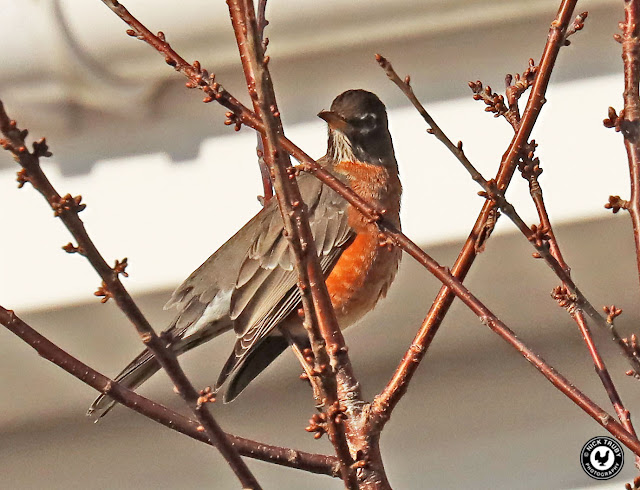
American Robins are not really a Robin at all but are actually a species of Thrush as this one exhibited by not only superficially resembling our native Blackbird, albeit one with a bright orange-red breast, but also by loudly "chacking" and flicking its tail and wings just as a Blackbird would. It was European settlers to North America who termed the bird as a Robin because that red breast reminded them of the familiar bird back home. The American Robin stayed a few minutes in the tree surveying the area to ensure all was safe, we had noticed a couple of cats in the vicinity, before it flew a short distance to land in a cotoneaster bush, where it had been in many of the photos that I'd seen on social media.


The cotoneaster was clearly the American Robins own personal larder but it didn't tuck into the bright red berries straight away, again the bird made a complete check of its surroundings before beginning its feast. Some of the birders and toggers present had obviously been before because they had staked out the cotoneaster bush so the best I could do was tag onto the back of the line and shoot frames between shoulders and heads. The bush was partly obscured by garages so there was only a limited field of view if stood closer, although from the far side of the road it was easier to see the bird so Mrs Caley had fine unobstructed views. I watched the bird, its behaviour of nervously flicking the tail and wings plus its fairly large size put me more in mind of a Fieldfare than a Blackbird although it seemed quite happy in an urban setting whereas Fieldfares are not unless the weather takes a turn for the worse.


The American Robin decided it was time to feed and boy did it feed! I've watched birds like Waxwings devour berries with some gusto but this bird must have been a champion speed eater, berry after berry disappeared down its throat and I wondered how it managed to breathe. At peak I reckoned it was downing a berry every other second. The gorging was accompanied by the racket of dozens of camera shutters, mine included, as we all tried to capture the moment a berry was held in the bill ready for swallowing but that was incredibly difficult to get owing to the speed of dispatch giving the camera shutter a run for its money. There was no time to review the images at the time so I was pleased to find a couple of "berry tossing" shots when editing the photos later.


The American Robins choice of the cotoneaster actually helped it to blend in and became quite tricky to see at times despite the bright sunshine. When facing its admirers the redbreast blended into the sea of similarly coloured berries. 


After just six minutes of frantic feeding the American Robin flew up and away from its banquet and alighted in the original tree again. From there it flew into a much smaller bush and promptly disappeared presumably to digest its meal. I searched every inch that I could of that bush and could not locate the bird. It is amazing how a bird so large can just melt away into its surroundings.


We'd been on site for no more than twenty minutes but decided to leave, I had photos and if the bird stuck to its previous pattern of behaviour then it wouldn't reappear for a couple of hours. The next bird on the day's itinerary would likely need a lot more effort to see and we needed some sustenance of our own.

We easily found the place that the Hume's Leaf Warbler was frequenting, that was evident by a large group of birders stood halfway in the main promenade road staring up into a group of trees, but it took a bit longer to find a cafe for breakfast where we could park without paying. Taking a time-out for food wouldn't be a problem, the Hume's Warbler had been present since the end of November and had stayed loyal to a small area around the promenade so it wouldn't be disappearing on us. The birders already looking at it would provide us with an instant location fix so we wouldn't have to go searching for it either. Or so we thought anyway!

After a very satisfying Full English breakfast and very un-English two Flat White coffees, I was fuelled up and ready to go again. We parked a short distance from the throng of birders, which had thinned out a bit since we'd driven past but had attracted the attention of the local constabulary presumably because of the encroachment into the road. We joined the twenty or so twitters left and asked where and when the Hume's had last been seen. A chap answered, "It's been up in that furthest tree but hasn't been seen for half an hour now". We joined in peering at the spot where the Hume's had been seen and soon realised just how difficult the task would be. The trees in question were Holm Oaks, a type of densely leaved tree that is found around the coast. Unlike all of the Oak trees I'm used to, this particular species doesn't appear to drop its leaves in winter so we were looking for a very small in a tree with an almost impenetrable canopy. Seeing such a small bird flitting around in that lot was not going to be easy at all.

Our mission to see the Hume's Leaf Warbler was made more difficult when a birder, who had been at the American Robin twitch earlier, ran across the road and stated, "I don't know why you lot are looking for the Warbler there" and "We've been hearing it calling non-stop over here for the last half hour!" We had to make a choice and with no sign of the Hume's in the Oaks, we decided it must have slipped out and down across the road, and followed the chap across the road and into a pedestrianised promenade which was bordered by ornamental shrubs and trees. The first sighting, and most of the subsequent reports, of the Hume's Warbler had been made along this narrow promenade and the bird had only been seen from where we had joined the other birders on the opposite side of the main road in the past couple of days. We spoke to another birder who said that she'd been hearing the Hume's calling constantly from a group of fir trees although she had only gained glimpses of what she thought was the bird. We spent the next forty-five minutes patrolling a hundred yard stretch of the walkway and didn't hear the bird distinctive disyllabic call once! 

Thinking that we may have been unwittingly duped, I suggested to Mrs Caley and a couple of other people who had also followed us across the road, several others who had come across at the same time had already given up, that I go and check back across the road and see if the bird had been sighted again there. I was surprised to see that the group of birders had grown slightly in numbers and once more asked if they had the Warbler. "Yes, it's in that tree" and was pointed in the direction of the same Oak that the Warbler was supposedly in before. Less than fifteen-seconds later I saw the Leaf Warbler flit quickly out of the leaves and back in again. It seemed as if the Hume's had been in the tree all along and that we had truly been led down the (wrong) garden path!

I called Mrs Caley to join me and we resumed our search for the Hume's Warbler in the right place again. Now we were assured that the bird was in the group of Holm Oaks, I had just had that fleeting view for confirmation, it was a case of waiting long enough to see it well and hopefully to grab some photos. We didn't have to wait too long before the bird appeared in the canopy. All I had to do was to follow it, aim the camera and click at the place it should be since seeing it through the viewfinder was almost impossible. My first attempt was almost perfect apart from one crucial aspect, while the burst of images obtained had captured the bird almost completely unobscured and "in the open" unfortunately the focus wasn't on the bird itself but instead on some of the many leaves which the Hume's uncannily resembled. At least I had a full grasp of why the bird is called a Leaf Warbler!

Hume's Leaf Warbler


A familiar face from Oxfordshire, Adam (read his account here), joined us in the hope of getting some views of the Warbler. Of the trio of birds that we'd seen this was easily the hardest (ha!) to see. Perversely though the more difficult a bird is to track down then the more I enjoy the chase and, in trying to get a good look at this Hume's warbler and get a decent photo of it, I was in my element. I don't lack for patience when it comes to scarce Warbler species. The Hume's Leaf Warbler had completed another hat-trick after having seen its closely related cousins, a Yellow-browed Warbler and a Pallas's Leaf Warbler, already this year. Of the three, I still prefer the Yellow-browed but that's probably because I've spent so much time in Cornwall searching, finding and then watching them during October holidays. The Hume's had reappeared at the top of its favoured tree again and I fired off more shots. A review of the back of the camera images was disappointing yet again as I couldn't make out the bird in any of them. Then to make matters worse, the Hume's suddenly and very briefly, for no longer than a second, appeared right out in the open on a very top branch and I missed the shot. Groan!

I spotted the bird right in the shadows at the back of the tree next time and for a while just watched it through the binoculars as it hunted its insect prey in the tangle of hanging branches and leaves. Hume's Leaf Warblers are very closely related to Yellow-browed Warblers but the overall appearance is of a duller plumaged bird, the yellows and greens of the brighter Yellow-browed being replaced by muted buff and grey-green tones. The easiest way to separate the species is by call and thankfully this Hume's Warbler was making its "dsu-eet" call frequently. I peered up into the tree from below and fired off more shots and this time had captured the bird reasonably well but only of the underneath of the bird.


When the bird appeared in a bare branched sycamore a few minutes later, a fact I was made aware of by noticing several cameras suddenly held skywards, I was in the wrong place at the wrong time and never got a chance at another potential "money shot". I wasn't having the best of luck but it's a hard game photographing Siberian sprites and I'm happy just to get record shots. I got a few more images and show a couple here to illustrate just how well these Warblers blend into their surroundings. Also don't forget that these birds are continually on the move moving quickly through the foliage so getting these shots wasn't easy!


My best efforts, in regard to photos came when I spent an hour or so peering closely the next day at the images I'd taken of the Hume's Warbler (and leaves mostly). On some of the very first sets that I'd taken, I discovered that the bird was wonderfully in full view and in good focus too. Annoyingly a leaf obscured the wing bars but I was just grateful that I'd managed to capture a decent record shot of the bird.


It was a terrific days twitching in a lovely town that I'd never spent much time in before. Three very good additions to the year list, a lifer for Mrs Caley, and I managed to get photos of the American Robin to further embellish my own previous sighting of one too. A fantastic hat-trick!

Year List additions;

132) Hooded Crow, 133) American Robin, 134) Hume's Leaf Warbler